a Taj MuttHall Dog Diary: contacts
Showing posts with label contacts. Show all posts

Friday, February 08, 2013

The Horror!

SUMMARY: People should stop inventing cool web-based tools to suck up my time.


And because I love you all, I'll give you the link to make your own: Pulp-O-Mizer.

Wednesday, April 11, 2012

Sunday, September 19, 2010

Simple Truths of the Universe: The Agility Version

SUMMARY: From a friend's facebook status:

100 years from now it will not matter what kind of car you drove, how much money you had or what kind of house you lived in...but it will matter if your dog can hit an A-FRAME CONTACT!!!

OK, Lee E--had a rough weekend with the contacts, eh?

Thursday, September 02, 2010

Fixing the Danged Contacts

SUMMARY: Boosts, once lovely, are broke. Tika's, always struggling, are broke. Plus some useful definitions.

Definitions

  • Two on/two off (2o/2o): Stops at the bottom of the contact with two feet on it and two feet on the ground. A common strategy for ensuring that the dog hits the contact zone, because it is an easily teachable position.
  • Running contact: A *trained* pattern in which the dog doesn't slow down on the descent but must run through the end of the board, not leap from it.
  • Maintaining criteria: Choosing a way in which something should be done and then refusing to accept less than that. For example, for 2o/2o, not accepting the dog running past it or leaping off it. (That's after you've been through all the training process, of course.)
  • Running contacts through gradual relaxation of criteria: Agility-dog-training joke.

Tika's Contacts

In early training, her contacts were lovely, fast, accurate 2o/2o. That meant things like, if I was way behind her, she still ran full-speed to the end of the contact and stopped; she didn't slow down and wait for me. And she *stopped*. Until there were squirrels in the training facility (remember on the Pirates of the Caribbean ride where the voice says, "Thar be squirrels ahead!"? (During the 30 years before the dang move-based renovation anyway.) That was the warning in class!

We fixed that by putting tika on a 20-foot lead, which the instructor held while I ran tika on the contact, and when she flew off after the squirrel, she came to an abrupt and ignominious end (of the lead, that is).

She's been just about perfect just about always in class even since, but I have fought with it at trials for lo these many years. A few years back, I just stopped. I was spending trial after trial after trial giving away my entry fees because I'd do something to correct her or stop her on the contacts when she tried to run through them. Turns out that she was hitting the yellow contact zone most of the time, and she was fast but not as fast as many of those Border Collies, so I've been accepting the "modified running contacts" (as one innocent admirer called them).

Except that means that I have to babysit the contacts. It does make a difference in how i run a course. Like last weekend's Grand Prix, where I really wanted to be 10 feet away from her on the dogwalk to get a critical front cross. And she bailed BIG time.

Or in Steeplechase Round 2, where I got almost right on top of her on the Aframe but she still bailed BIG time.

I'm thinking that it's the rubberized contacts. They are SO quiet and the surface is gentle and easily gripped, and I think it accelerates the dogs!

Boost's contacts

Have always been lovely in class. (You know how it goes.) And were pretty good in competition, too, although--

Well, see, we started with a nose touch at the end of the contact (to keep the dog focused forward) and, despite warnings, I dropped that criteria. So Boost started running to the end and swiveling back to face me. That's a problem when I'm trying to go straight or turn away. And then she started leaving the contacts without waiting for my release --I'm afraid I encouraged that by releasing very quickly in things like Gamblers and Steeplechase.

Last weekend, she stuck only one of all the aframes, dogwalks, and teeters that we did. One. Which makes it very hard to get distance and assume that she'll be facing the correct direction at the end of the contact. In the past, slowing down and making her DOWN when she leaves early has fixed the problem. Well, that didn't work Saturday.

So Sunday I picked her up and took her off after she left the contacts early (well, ok, except in round 2 of the Steeplechase.)

I'm going to blame some of that on the rubberized contacts, too.

So--fixing them--

Hard to fix nonsticky 2o/2o when the dogs do them fine at home and in class. They're way past where me doing things like crossing in front, saying "good dog", moving suddenly, throwing a toy, and so on will get them to break.

In class this week, I bumped up the level to my most excited and devious. Got Boost to break once with one method and another time with a different method, and then she was solid. So I got the instructor involved. NG appeared suddenly on the opposite side of the contact as I yelled "touch!", and NG yelled in an excited voice while running, "yay, get it!" and threw a toy. On the dogwalk, Boost watched with fascination but didn't break; on the Aframe, she broke, we repeated, and then she was solid.

Tika? Ha! No food involved, Tika didn't care what the instructor was doing. Continued with rock solid contacts, completely ignoring NG.

Sigh, so this weekend--Regionals--3 days--

Sooooo with Boost I probably will take her off the course again if she leaves the contacts early. I REALLY need reliable 2o2o. I hope the message gets through.

With Tika, I dunno. In competition, if she's going to do 2o2o, she tends to slow way down, so I like the speed of the "modified running contacts." And she's 9 and a half now. And I fought with them for SO long, I just don't want to go back to it.

Did take a couple of seminars in running contacts, thinking they'd be perfect for her, but the training is (seems to me) far more rigorous than the 2o2o, and I've just never felt rigorous enough. Plus REtraining contacts after 8 years, yeah, well, good luck with that.

Guess we'll see how they look after the minor catches in class! Wish me luck!

Wednesday, August 25, 2010

Hot and then Hot Again, and Burning Some Rubber

SUMMARY: Here's our heat spell; hope it's gone soon. Plus new contact surfaces.
The heat that has chewed on the eastern half of the country for so many months has spit them out and come looking for new prey--and here we are. We in California may have been commenting on the unseasonably cool temperatures all summer--great for hiking and dog activities--but now we are obsessed with our mini-heat wave (yesterday and today, predicted to be gone by tomorrow, thank dogs!).

Last weekend the temps barely moved into the 80s in my area (high 20s C). Yesterday--well--my back porch around 3:00:

(That's  41.9 C outside on the porch, 27.6 C inside the house.)

We were scheduled for class last night at 7:30 in the east foothills. This is what Santa Clara Valley temps looked like at 5:00 on Weather Underground. Note there's only one temp reading in the whole area below 100, and that's 96 up in the hills. See that 106 in the upper right? That's in the vicinity of class. High-temp records for this date dropped left and right.

We also had a Spare The Air Day yesterday. I felt it in my throat and chest. Wasn't going to go to class even if they held it--but they DID hold it, and I couldn't resist the call "Come try our new rubberized dogwalk!"

Yes, the future is here! Bay Team and SMART now have completely rubberized their agility equipment: Aframes, dogwalks, teeters, tables, and chute floors, thanks to an incredible amount of work by several Bay Team members over the last couple of months.  (And, after hearing all the stories, I'm also convinced that buying an already-rubberized contacts is the way to go, unless you really have no money and hundreds of hours of free time. Dunno what to do if, like me, you've got neither. Ah, well.)

We had the rubberized tables and chutes at the July trials. Nice!

The dogwalk is pretty amazing--so quiet when the dogs run across it. And the color in the rubber is so good that, from a distance, you can't differentiate it from a regular dogwalk.  The one last night still has "slats" going up and down--in this case, they're part of the rubber skin. Dogs should be able to go much faster, more securely, over these contacts.

Our main concern: What happens to dogs who get used to the better grip (particularly on the dogwalk) and then suddenly encounter an unrubberized one; will they be LESS safe trying to get on it and run across it?

For sure, though, it puts an end to those exciting sliding contact finishes. Drat.

OK, though, I'm sold; I may have sneered at rubberized surfaces originally, but now I'm convinced they're good. Didn't think to take a photo, but I'll try to remember this weekend.

And it should be  a good weekend--now they're saying that temps will drop into the 70s (low 20s C) or even lower in Prunedale. What a weird week!

Monday, May 17, 2010

Ghost Handlers in the Sky

SUMMARY: From K-TMH, only the best in hijacked lyrics.
OK, this is May 17 in San Jose; why am I back in my long underwear? It's too cold and dreary to practice those contacts, really it is; I was too busy last week, it'll be too hot next week. Besides, what's a missed contact or two among friends?

OK, sure, thanks for asking, I *will* make up new lyrics for the occasion.

Old Taj MuttHall went to the yard one dark and windy day.
Upon the porch she rested as she headed out to play.
When all at once a red-eyed pack of Border Collies came,
A-plowin' through a ragged chute and up a rotting Frame.

Their tongues were all a-slobber and their toenails made of steel;
Their noses black and shiny and their dog-breath she could feel.
A bolt of fear went through her as they thundered through the course,
For she saw their handlers running hard, their voices raw and hoarse:

"Get it, go touch!
Hit it I say!"
Ghost handlers in the sky.

Their faces gaunt, their skin sunburned, their t-shirts soaked with sweat,
They're running hard to work the zone, but they ain't got it yet.
'Cause they've got to run forever on that course up in the sky
With dogs that fly off contacts; as they run on, hear their cry.

"Get it, go touch!
Hit it I say!"
Ghost handlers in the sky.

As the handlers loped on by her, she heard one call her name:
"If you want to save your soul from Hell a-runnin' in this game,
Then handler, change your ways today or with us you will run
Trying to Q the Devil's dogs, and never having fun!"

"Get it, go touch!
Hit it I say!"
Ghost handlers in the sky.

Saturday, March 27, 2010

Running Dogwalk Calculator

SUMMARY: Are you fast enough?

Running-contacts.com has posted a note about their running contact calculator.
Read about and download the calculator here. You have to actually time yourself and your dog running; I plan on giving it a try soon but I really like the idea.

Tuesday, April 28, 2009

Ambitions!

SUMMARY: OK! Time to get serious about agility training!

Bring it on, human trainer person!


After everyone seemed light on the concept of Correct Contact Performance this last weekend--how did I manage to ruin Boost's Perfect Contacts? Really, they were the best I've ever had on a dog!?--I have vowed that we're all going to do 50 contacts a day here in the yard all week so we'll be prepared for this coming weekend's USDAA trial.

Although I don't know what it's worth--does Boost EVER leave a contact early here in the yard before being released? Not in the memory of humankind.

But what the heck, maybe if I do it often enough then it will overwrite the neural pathways that she has developed that say it's ok to leave the contact as soon as you feel like it. Research has shown that you can do that. That's kind of how you develop habits in your brain--do it over and over and your brain rewires itself. That's what neuro-linguistic programming is all about. Can one do NLP if one is a canine and doesn't have so much of the same linguistic capabilities? Can dogs do daily affirmations? Look in the mirror and say "I will do contacts correctly this weekend"?

"Every day, in every way, I am doing contacts better and better."

"Touch! Touch! Touch! Yes I can!"


I think perhaps we can do the equivalent with lots of repetition and reward.

So I will be a dog-brain rewiring specialist this week.

Yesterday we first revisited nose touches to a target. Ah, indeed, it's ok to just brush your nose past the surface of the target? Or swipe it along the target? Really? Did I ever teach them that? So instead of 50 contacts, we did 50 attempts to get them to >>ponk!<< their nose straight down on the target, not swipe, not push, not lower to their elbows first, not put a paw on it also. Just >>ponk!<< straight down and up. It's really lovely as long as I hold it in my hand at ground level or lean it against the toe of my shoe. Do you suppose the judge would mind if I stood at the end of the contact with a clear plastic target leaning on my shoe?

But there is something evil about the target lying flat on the ground. Really, once upon a time I could swear that we all did this correctly.

Actually, here in the yard, even without the target, Boost will bob her head up and down as if she were thinking about maybe ponking the target if it were there. I tried that this weekend in the ring after many many, shall we say hundreds, of leaving the contact earlies. She just stared at me. Stared. Like, "'Touch?' What is this noise you make?"

OK, so we will also do 50 jumps a day to learn once and for all that knocking the bars isn't an OK thing. Yesterday we probably didn't do 50 each. Might have done 20 each. If I were a Four Star Trainer, I would be logging these things so I'd know exactly how many I actually do. We all seemed to be getting the idea. Until we'd throw in a sequence, then we'd go back to whack-a-bar.

I'm jumping them both at 28" or so this week because we have a USDAA trial this weekend. I think Tika can handle a week of that. And Boost usually jumps 22", so maybe if I get her used to thinking higher and working harder at it, she'll pay attention.

But I also know that I need to work on her just *doing the obstacles in front of her* for crying out loud instead of looking at me. Or, officially, doing obstacles between me and her. Like, say, on a straight line to a turn where I'm calling her and have done the front cross and she's still blasting straight ahead full speed, looking at me and not bothering looking to see whether there's an actual obstacle there to take.

Oh, yes, we have lots of info on how to fix these things.

I just have to do it.

Mwah ha ha haaa! TMH and the Merle Girls (Boost, Tika, and MooMoo) will take over the agility world!!

Sunday, November 30, 2008

Training

SUMMARY: Winter doesn't stop agility in California--but it might stop me.

I've heard people say how nice it is to have a break from training and trialing dogs during the off season. However, as I've noted here before, there is no off season for agility in my world.

We have a USDAA trail in two weeks, and it's an off-the-wall combination of events: all the Tournament classes (DAM Team, Steeplechase, Grand Prix) with also Jumpers, Gamblers, and Pairs. (No Standard, no Snooker.) AND--because some people really like the old games from back when trials were small and finished early in the day--Strategic Pairs.

I've decided that I need to refocus Tika's contacts on hitting her 2on/2off, and refocus Boost's contacts on STOPPING AND WAITING AND NOT TURNING TOWARDS ME. Boost's were so good for so long but have just started getting sloppy this summer.

So I've done a bit of nose-touch work to targets, on and off the dogwalk. Not a lot, just some, on days when I'm in the mood. And the mood is holding me back; maybe the rest of the world doesnt' take a break, but I feel like *I* need a break.

For instance, I haven't had jumps up in my yard since we came back from Scottsdale, and that's been almost a month, and I know that I need to practice lateral lead-outs and serpentines and keeping bars up. But I just don't wanna. The weather this year isn't encouraging an off season, either; it's supposed to be possibly into the mid-70s (F) today.

The dogs are going nuts because I've been ignoring them a bit while life goes on around me. Plus no class this week--for some reason the instructors didn't want to schedule classes on Thanksgiving day, go figure!

So, OK, I'll go do the agility trial but I might not shine because we're not practicing that things that we need to practice. And is that a waste of money and time? Torn. Conflicted. But it's a beautful day. Maybe I'll take the dogs hiking.

Monday, November 17, 2008

Move Tika to Performance?

SUMMARY: Do I need to move Tika to the lower jump height division? What are my criteria?

I've had the gut feeling that Tika has been slowing down on her courses. She'll be 8 in February, but really I don't think of 8 as being that old, and we've gained a comfortable working relationship that works fairly well in USDAA and very well in CPE (which we're not doing much of at the moment). Plus she still jumps nicely most of the time at 26".

(Fun note: In CPE, I jump her at the highest height, 24", to avoid messing up her 26" USDAA Jumping. But she's legal for 20" in CPE. Which means that I could eventually move her down to 16" in their Specialist category--like Performance in USDAA--or even to 12" in their Enthusiast category! Can you picture Tika running a course at 12"?!)

Then there's the issue of her coming up sore periodically. This weekend she did 6 runs Saturday and was fine, then Jumpers Sunday morning and was fine, then came out of her crate before Snooker saying "I'm sore, I'm hunched over, I don't want to play tug of war, I can't do anything." Fortunately there were about 8 dogs ahead of us, so I got her moving, got her stretching, massaged her neck and spine and shoulders, used treats to encourage her to stretch her neck and back in various ways (boy, she really perked up at the treats), and by the time we went into the ring, she looked perky and comfortable. Ran fine. Ran fine in Standard, too. Ran fine for frisbee later. Looks fine today. Maybe just a cramp? But I was inches away from scratching her because she looked so unhappy.

So there's that to consider.

To help decide how much she's slowed down, I took my useful database of info I've collected on my dogs' runs through the years, threw out Novice and Advanced classes, threw out classes where we had refusals or runouts (because they'd skew the picture of her true speed), chose only Grand Prix, Jumpers, and Standard as useful classes, and ended up with data from early 2004 through this weekend. For each of the 3 classes I plotted the following in Excel charts: Her yards per second (YPS), how far off the SCT (standard course time) her time was, and how far off the first-place dog's time she was.

I couldn't clearly tell from the plot of her YPS whether she's slowing, so I did a sort of a running average, and it showed a few interesting things.

1) Her YPS in Standard abruptly shot up starting in April 2007. (--about .2 YPS--which for her would be about 2.5 seconds faster on a Standard course.) What happened in April 2007? The Aframe height changed from 6'3" to 5'10". (Caveat: At some point last year I decided that it was OK for Tika to have running contacts because she was doing it anyway and we needed the extra speed. I can't find my blog post on that, but I was still trying to get the 2o2o behavior at that time.)

I can't quite tell whether it affected everyone equally; it looks like she picked up some time compared to the first-place dogs, but not a lot.

2) Her Standard YPS has indeed been drifting slowly downward since, from 3.9 then to 3.7 now, over a year and a half. So we've lost those couple of seconds again.

3) Her Jumpers YPS rose steadily from 2004 to 2006 as we learned how to work together, peaked at almost 6 YPS in early 2006, slid steadily to just over 5.5 YPS in mid-2007, and has very slightly drifted to below 5.5 YPS since. (In other words, she hasn't slowed much on Jumpers courses in the last year and a half.)

4) Oddly, her Grand Prix YPS average seems to have climbed slightly over time--but we don't have nearly as many good data points on that.

So I'm not sure what it tells me. She's still way below SCT and is by no measures a slow dog. But the numbers from this weekend tell me that we're still fighting a battle to ever earn placement ribbons: Note that in every class, she did very well as the Q rate seemed low--but in almost every case, she was the slowest of the dogs to Q or to get the highest points.

I don't know what moving her to Performance would do in that area; Performance is not an escape from experienced, top-quality competitors. Several dogs who've beaten her consistently in the past in Championship are now in Performance.

The other thing is--she's now getting so close to her ADCH-Silver that it would be nice to finish at least that, and if this weekend's any indication, she's very capable of doing it without hurting herself. To do that, she needs 25 legs in each of the 5 regular classes, and has:
* Standard: 22
* Relay: 26
* Gamblers: 22
* Snooker: 30
* Jumpers: 20

It's always those danged Jumpers, isn't it!

So I'm sticking with a wait and see strategy on her regular classes.

I can also decide on the tournament classes. All she needs for her Platinum Tournament Championship is one DAM Team Q and one additional Q of any kind (DAM, Steeplechase, Grand Prix). There are no higher awards in the Tournament area. So I could move her to Performance's lower jump height there if I wanted to. The question is just whether--if there's another Nationals out west--I'd want to qualify her in Championship or in Performance, and whether I'd really want to go anyway, with the fact (same as this year) that she just can't compete with the top dogs.

It's only Gamblers where we can really shine on opening poins, as usual.

Sunday, August 03, 2008

In Which Perfection Is Reversed

SUMMARY: Tika does contacts; Boost does weaves.

Tika, the consummate leaper-offer-of-contacts dog, ran her contact drills in class Thursday night as if the thought had never occurred to her. Every contact was very fast and ended in a crisp, eagerly poised 2-on-2-off position. Contacts of beauty! Grace! Poetry! The kind of contacts everyone wants to have (except those who want running contacts) but not everyone gets! The kind that *I* want to have but don't always get!

Boost, whose contacts are breathtakingly lovely, was the one whom I was able to easily entice to leave the contact early (not waiting for the release command). I have seen indications of this in competition lately, so we need to proof them more at home. So I've been doing them in the yard, just making her stick the end and going back to waiting for a nose touch. She's getting faster at offering that again; I'd let it slide because "she didn't seem to need it." Well! That'll learn me.

We do need work on left turns into the weaves again, though--confirmed in class and at home.

But Tika, the perfect weaving dog, was easy to make pop out of the weaves or go into the wrong entrance. And at home, where I've been doing distraction drills, she seems to be popping out MORE rather than less! Argh! But at the same time, she's getting faster on distractions when she DOESn'T pop out--like she's learning to not slow down to think about them.


This dog did not do 12 weaves in competition.
On the other hand, Boost--the dog who can't do more than 10 in competition--went all the way to the end in every danged set of weaves in class, and we were doing weave drills with 2 sets of poles and front and rear crosses and lag-behinds and run-aheads and all that. A joy to watch! World Team Coach had suggested that I always toss a toy for her right at the end, before her head turns to me. That was what Mo Strenfel also suggested in our weave pole seminar a year ago, and I've been doing it religiously ever since. Well, not every time. Sometimes we go on to the next obstacle.

The difference is that I used to throw the toy in a straight line forward of the weaves so that it rolled or bounced ahead, and Mo said that, to fix my popping out problem (yes! it has reappeared often!), that I should make the toy land right on the ground at the end of the last pole to keep her from thinking of running ahead. Now WTC suggests that I use something that rolls or bounces instead of just lying there to get her to learn to complete the weaves while thinking about running ahead.

WTC also said to never let the dog know that they popped out early in competition because then they'll start to think about it more and start looking at you when they get to that point and pop out more. My experience says that, with Boost, if I ignore it, it keeps happening, but if I make her lie down and then put her back in where she popped out, she stops popping out. So am I setting up for long-term failure? Or fixing my problem?

That's what I love about agility, the clear, consistent guidelines for improving obstacle skills given a specific problem.

Anyway, we're mostly working on contacts and weaves at home this week, plus rear crosses on straight tunnels, and I'm trying to pay more attention to my own body language differences for rear crosses versus pulls or straight-aheads. My timing is still so bad. Ah, well, give me another 13 years of practice and I might nail it.

This dog did not pick up its feet when going over the first jump.

Both dogs really need to do bar-knocking drills, too, but not now. Maybe next week.

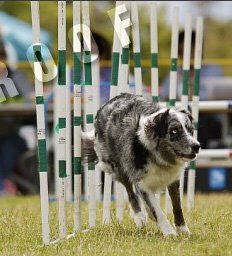
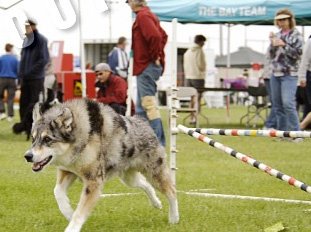
(Photos borrowed from Pets and Their People Photography; there are a bunch of photos of both my dogs, some of which I'm buying, but these probably I won't and will just borrow low-rez bad copies of for this page.)

Sunday, April 13, 2008

Boring Notes To Self From Weekend

SUMMARY: What we did well on, but mostly what we screwed up. (This is my third post of the day. You'll probably more enjoy my previous posts about Weekend Courses or Haute TRACS is Almost Done.

Boost

  • Weaves: Hitting the correct entry and then skipping a pole. Several times. This cost us 14 points in Saturday's Snooker, time in the Steeplechase, I don't know where else as I didn't take good notes at the time. Popping out early. She did this almost 100% on Thursday, I think. I made her go back in and correct them on the theory that slowing her down is punishment enough. That didn't seem to help, so on Friday I made her lie down and THEN made her go back in and fix them. The next set of weaves she did the entry-skipping thing again; made her lie down, then go back in, and she finished them completely and I whooped and ran her quickly out of the ring over a couple of fast obstacles.

    That seems to have fixed it again, as she completed all of her weaves correctly on Saturday, I'm pretty sure, enough that I dared three sets in the gamble and she did great, made entries AND stayed in. Woo.
  • Contacts: Oh, bad dog, left the first two early in team standard and I didn't want to mess around in Team events. So later I made her lie down when she left a contact or two early, and that seems to have fixed it again. You really do have to stay on top of this stuff, don't you!
  • Start line stay: She is so good! Although in that same first team run, she left before I released her, and I let her get away with it because it was team. I feared for my life after that, but in fact she stuck all of her remaining start-line stays all weekend very nicely.
  • Bars and refusals: I just didn't count them well this weekend. There were many, many, many on Thursday but seemed to be better on Friday and even better on Saturday. I wonder, if I had stayed through Sunday, whether we'd have actually had a run or two with no refusals or knocked bars? We just don't practice enough running and jumping, I guess. Not enough room for it in my yard; class is so much more focused on handling.
  • Energy: So far she seems to maintain total drive and enthusiasm, although she was more easily distracted away from her tug toy while going to and from the ring. I hope that's just growing maturity and confidence, not a stress reaction. I'd hate to think that I'm slowing her down in the ring by my incompetent handling or stressing her out about doing well in the ring.

Tika

  • Contacts: Barely getting toenails into the Aframe down contacts and flying over most of the dogwalk downs. I don't believe that we were called for any dogwalk ups this weekend. Maybe I'm concentrating on the wrong part of the contact and Rachel's right about that being trivial! I need to just decide how she's supposed to do her contacts and what I'm willing to accept in the ring and go about fixing it again. She never used to have so many flyoffs. I don't think so, anyway.
  • Drive and enthusiasm: I've always had trouble getting her to play with a toy before a run, except the first run of the morning, where she really gets into it--until we get ringside, where she'd rather sniff the ground. Presumably that's mostly the chow-hound's food obsession, but the amount of time I spend dragging her around by the neck trying to do a little jogging to warm up or just to get from one side of the ring to the other is a little bit concerning. Is this a stress reaction more than mere food sniffing?

    She does seem to me to be tiring and flagging sooner and more often. Heat never seemed to matter to her, but this weekend she didn't leap immediately to her feet when I approached her crate saying, "Tika, you want to do some agility?" This is so unlike her. This just adds to the assorted things I have been noting about her getting tired so much faster than Boost, where not long ago she could completely keep up, or about being good for only a couple or three runs in class before her drive visibly drops.

    I mean, really, she's still a fast dog, but not drivey fast like she often used to be. Her Saturday Jumpers speed was 5.25 yards per second, which is good but not great (Boost's 5.96, winning dog 6.41).

    So I have all these questions running through my head: Is she sore? Is she getting old? Does she have something seriously wrong with her like Remington did that mystified me about his performance for so long? Is she out of condition, am I not doing enough with her? Should I be doing less with her? Argh, so hard to figure out.
  • Weaves: I keep relying too much on her being a "good weaving dog" and then don't work the weave entries or exits at ALL and then get errors or pop-outs. But she did make a couple of really beautiful and very difficult weave entries all on her own this weekend. I'm not always certain where I need to give a bit more info and where she's fine on her own. Should probably experiment.
  • Start-line stays: She has been so much better at staying since I started having her lie down at the start, which she wanted to do half the time anyway. She still sometimes gets up early and creeps up on the first obstacle, but I'll take it as long as she doesn't actually start doing the course on her own. It's not so much of a problem with electronic timing, so she's not creeping across the start line, but I have to make sure I give her plenty of room--just in case--for those classes (gamblers, snooker) where a traditional start line is still used.

Me

  • Energy:I really felt droopy Thursday, which was not the hottest day, and all weekend I seemed to have trouble getting my feet to take me where I wanted to go. It might have been lack of sleep on Thursday. It might have been allergy drugs Thursday and Friday so I didn't take them Friday night, but didn't feel any better Saturday. I keep thinking I'm in reasonable condition. I sure wish I was in the right frame of mind to take these extra pounds off again! It's just not happening at the moment. I'm sure that contributes immensely to my perceived inability to move around the course.
  • Handling: I made SO many mistakes this weekend that I SO know better. The kind where the instant you make it you know you've just screwed up, usually even before the dog goes off course/knocks a bar/gets a refusal/etc. Where is my brain? I realize that everyone makes mistakes, but this weekend felt particularly bad for me.
  • Attitude: On the other hand, I felt less stress about any of my runs than I have in a long time. I enjoyed myself on course, I didn't feel like crawling into a corner and bawling when I messed up yet another course, I never felt the kind of self-pressure I feel for, say, the last leg for an ADCH or trying to get a needed Super-Q or such. Even though I wanted Tika's 2 jumpers for her ADCH-Bronze, I wasn't thinking about it at all during my runs, just concentrating on the runs themselves. So the question is--did I make more stupid errors because I *wasn't* stressed and running on adrenaline? My Q rate doesn't seem to be horribly different from other USDAA trials, so I'm not sure really what difference any of this really made.

Sunday, April 06, 2008

Contact Consult and Commuting

SUMMARY: Went to Rachel's for contact work. Long drive, interesting touristing.

I set up an appointment with Rachel a couple of months in advanced, she's so booked up. Last Wednesday was the day. I groggily rose and was on the road with the beasts by 8:30 for our 11:30 appointment in Atascadero. Tuesday was a beautiful sunny day. Thursday was a beautiful sunny day. Here is what it did on Wednesday, at least within a 10 mile radius centered on Atascadero.


So we stood bravely in the drizzle for the better part of 3 hours to talk about contacts and how to use her box-training method to help Tika's dogwalk up and start her on a running Aframe.

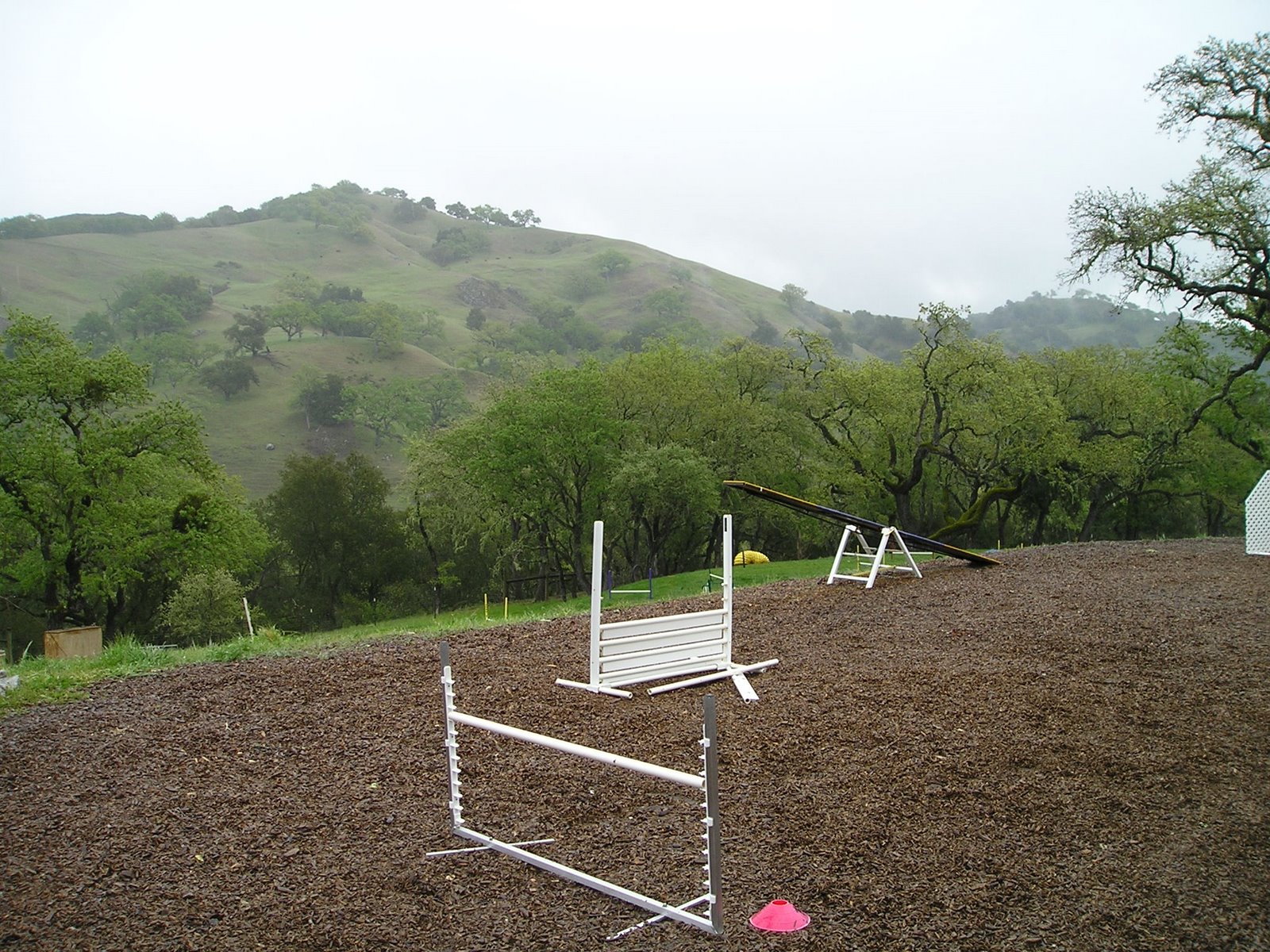
Here is what the view from Rachel's yard looks like. Rough life, huh?


Here is what Rachel said about Tika's dogwalk up contacts. "You're missing only 10%? That's, what, one every 2 or 3 weekends, assuming that you're doing dogwalks in gambles?" She says that usually people looking for help are missing at least half the time, and mine is a minor problem. For me, though, it's just one more in a long line of one-fault runs that keep me from qualifying. More often it's knocked bars, or the Aframe down, sure, but if I can eliminate this problem--

But we worked on her technique, anyway, for getting two feet into a zone-sized box while running. I had already taught Tika to get into the box on a "Hit it" command, months ago, but stopped before Rachel's seminar in January because I wasn't sure where I needed to go with it. I told Rachel that Tika could already find the box on command (but I always have a lingering doubt on whether I really taught it or somehow my imagination was playing a trick on me)--and Tika saved my honor by showing that she could, indeed, go into the box no matter where I set her up and no matter where I was standing. The biggest issue is that she's not RUNNING, which is why I added (months and months and months ago) the treat-dispensing machine beyond the box, hoping that she'd speed up to get there. (She didn't.)

(Rachel suggests that the problem with "Hit it!" is that it makes the judges look more closely at the up contact because now they know that you have an issue with it.) But at the end of the session, we tried to get Tika to miss the dogwalk up to see whether we could detect a pattern, and she nailed it every time, over and over. And we were both running full out, too. So she's not missing when she's trying to catch up to me. Or maybe it was because we'd spent an hour and a half getting her to get her two feet into the box on the ground so she was more conscious of it. (We weren't using it on the dogwalk.) Rachel thought that Tika was, in fact, already adjusting her stride when I said "hit it!" on the dogwalk, even though we've never used the box on the actual equipment. Huh. Maybe.

We also worked on Tika's boxwork for the Aframe down contact as described in Rachel's seminar.

So, anyway, I have homework to do on getting her to do the boxes correctly at a full run (when she speeds up, she starts dropping just one foot in for the dogwalk box and only a couple of feet, not 4, in the Aframe box).

Boost's down contacts


I said that I wanted to tweak Boost's down contacts a bit because, although she's fast, she takes about 300 fast, tiny steps in the last part of the descent, and I thought she'd be faster if we could eliminate those. Rachel watched her do a couple. Boost did a couple of absolutely perfect Aframes, no slower steps, and Rachel said, you've got a genuine 2-second dogwalk, and there aren't many people who can really claim that. Why mess with it? So I guess I won't. So we did a little work on how I cause refusals with my handling of Boost.

Here is what I look like after several hours of rain and with knowledge hopefully soaking into my brain along with Atascadero water-fall-from-sky and a 3-hour drive home ahead of me.


Going home


I've been doing these Wednesday evening hikes starting at 6:00 to help me get ready for Havasu Falls. But, leaving from Atascadero around 3, there was no way I'd make a 3-or-more-hour trip plus drop off the dogs and change my clothes. So I suddenly realized that I had something I almost never have: A leisurely drive home with no deadline, where I could stop or do whatever I wanted. And since it wasn't a hot, sunny day, I could even leave the dogs in the van.

Driving out of the hills from Rachel's house, I took the time to stop for photos of the native fauna in their natural habitat, all within easy camera range of the vehicle:

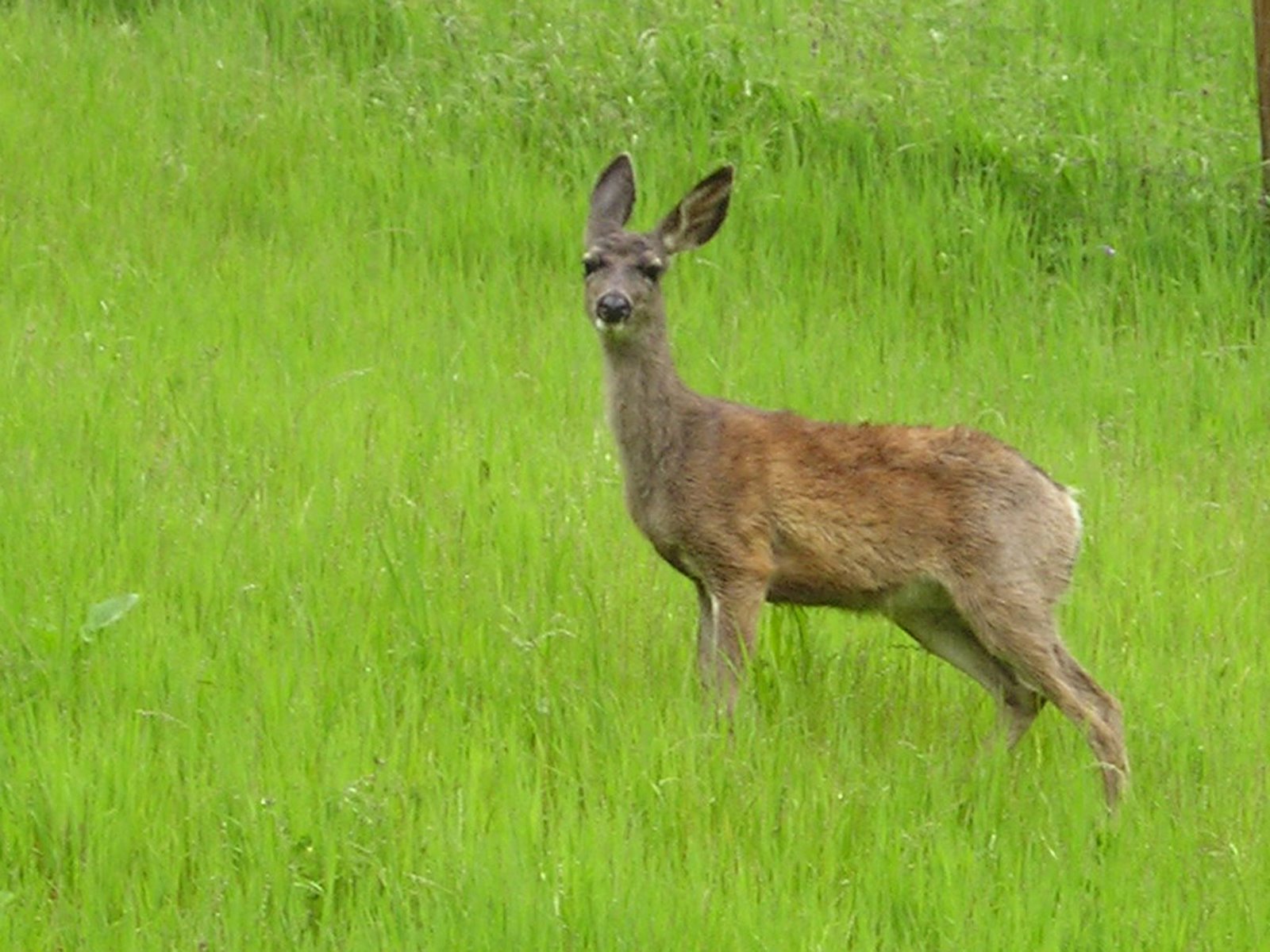
A deer in its native woodland meadow:

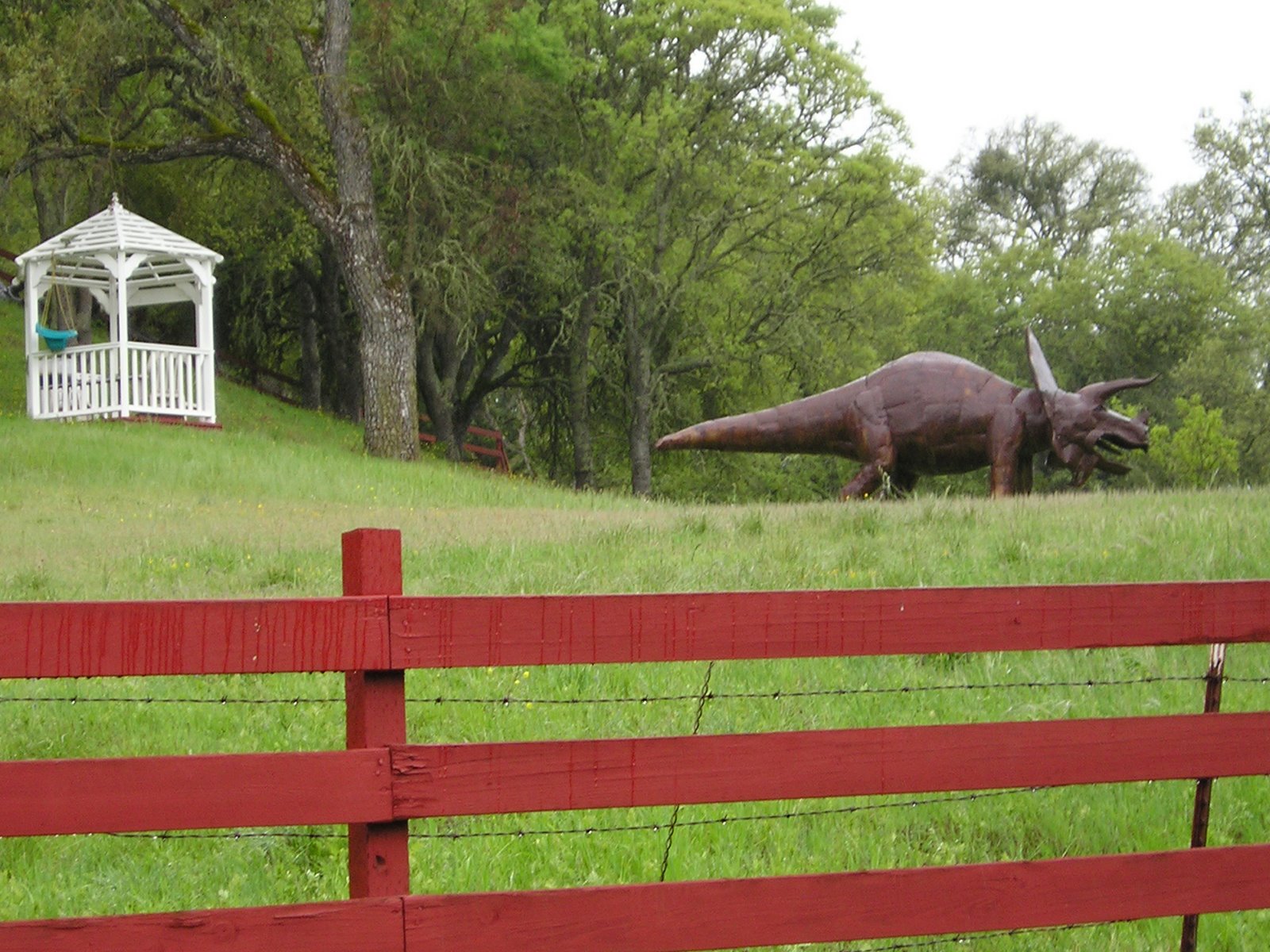
A triceratops leaving its native gazebo:


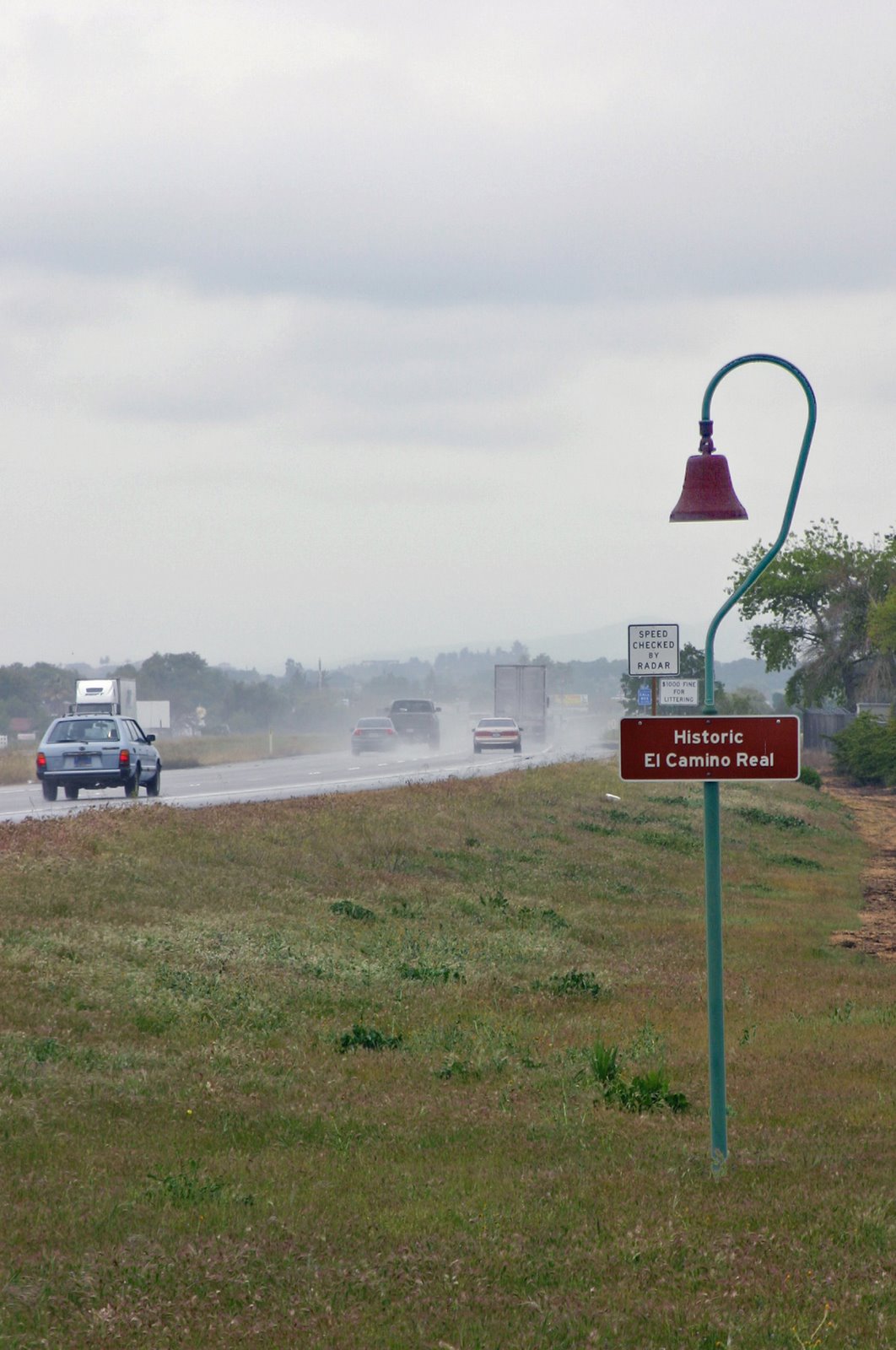
My entire drive was along U.S. 101, following the route of old El Camino Real (or should that be "El old Camino Real"?), so I had to duck down a scenic frontage road to sneak up on this beauty in its native habitat, the side of the highway:

I'm glad that they're back, lining El Camino Real all up and down California. They used to be there, then idiots gradually stole them all, and now I guess they've found a way to attach the bells so that they aren't so easily removed.

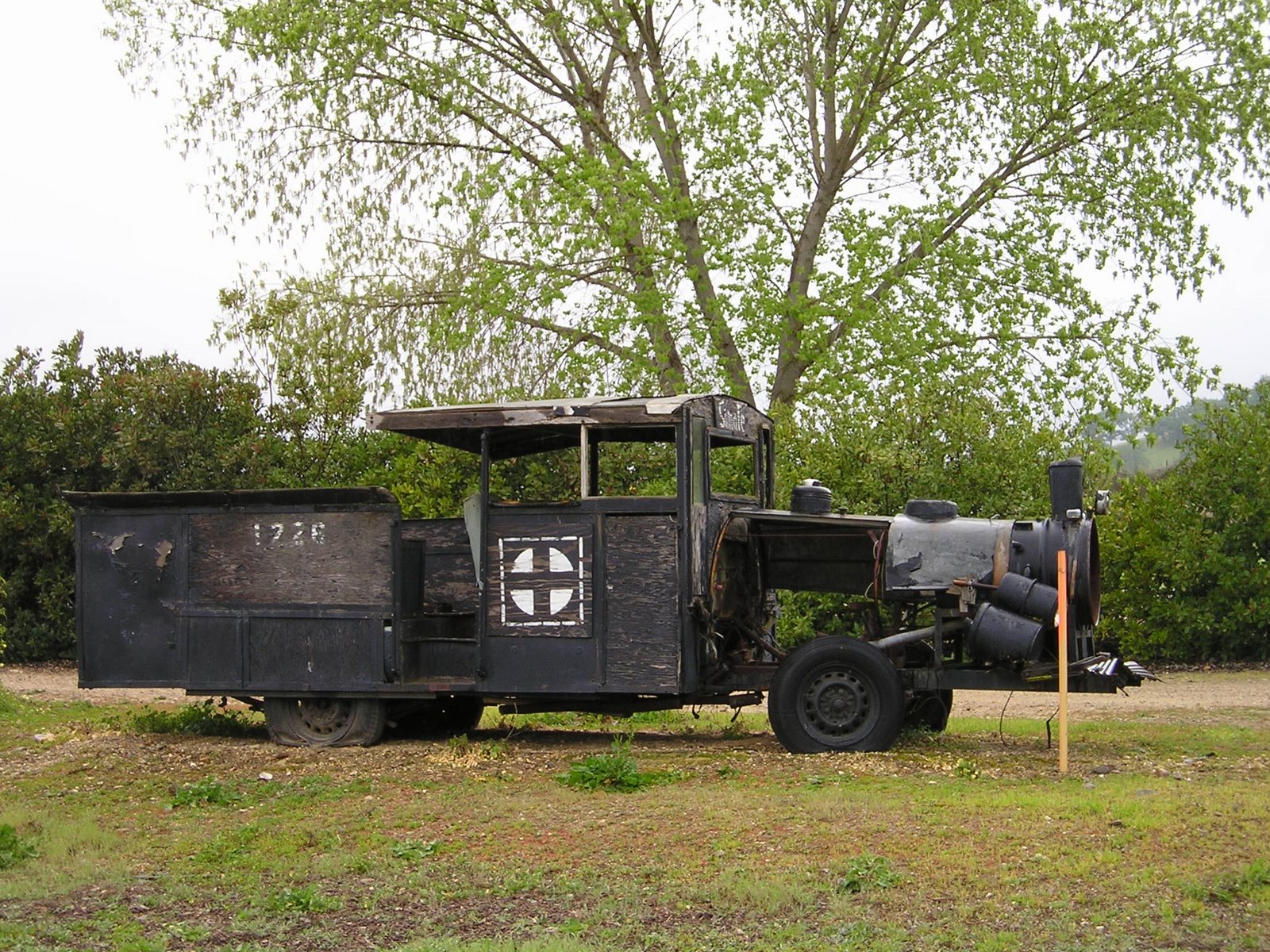
This detour also gave me the opportunity to see this rarely viewed Santa Fe railroad fake engine in its native habitat, a front yard in rural California:

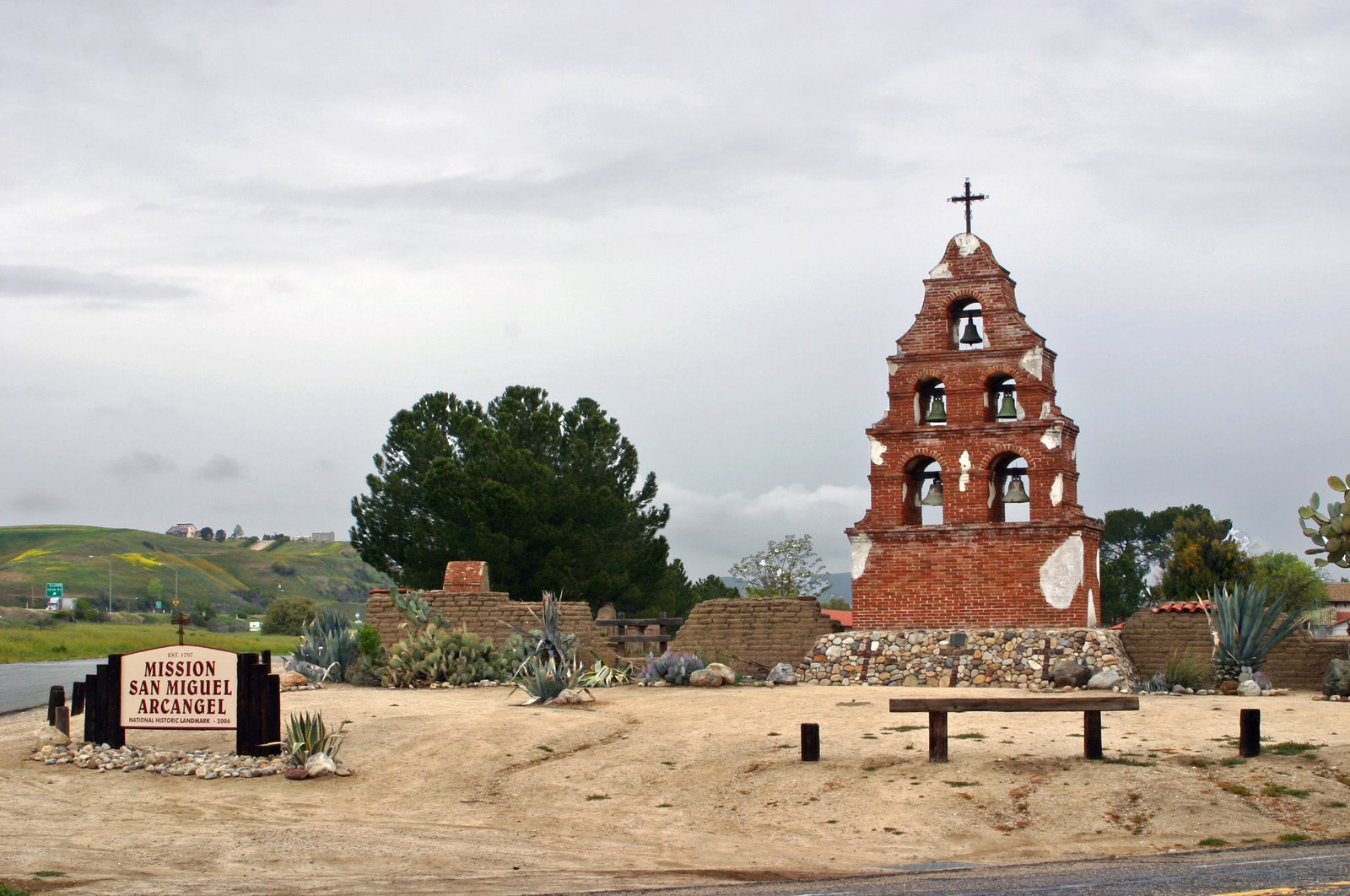
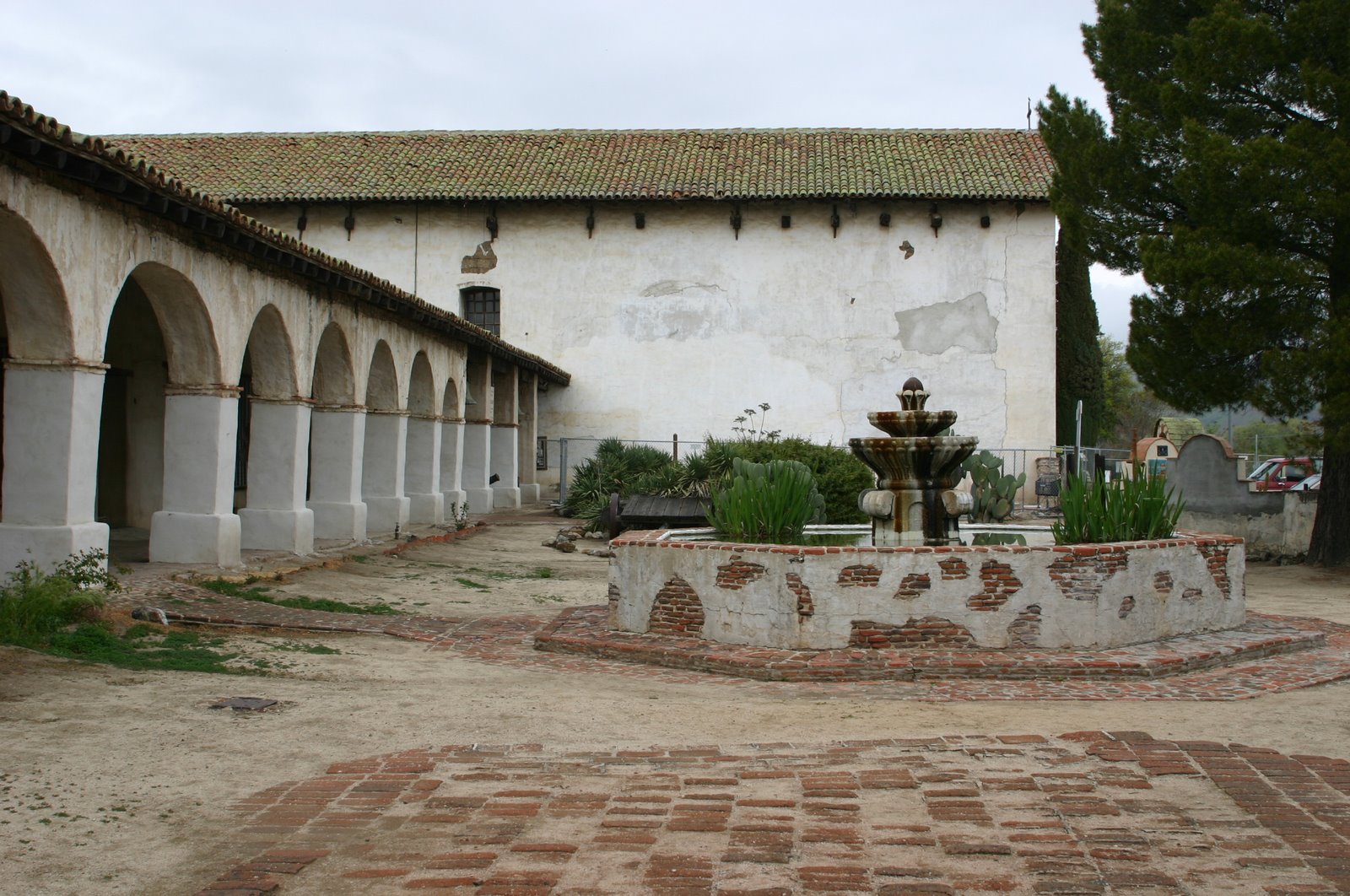
Then I stopped in San Miguel to see the mission. Right off the highway is a modern mission-like bell tower, connected to the ruins of the old adobe wall around a couple of acres of Mission land:


The mission itself is somewhat open for tours, although the church and cemetery are current closed to the public because the walls are about to fall on top of you and are propped up with giant props while they retrofit it to better withstand earthquakes. The arches on the extension next to the church are all of different sizes and shapes. They claim that this was done deliberately and that San Miguel was known far and wide for these interesting arches. Personally I suspect that the architect was known far and wide for having too many sangrias.


When I looked in Wikipedia for a link to the mission, I discovered that the article was sparse and had no modern photos, so I had to add some photos and more text. View the updated wikipedia article on Mission San Miguel Arcangel.

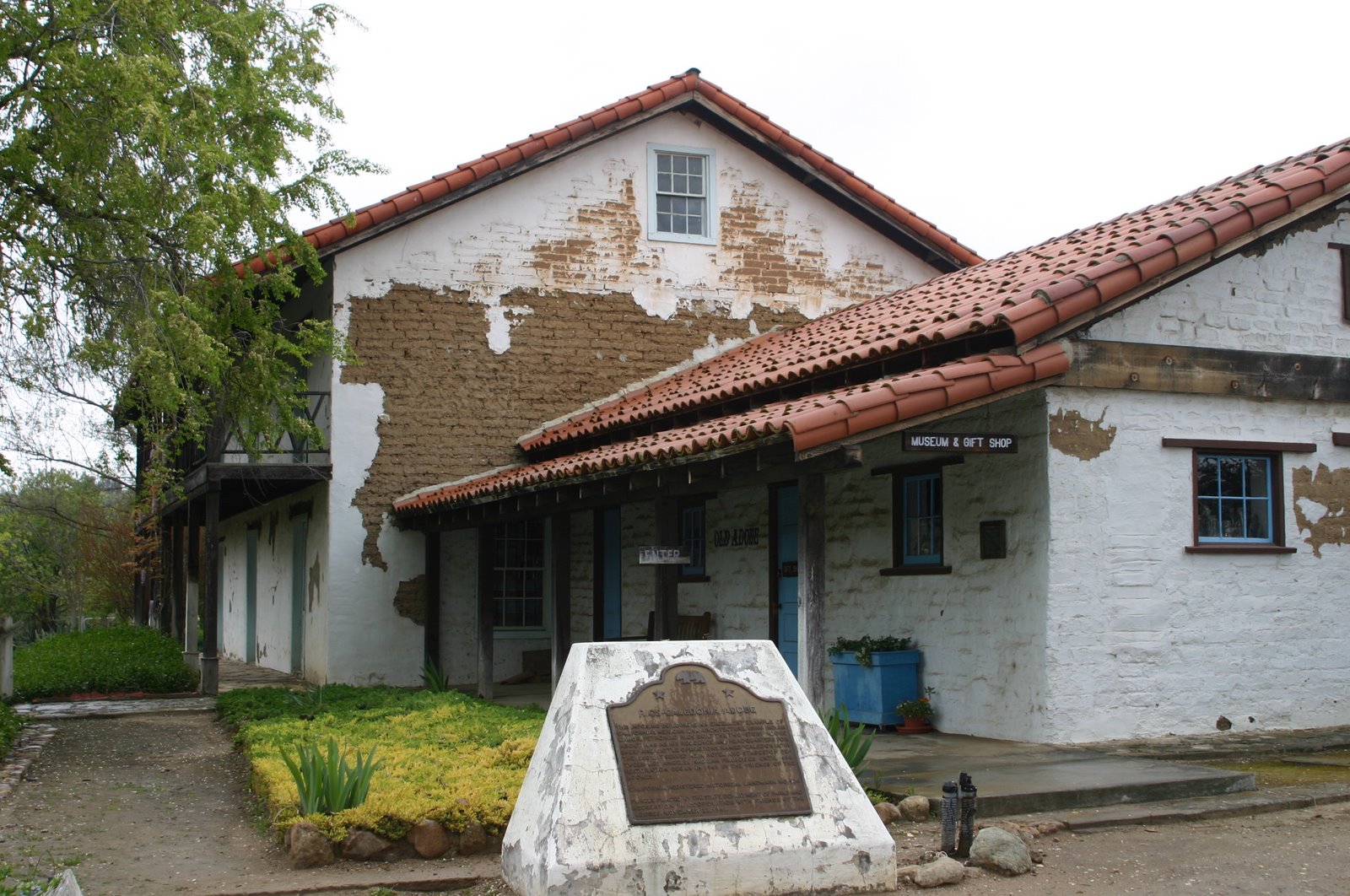
Across the street, I discovered that there's an old adobe that's also an historical monument, the Rios-Caledonia adobe. It originally served as a stage stop and inn on old El The Camino ancient historic Real until the train put a stop to that (perhaps the very Santa Fe rotting down the road a bit?), then it was used for an assortment of purposes until someone got the great idea of turning it into a tourist attraction back in the 1930s when it was still practically new (well, compared to now, anyway).


When I went to wikipedia for a link to THAT article, I discovered that there WAS no article, just links to it in various places, so I had to write it up and upload more photos, which you can see here. The mission and adobe are tied together somehow in a weird mass murder, if you're into that sort of history.

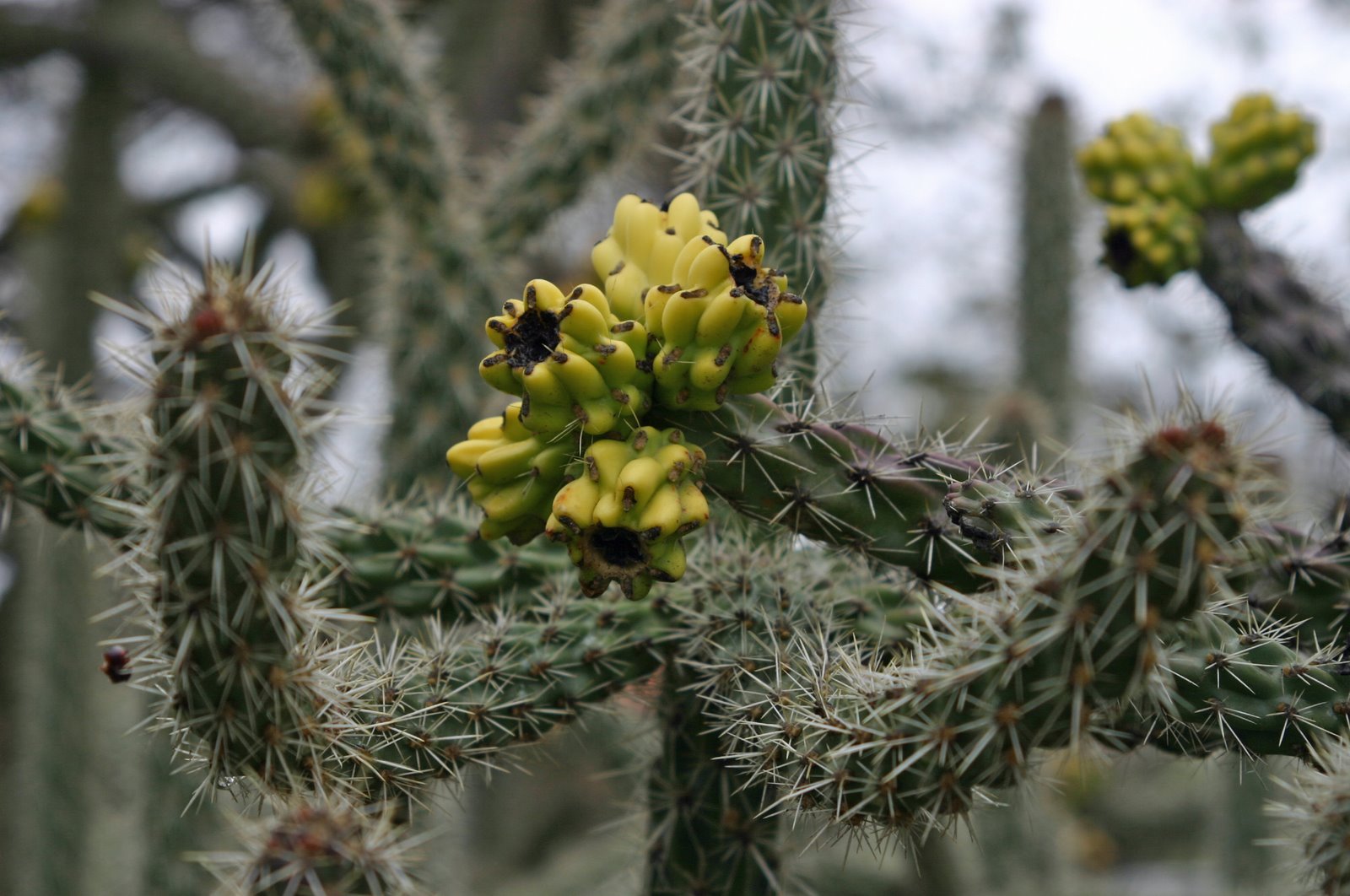
The adobe museum is open only Friday through Sunday, but the grounds were open, so I could browse the outside, admire the fact that they had doggie-pick-up bags readily available onsite, and get both eyes poked out simultaneously in the well-tended cactus garden.


On the trip, I passed The Old El Camp Roberts, which looks like it's falling apart, literally, although it's supposedly still in use by the National Guard.


Lastly, I had this disturbing encounter:

Tuesday, March 18, 2008

There Is Nothing Like A Frame

SUMMARY: Today's song lyrics

Update March 19: See end of post!
Sometimes I wander around the house singing to myself and to my dogs. This is what came out this morning (from the famous musical, South Pacific Dog Agility):


Apparently not doing 2-on/2-off today.
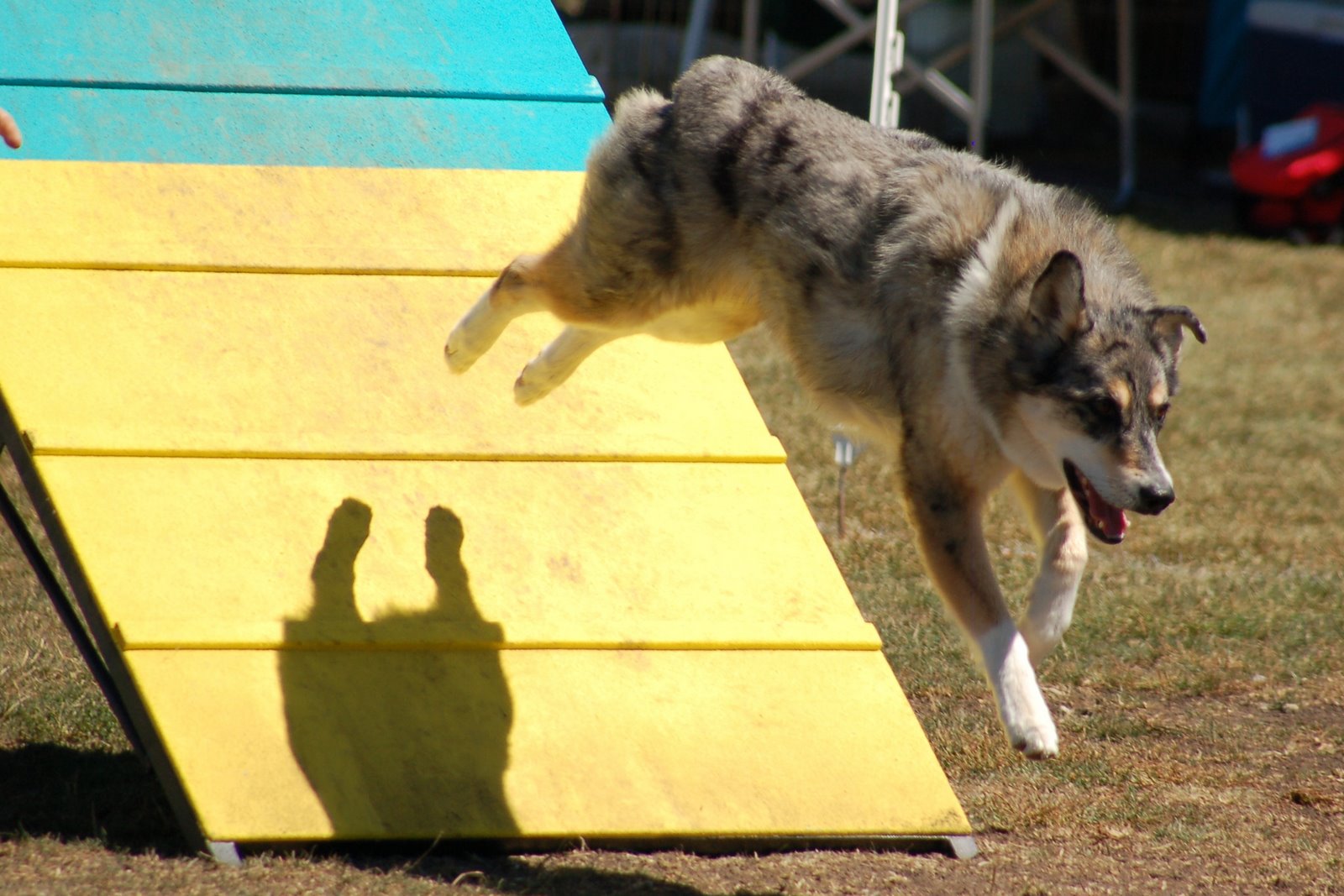
Photo by Sarah Hitzeman
 

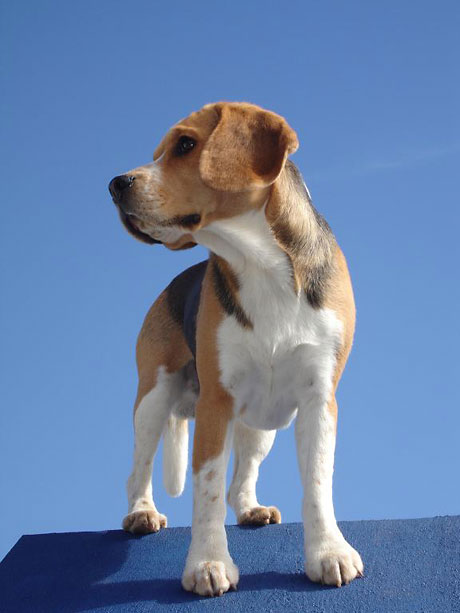
Teddy the Beagle demonstrates the viewing potential of an elevated structure.
We miss contacts on our teeter,
We miss contacts on our 'walk,
We got weavepoles that are iffy,
We got bars that we can knock,
We got rules that can confuse us
In the tricky Snooker game.
What is the worst?
The darn A Frame!

We get runouts and refusals,
We get broken start-line stays,
We get lost on Jumpers courses
That are set up like a maze,
We get caught in chutes and tires,
Visit judges for a spell.
What is the worst?
You know darn well!

There is nothin' you can fly off so wide from...
There is nothin' else you can't really hide from...

There is nothin' like A Frame,
Nothin' in the ring,
There is nothin' you can blame
That is anything like A Frame!

[verses omitted to get to the grand finale--]

There are no flyoffs like A Frame,
And no creeping like A Frame.
You can perch on A Frame
And look around from A Frame,
Run around an A Frame,
Bail right off an A Frame.
There ain't a thing that's wrong with any obstacle
That can't be worse when you have to pull
To a big wide, steep-sided, slatted, faultable Frame!

NOTE: If anyone can successfully fill in the missing dadadas with an appropriate line, I'll add it here with credit! Update March 19: Thanks, Wishy the Writer, for this suggestion: We get caught in chutes and tires, Visit judges for a spell. (Read lyrics to original "There is Nothing Like a Dame." Oh, cool, YouTube has the scene with the song from the movie, so you can see and hear the original, too! Don't they look like a bunch of handlers walking a course? Sure they do!)

Wednesday, February 27, 2008

Rachel's Running A-Frame Part 2

SUMMARY: Sorry it took so long--a little busy.
Part 1
Brief note on up contacts

Advance note: This was supposed to be the same seminar delivered once in the morning for 3 hours and once in the afternoon for 3 hours. However, by the time I had to leave, about 4 hours into the day, it looked like it was going to be a sort of 7-hour seminar with some repeat of what was covered earlier. In other words, I didn't really see the dénouement, which would be how to fade the PVC frame (except for removing the little feet from the bottom as a first step).

Adding the A-frame


OK, you've worked the simulated A-frame on the ground and the dog can do it reliably (all 4 feet in the box every time, with you ahead, behind, left, right, moving, standing). And you've videotaped consistently enough to know that she really is getting all 4 feet in every time.

Now you can move to the Aframe. Notes:
  • Start at 4'6".
  • Only 2-3 times a week, half a dozen at a time. Don't want to fatigue the dog.
  • Don't add other obstacles in sequence after A-frame until they're pretty solid.
  • She won't work dog on running Aframe until over a year old because of muscle & power development.


Step 1 positioning
 
Step 3 positioning
 
Breaking 2on/2off part 1
 

Breaking 2on/2off optional part 3
 
Set up the box on the A-frame (see Part 1). Back chain the dog by placing the dog on the A-frame above the 2nd slat above the contact zone. Then you get into whatever position you're going to start from (remember to vary) and give the command (oh, yeah, did I mention adding a command way back when they've learned how to run into and out of the box?).

Second step is with the dog starting just beyond the apex (on the down side).

Third step is to get the dog to run the whole thing with a good running start.

Breaking the 2-On/2-Off

For dogs who've already been trained to the 2-on/2-off method of stopping at the bottom, you need to break that behavior. They might just avoid it naturally when you set them up as discussed above, but if they don't, you need 2 or 3 extra steps.

Important: DO NOT EVER give the 2o/2o command on the Aframe again. (If you keep the 2o/2o dogwalk, you'll want to intermingle some DWs and AFs to be sure dog understands the difference.)

First, put the box on the ground slightly in front of the Aframe and set the dog up in the 2o/2o position; you'll have to do this manually somehow because you DO NOT EVER give the 2o/2o command again. Move to your position, then give the "hit it" command. Dog should do it just like he's been doing it on the ground all along.

Second, set the dog on the Aframe in the contact zone so all 4 feet are there (since that's where he's going to be hitting, in theory). Move to your position and give the "hit it" command.

You shouldn't have to do these steps more than once or twice, I think she said. If the dog still wants to stop when you go back to the Aframe steps 1/2/3, you can just make it harder for the dog to stop by angling the box so it's partway off the Aframe a couple of times.

That's it! Now you have running A-frames!

Monday, January 21, 2008

Rachel's Up Contacts

SUMMARY: summarytext

I asked Rachel about using this method for up contacts, because I know that she's done it and because that's (currently) my main interest with Tika. This seminar didn't cover it, but Rachel said that the criteria and the training are different--for example, the criteria is one foot in--and she has worked with multiple dogs on this, too.

I'm convinced enough that she's come far enough with this that I'm going to schedule a time to go down to Atascadero some day soon (I hope) to work with her.

She did say, though, that she's not sure that one could use this method to teach BOTH a solid up contact AND a running down contact, because the criteria are different for a similar set-up. I said I'd be interested in doing that, though. She wasn't encouraging.

For Tika, if that's the case, I'll have to decide whether the missed Qs from the up contact are more relevant than the missed Qs from time--but here I'm talking about Steeplechases and Grand Prixs. Sure, we've missed some Standard Qs from up contacts, but in fact she has more Standard Qs (16) than any regular class except Snooker (22), so that's not a major concern at the moment. BUT the number of times that we've missed a Steeplechase Q by less than a second or two when we've dropped a bar, or the number of times we've missed getting into Round 2 of the Grand Prix by a second or two when we've had some fault, says that if I increased the reliable speed of her Aframe, maybe I'd get more Qs in St and more 2nd rounds in GP even WITH the fault.

On the other hand, it's also true that, when I really push her, she pops off the Aframe anyway so isn't wasting a lot of time there--although it might still waste a little time because I'm taken by surprise and because she knows she's likely to get called on it so might hesitate.

So, anyway, I have to decide, but I think a couple of hours with Rachel will help me with that.

Sunday, January 20, 2008

Rachel's Running A-Frame

SUMMARY: Attended a half-day seminar with Rachel Sanders on running A-frames.

Disclaimer: This is a summary of what I heard. It is also my interpretation of what I thought was meant. Any errors are mine, not Rachel's. This is my first real exposure to this method. (Figured I had to say this before people start pointing out my mistakes!)
Jan 23: I've cut out a bunch from my original post, as it was too detailed to be fair to Rachel.

Goals

To get the dog to do the down ramp in two strides, hitting all four feet in the contact zone, and leave the A-frame without stopping. For dogs of any breed, any size.

Why? Rachel isn't doing this primarily for speed on the course; she's doing it because she believes that running contacts are much easier on the dogs physically than 2 on/2 off ("2o2o"). And she believes that this method will prove to be more reliable than several other methods of teaching running contacts, which she discussed. (She also discussed several of what she calls myths about running contacts, like dogs of only certain builds can do it, or dogs can learn to do it on only one height of A-frame, etc.)

She has now worked with more than 60 dogs with this method, quite a few of whom are competing. She's still refining it as she encounters more dogs with different responses to the method--which is, of course, completely typical for working out a new method.

After a 3-hour seminar, jam-packed with info, I am jazzed about the possibilities and realized very quickly that even the 3 hours could provide enough to get me started but not necessarily all trouble-shooting issues and a detailed training plan. I'm hoping to get some more work with Rachel in March.

Equipment


The box will be centered over the contact zone.
A "box" made out of PVC.

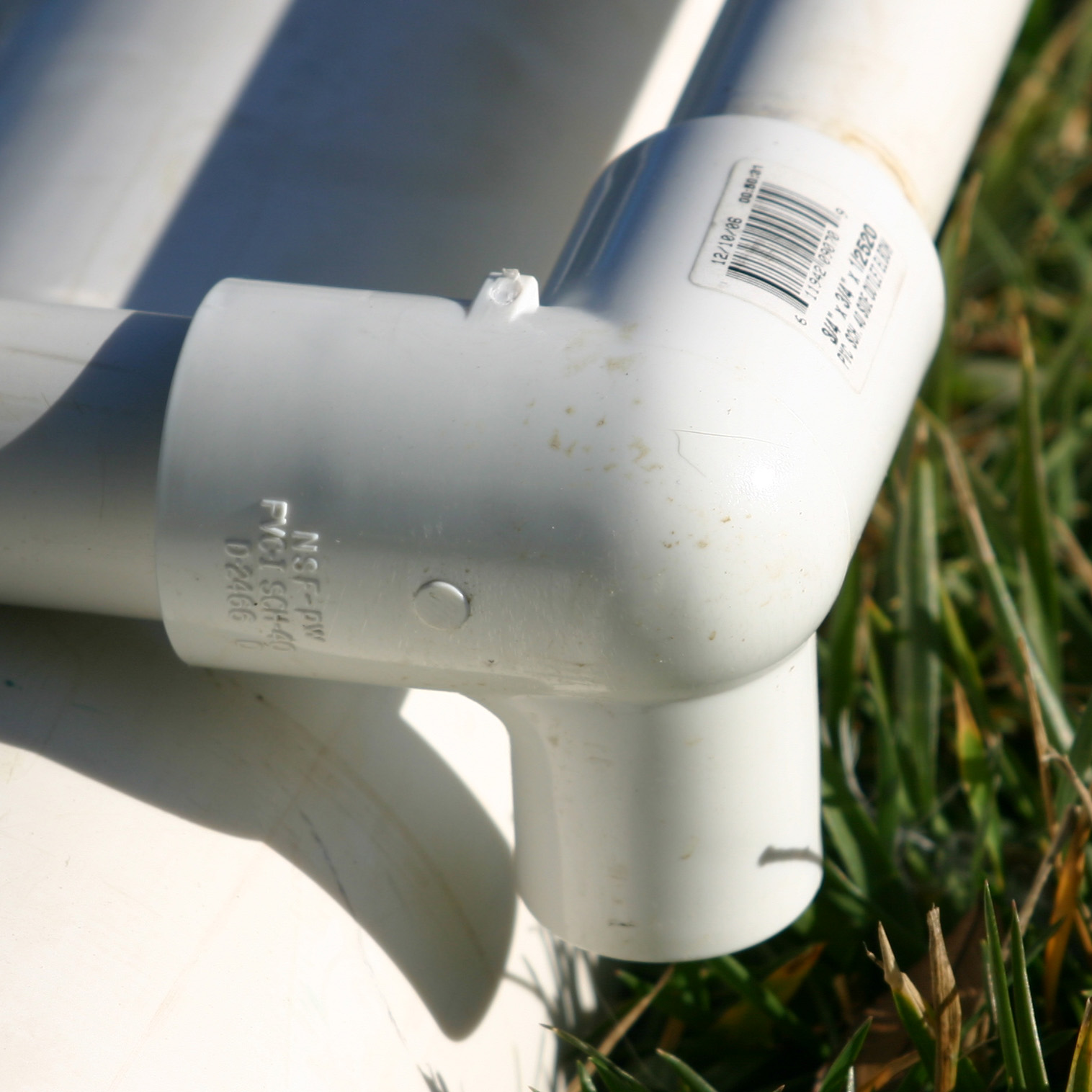
The corners are just standard PVC ells with a third "leg" where a riser would screw in.

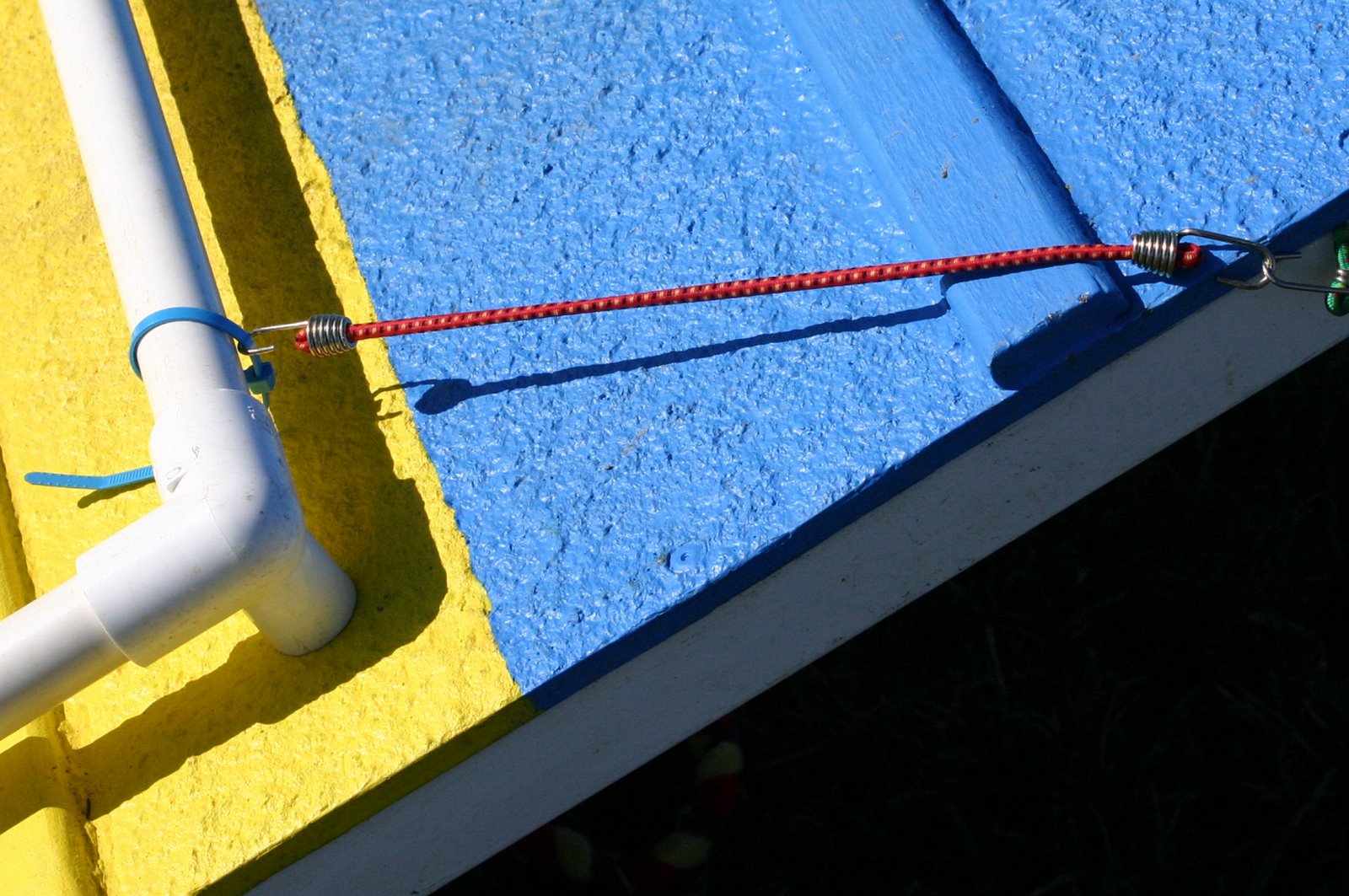
Corner detailHold in place with plastic tie and bungie to chain underneath Aframe.


Training the box

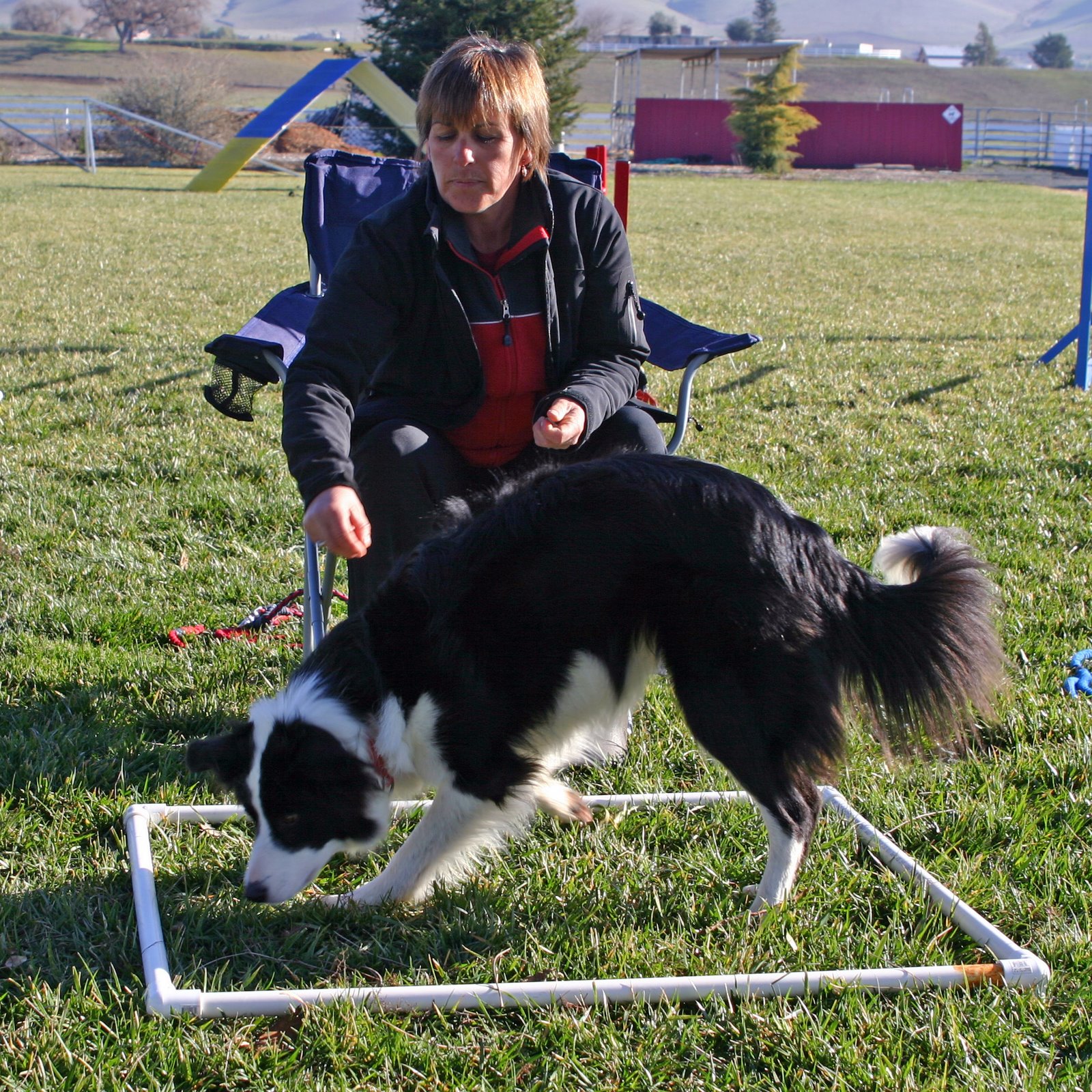
Click to mark all four feet in the box by tossing the reward away from you.


Before you get to the A-frame, you work with the box on the ground, first teaching the dog to go into it with all four feet. First, when the dog shows any interest in the box, click and reward inside the box, away from you. Then reward for all four feet in the box.

Continuing box training


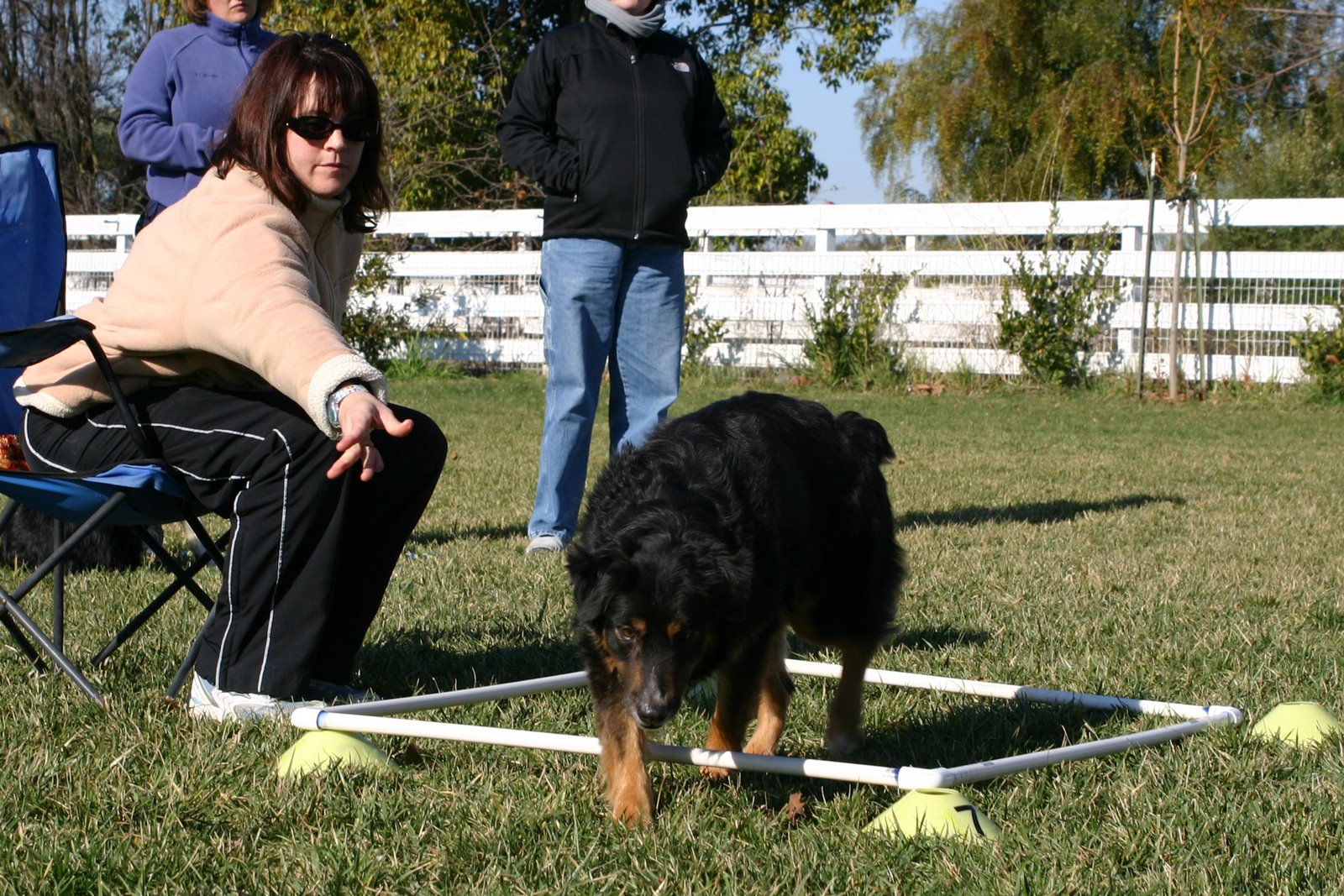
To get the dog moving out of the box, reward by tossing treat outside the box. (This box is slightly raised to make it easier for this dog.)

Eventually, reward motion that carries the dog out of the box opposite the side on which he entered. Toss the treat away from you across the dog's path so the dog doesn't look at you for the reward. Replace the treat with a toy as soon as possible.
By now you should lose the chair, but try to find a way to stand where you're not tempted to move, lean, etc.

Gradually you work further away from the box, always rewarding only if all four feet land inside the box. (Rachel emphasizes that the only way that you can train your eye to recognize it is by videotaping and watching your actions.) Then you'd gradually add motion. Same sort of thing as teaching any other obstacle.

Flat A-frame


Flat representation of an A-frame.

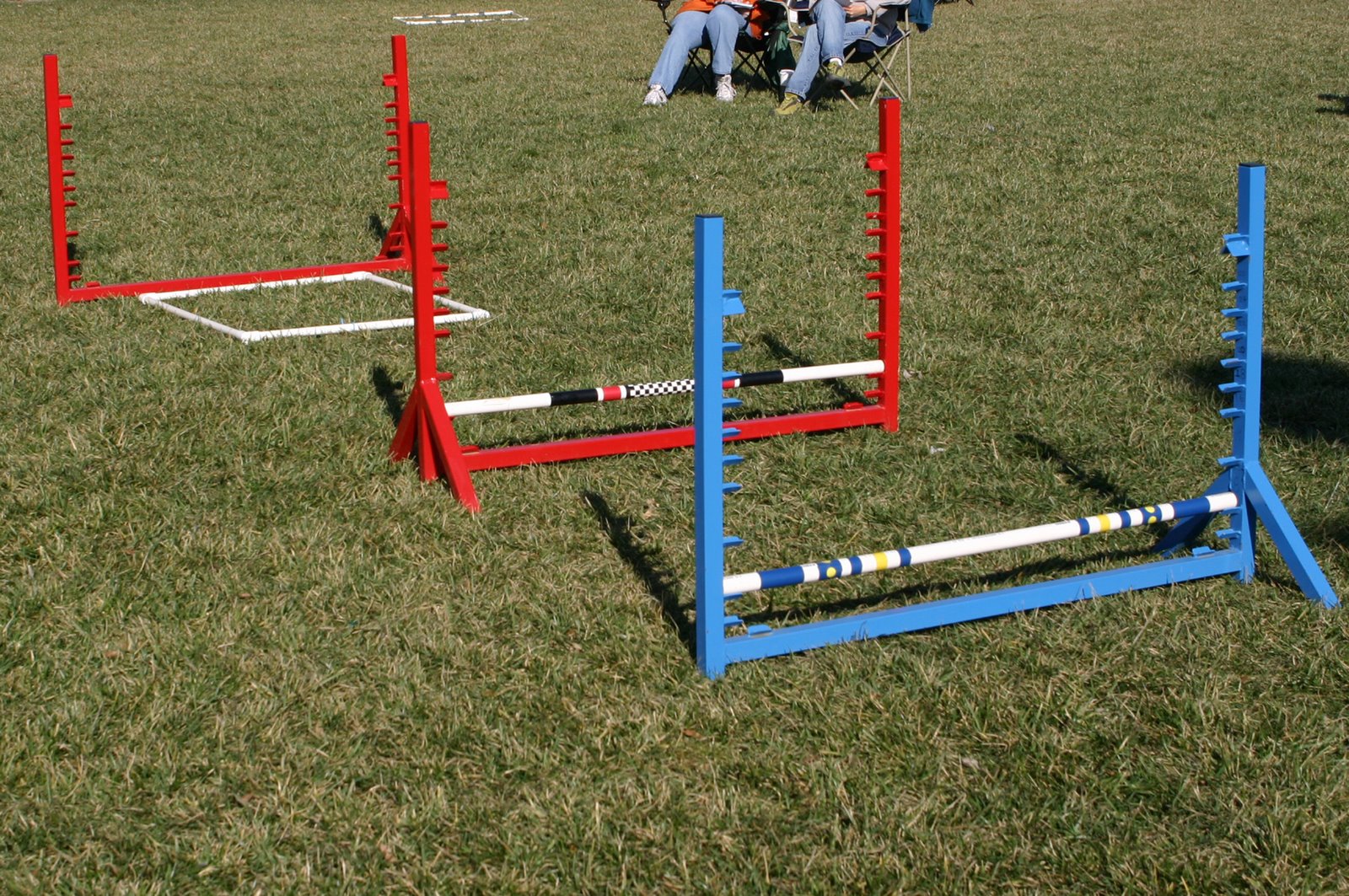
Rachel also discusses how to practice doing the A-frame without actually having one, using jumps to emulate the layout of an A-frame as shown in the photo. The middle jump represents the apex of the A-frame. The PVC box goes right where it would go on the Aframe.

Then work with the dog in the same way you did with just the box--first standing still at different positions, then adding motion from different positions. Goal is always all four feet in the box.

(I'll have to post more tomorrow--on working the A-frame itself and on breaking a 2o2o contact to move to a running contact.)

Update: Feb 27 2008
"Tomorrow" eventually came: Part 2

Sunday, November 25, 2007

Tika's Contacts

SUMMARY: #2 of several posts related to this weekend. Tika's contact speed looks good. Accuracy still needs work.

One reason that I've wanted to take time off from agility this winter is to work on Tika's contacts. We have a variety of issues:
  • Predictability: Doesn't always stop and wait for my release at the bottom. This means that she often gets ahead of me because I'm behaving as if she's going to stop, which leads to offcourses and refusals on the next obstacle.
  • Doesn't always even hit bottom, leaves earlier & earlier, lately resulting in flyoffs for faults (or zero points in point games).
  • Speed: When I make her stop or correct her, the result is that she slows way down on the descent. We just can't afford that time loss among the high-speed, high-drive dogs out there, if I want to try to get and stay near the top of the heap.
  • Dogwalk up contacts: Leaping over the up contact zone, resulting in faults in USDAA.

I believe that the first three are interrelated and that I can solve all of them with the same strategy. Since coming home from Scottsdale, I've been doing many, many contacts with this criteria to earn a reward: Tika must run as fast to the bottom as she runs up (which is always pretty fast) AND she must wait for me to release her.

I'm concentrating on high-energy rewards. She's a big food hog and loves her treats; it's been a challenge getting her to take a tug-toy as reward for her contacts, but I think that the treat rewards are one thing that has slowed her down. She's gotten much better about accepting a toy as reward recently. I'm still working on it, but there's improvement. And, very important now, I don't reward if she's slower than I want, rather than rewarding ONLY for the two-on, two-off position and waiting for me.

Sometimes I reward by letting her go into the next obstacle and then playing like crazy, but not too often; just want to keep reminding her that the contact is in a sequence and she doesn't get to slow down just because I'm not at the bottom to reward her. I'm trying to drive in and reward her within microseconds after she hits the contact, not to cruise over saying "goooood girl" before delivering the reward.

I'm concentrating on high-energy approaches to the contacts. I never just line her up and send her; I hold back on her collar (which she takes with high excitement), I play with the toy out of her reach, I beat the toy on the contact zone, I run to a tunnel before the obstacle and then send her. I'm trying to remember to mix up being behind her as she starts the contact, being ahead of her as she starts the contact, and running parallel. (I don't have much room in my yard for crossing in front of the contact, but I know that I need to work on that, too, to keep her from popping off as I cross.)

I've gone back to a lot of basic work, as well--driving to a nose-touch target on the ground; driving to a nose-touch target at the end of a contact training board; putting her on the contact on the down ramp, revving her up, and driving to the end of the contact to a nose-touch target. I'm trying to mix up standing still behind her, running with her, and running out in front of her. I think that this is helping because I can do many more of these than I can do full-length contacts.

I'm trying to be consistent with my command--"Climb! GO!! Touch!"--and not use my voice to try to build drive ("Go! Go! Go! Woohooo!") because I want my performance to be as consistent as possible so that I'm not giving extra cues in competition that it's OK to fly off or that it's OK to slow down.

I'm now trying to do high-energy corrections-- on the lie-down afterwards in competition (when she doesn't wait), rather than stop completely, assume a calm voice, make her lie down, walk past her, then release, I'm trying to do a drivey, high-energy down--so I yell "down" with as much excitement as I can, keep my own body and voice high-energy, run past her, release as quickly as possible. Because, in the past, I've noticed that, when I make her "down," this slows her down. So I want everything that she AND I do in relation to contacts to be high-energy and drivey at all times.

So, at home, I'm trying to make the corrections high-energy, too. No "oops" and just bringing her back around to touch. And I'm trying VERY hard not to ever let her back up a step to put her foot on the contact--if need be, I rush in and grab her before she can try it. I NEVER taught that, but I see her try it once in a while, and I've seen too many dogs lately get faulted for that.

I'm not bothering with 2-on/2-off on the teeter with her, and haven't for a long time, because the only times she's ever done flyoffs is when she doesn't realize that it's a teeter. But I have been working on speed and drive on that her WHOLE agility career, and she's doing very nicely. I almost never get sliding teeter contacts, but she does drive into the contact zone, and I release her quickly and this weekend her teeters were nice.

This weekend, every one of her contacts was fast. She didn't stick her 2-on/2-off dogwalks--ran through them without stopping--but she didn't fly off. I did make her lie down twice, and a couple of her Aframes were just lovely, driving to the bottom and waiting for me, eyes bright, poised to run, rather than simply trotting down and assuming the position, even after the drivey "Down" corrections.

I think we're making progress.

Up contacts? Pfah. I'm still not convinced how I want to do them, so I'm ignoring them yet again.

Monday, October 01, 2007

Training Me and the Dogs

SUMMARY: First day of boot camp for me. Working on Tika's drive, bars, future contact work.

So much to do, so little time. We've got a USDAA trial this weekend, a week off, another USDAA trial, another weekend off, then that following Monday or Tuesday heading for Scottsdale.

Boost's not competing at Scottsdale, so it's just the usual stuff. She's doing some fabulous weave entries in the yard now. So she WAS learning all that stuff, she just now got around to deciding to apply it!

With Tika, I need to focus on:
* Tika's drive to the end of the contacts, particularly the dogwalk and teeter
* Bar-knocking drills

Tika tends to blast fast through most of the dogwalk and then saunter to the end--or, as she's just started doing, leaping off before the contact. So I just keep rolling around to contact-drive work, revving her up, slapping the contact, driving her with my body, too, and not rewarding crappy slow sauntering ones. We never got our second Steeplechase qualifier--sigh--so it's just Grand Prix and Team.

I've been working on the ground in getting her and Boost to run through my PVC frame that's the size of the dogwalk contact and going to a target further ahead, so they get clicked for getting front feet into the box and the reward goes at the target. Tika's still mostly jogging through it, although I think she's picking up speed; Boost blasts into the box but in her short life we've done so much targeting work and stopping on the contacts that she wants to stop in the box. But, when she does get out again, she drives to the target.

That's in prep for working on Tika's up contact, which I just really don't think I want to deal with before Nationals. And I have a fantasy about retraining contacts to be running contacts, which I REALLY REALLY don't want to even think about before Nationals.

But I'm reserving the rest of November, all of December, and part of January to muck with contacts. Only one CPE trial over Thanksgiving weekend, and I had the guts to NOT sign Tika up for Standard so I could avoid putting her on the dogwalk while I'm (in theory) retraining.

For me--today was the first day of boot camp. As expected, my arms are my real weak link. They are SO tired, I don't even want to be at the computer. But here I am. With lots of Real Work to do, too. Jogged most of the laps we did; walked the rest as soon as I started to feel it in my knee. Knee held up pretty good, actually. Next session--Wednesday morning.