SUMMARY: A-frame and Chute are free to good homes, maybe triple jump, maybe more, hard decisions
(scroll down to "What am I not planning on taking with me when I move?")
(scroll down to "What am I not planning on taking with me when I move?")
Ooops, thought I posted this on Friday (the 16th). Guess I'm posting it now, and just backdating it.)
When I bought my current home, nearly 2 decades ago, my Agility Gung-ho-ness expressed itself dramatically by taking my money. And I don't mean classes or competitions or travel (although those were also true). I mean: Equipment! Full set! Here in my yard! To train fabulous world-class agility champions!
... we didn't get to world-class because I'm honestly too lazy to be that dedicated to training and improving our skills. But it did help in achieving speed, accuracy, and championships of various sorts and quantities for Remington, Jake, Tika, and Boost.What I had before moving here
- A teeter, gift of my then-husband less than a year before we split up. It's not that he wasn't usually a kind and thoughtful guy, because he was. But--life happens. (1998, $400)
- A tunnel, a short 10-foot yellow one for which my agility instructor arranged group pricing, for her students and other agility folks. (1996, $100)
- Cheap weave poles, as in, I bought white stick-in-the-ground fence posts and tried using them (the little tabs all the way up them, however, were not an ideal surface).
- Cheap weave poles #2, as in, I bought a long metal strip from Home Depot and drilled holes in it and used very long bolts over which I dropped PVC piping of the correct size for agility. BUT turns out that that solid-seeming metal strip became astonishingly flexible when dogs raced through the poles.
- Cheap PVC jumps that I made using PVC for the bases and uprights, drilled holes through them, put a longish bolt through the holes, forming places on which to balance the crossbars. This didn't work well for several reasons (e.g., in one direction, if the dog crashed the bar, the whole jump came down).
- Tire jump, made with an actual motorcycle tire and heavy-duty huge PVC frame and base.
What I splurged on in 2001/2002
- Table: Wood top with PVC base--to change heights, had to change out the PVC legs, which wasn't speedy, but it was lightweight. (2001, $100)
- Weaves: purple powder-coat w/adjustable offsets (screw in pole supports), 20" spacing, 2 folding 6-foot sections for easy transport (2001, $197)
- A-Frame: From Duncan at Action K-9, one of the earlier makers of high-quality sturdy competition equipment. (2002, $865)
- Broad jump: 5-pc metal and wood, (2 short, 2 medium, one tall), flat tops --all of which made this obsolete for at least USDAA and CPE several years later, if it wasn't already that way because I think it was designed for AKC purposes. (2002, $174)
- Dogwalk: See Aframe. (2002, $752)
- Jumps!: Finally. Four official metal-frame with screw-on metal jump cups (2002, $170 total)
- Teeter base, adjustable height, heavy-duty metal base: Also Action K-9 (2002, $2.75)
- Tunnel: 20' heavy-duty double-walled teal & gray with 4" pitch--totally competition level. (2002, $360)
- Chute (aka closed tunnel): Competition quality plastic barrel with metal stand, 8' blue/purple/white sexy chute fabric! (2002, $251)
- Triple jump, whooo, big time! Purple powder-coated metal, 2 pieces (2002, $127.50)
- PVC for jump bars -- as needed, bought fancy tape and shelf paper to decorate them all with, ditto for the weaves. (Ongoing--minor costs)
Over time, added more jumps, more tunnels; retired jumps and tunnels as they rusted or wore out in the sun, replaced the table top once. The screw threads in my weaves rusted away, so that was useless, so replaced once with someone's no-longer-using 20" spaced official weaves, also eventually had issues, so replaced with someone's no-longer-using 22" spaced official weaves (of course at that time, USDAA had moved to 24" spaced weaves, so really they were no longer official). Resurfaced the teeter. A friend borrowed and resurfaced some of the Aframe.
What am I not planning on taking with me when I move?
- Aframe: Just too heavy for me these days. I haven't used it in several years, plus there is an important bit of damage that I can't fix myself. AND it's the old style textured surface, where now everyone uses rubberized. And it needs one critical bit of work.
- Chute: No one will want this, probably: All agility organizations canned them a couple of years back. Such a crowd pleaser (and I loved watching it), but they added too much time on the course (adjusting the fabric before each dog), and posed a risk to dogs who got tangled which BTW I also thought was unfair because that often added time to the dog's run and, really, there's only so much you can control with a fast dog through a floppy piece of fabric. I ended up never using it except with each new/young dog or as a refresher once a year or so. So it's in excellent condition.
- Triple Jump: Sigh. Lovely purple thang. I think no organizations do this any more, either.
- Dogwalk: Erk. At the moment, I *am* planning on taking it, but it needs some rehab and repainting and it's the sort of equipment that (because of its weight) I'd likely just set up in one place and leave it there, which reduces a bit its usefulness for anything beyond the contacts themselves (complex sequencing with the walk in the same place always is a little predictable for the dogs...) Still pondering. (And ditto on the rubberizing like the A-frame.)
And... really... how much agility training will I ever want or be able to do in the future? It is just a FUN thing, though!
What I AM planning on taking
- Jumps that are in reasonably good condition. This is maybe only half a dozen...
- Tunnels that are in reasonably good condition. This might be only one or two... [frowny face]
- Table (... oh, and the tabletop needs cleaning and repainting)
- Teeter with both bases
- Tire jump--TBD? Dunno--that motorcycle tire is heavy and needs to be retaped and is definitely not competition legal, and the big-old-PVC frame is broken in 2 places (works Oooookayyyyy just in the yard for basic use) that would require sawing and buying more pieces and measuring fit and gluing... ugh. But the PVC is lighter than metal frames...
... oh, also much cheaper, so I could build myself another one for not much other than time and effort. But how much would a real one cost me? Checking online--from inexpensive PVC-framed (but looks better made than mine) or used ones (quality TBD) to top-quality competition: $150 to $625 [really, J&J?!?!? REALLY?! -- I mean, Clean Run has one for $350-$525...]
- OK, tire jump NOT TBD, just talked myself out of taking it.
- Weaves. Even if they are only 22" span.
- Broad jump. I guess. It's not standard by far any more... but it's what I have and would probably work for basic training.
- PVC jump bumps for training (look up Susan Salo jump bumps).
- Tunnel bags - I have only 2 good pairs right now, and they fold flat once the sand/gravel is removed. ;-)
- Misc small other random stuff
Gallery of equipment fame and shame
 |
| Dogwalk when only a few years old. Glory days. |
 |
| Dogwalk is about 30' long. |
 |
| Dogwalk needs... um... TLC? |
 |
| A-frame in its younger age. |
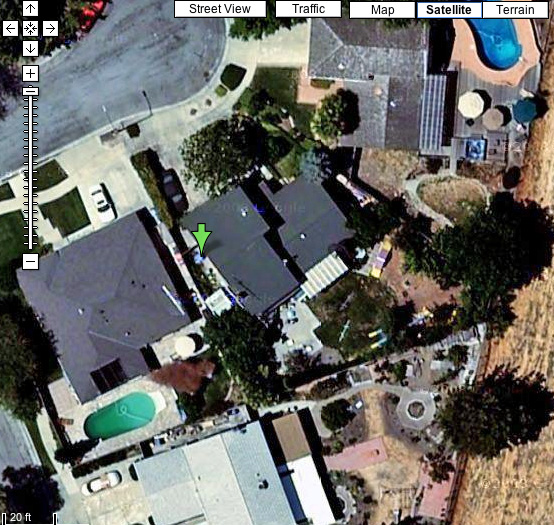 |
| A-frame in my back yard. (Go straight across to the right from the green arrow.) Takes up a lot of visual space and all in one large chunk. |
 |
| Aframe now. Mostly usable condition. |
 |
| But this is a problem (bent pipe). |
 |
| My teeter gets a lot of unauthorized use. |
 |
| Why teeter needed resurfacing 10 years back. Replaced with fiberglass. Currently, the metal parts are rusting and some of those surfaces are peeling away. But I think it'll be OK. |
 |
| Old tire parts I dragged out from behind the compost bins. Needs work. But OK for occasional gentle use at the moment. |
 |
| When expensive metal jump bases rust away... out they go. |
 |
| Same model chute as mine. Beautiful colors! Mine has no duct tape. |
 |
| When tunnels (purple) and tunnel bags (teal) are new and beautiful. |
 |
| When Good Tunnels Go Bad... and should really have been disposed of much earlier. |
 |
| This is what USDAA broad jumps should look like. Mine are flat across the top and form an upside down arc instead of an ascending format. |
 |
| My current weaves (except I've removed all the colored tape). Weaves also take up a lot of space: 12 poles with 22" between. (And modern poles have 24" between. So, yep, 22 feet long.) |
 |
| Previous weaves. The pegs had screw bases so they could be put in line as usual or you could move them out onto the tab to one side or the other for training. Those little screw bases' threads rusted away, sometimes the entire screw base. |
 |
| Tika demonstrates an unauthorized use of weave poles. Rules prohibit dogs from lying on their sides and pulling themselves along the weaves by hooking paws over the poles. Such a rebel. |