a Taj MuttHall Dog Diary: Sheba
Showing posts with label Sheba. Show all posts

Thursday, December 09, 2021

It Has Come To My Attention

SUMMARY: Some kind of festive holiday thing? "Krismass"?
Feeling: Inexplicably uneasy and, strangely, eager.

It has come to my attention that it is, once again, despite my best efforts, December. It is apparently, without my express written permission, in a brand new year, not repeating any of the perfectly fine Decembers that our holiday factory has worked hard to produce over the years. 

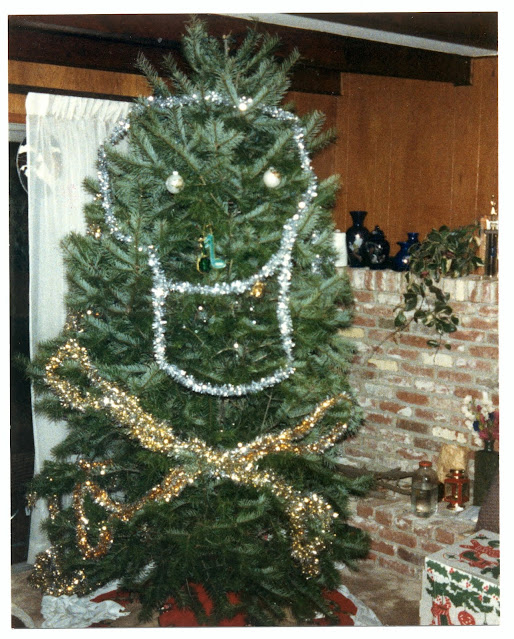
For example, 1987 involved pirates sneaking into our house while we were out doing something important --such as not decorating our tree--and leaving us with a garland skull and crossbones. Remind me to never again give relatives or pirates the keys to my house. At least not while boxes of pending tree decorations are sitting around unguarded. Why has no one submitted a re-use request for this perfectly good December, which required very few holiday decorations for a last-minute reconstitution?


This one was pretty good, too. I'd have signed off on a request for this one. The 2002 when Mr. Alien took over Disneyland. Remember that? It was in all the news. Anyone who neglected to wear their aluminum foil hat was instantly brainwashed into not seeing all the thousands of tiny Mr. Alien-kins swarming the place, aiming to abscond with the rumored "Magic." I don't know whether they succeeded. But then, I never actually saw any tiny Mr. Alien-kins, having left my aluminum foil at home.


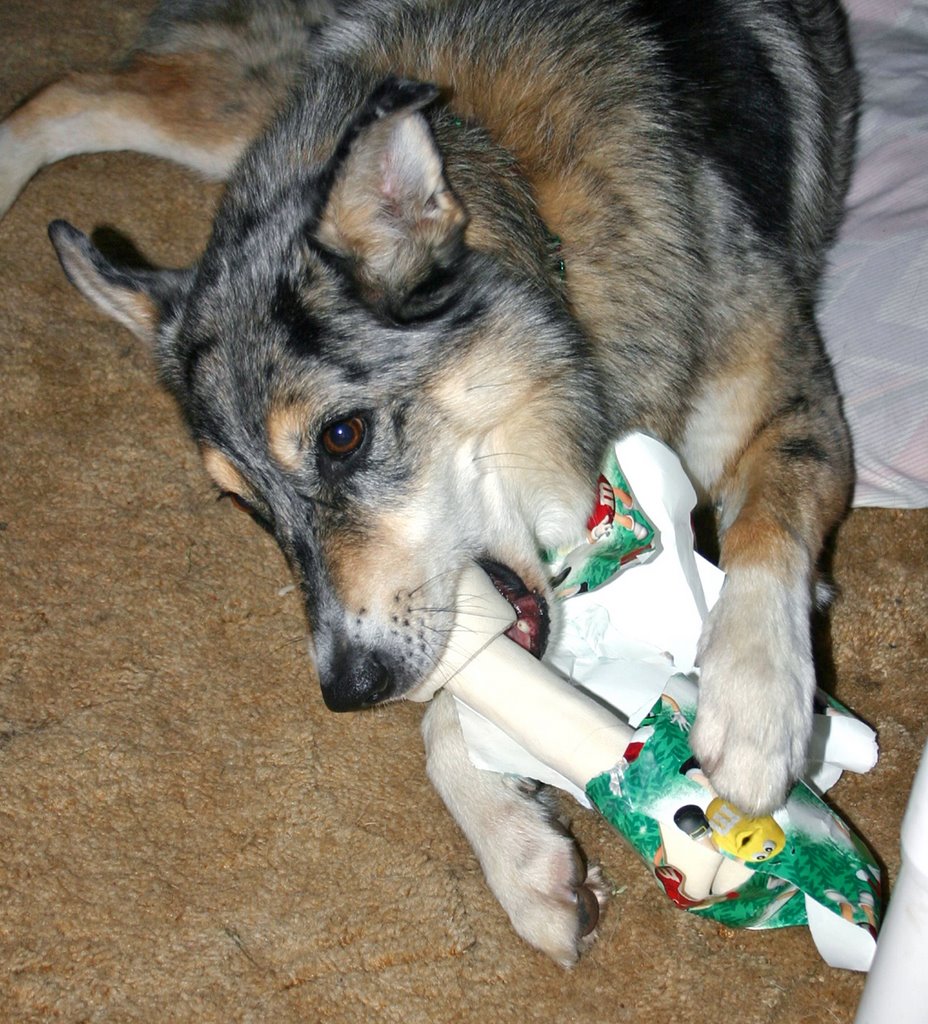
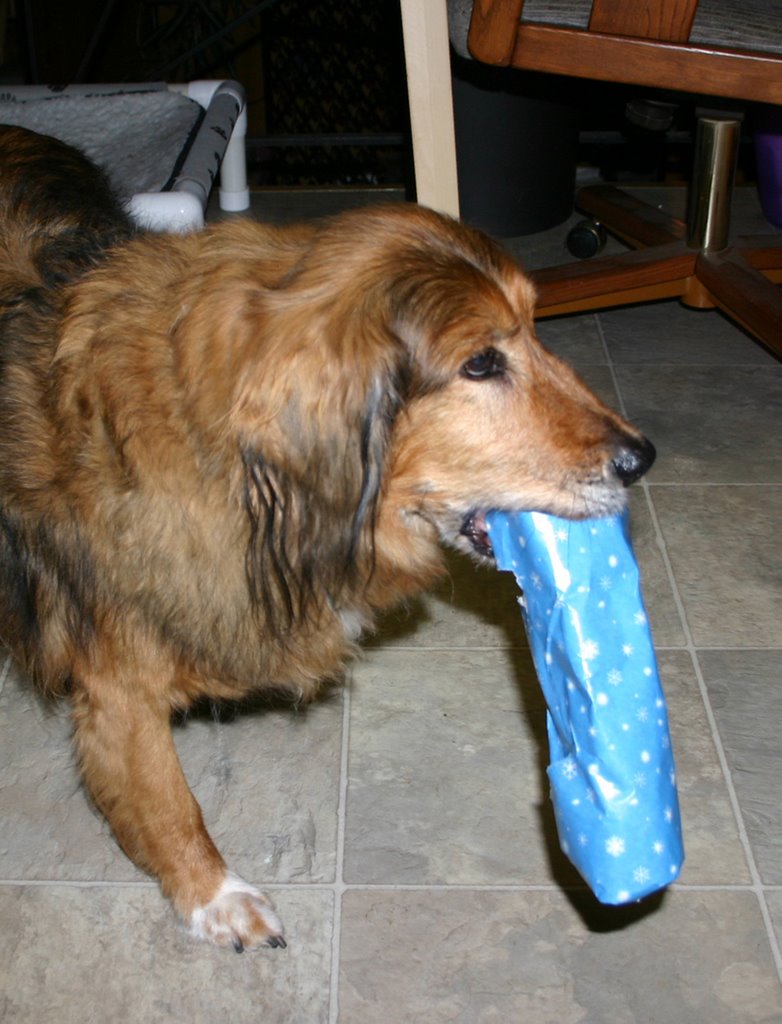
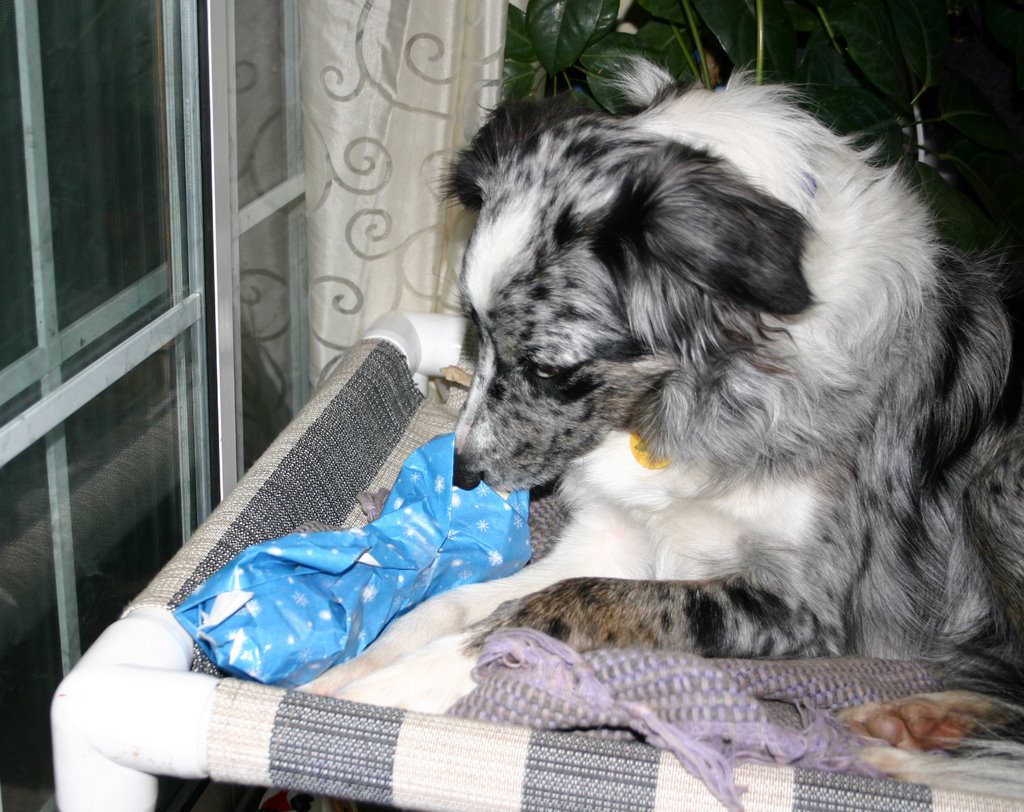
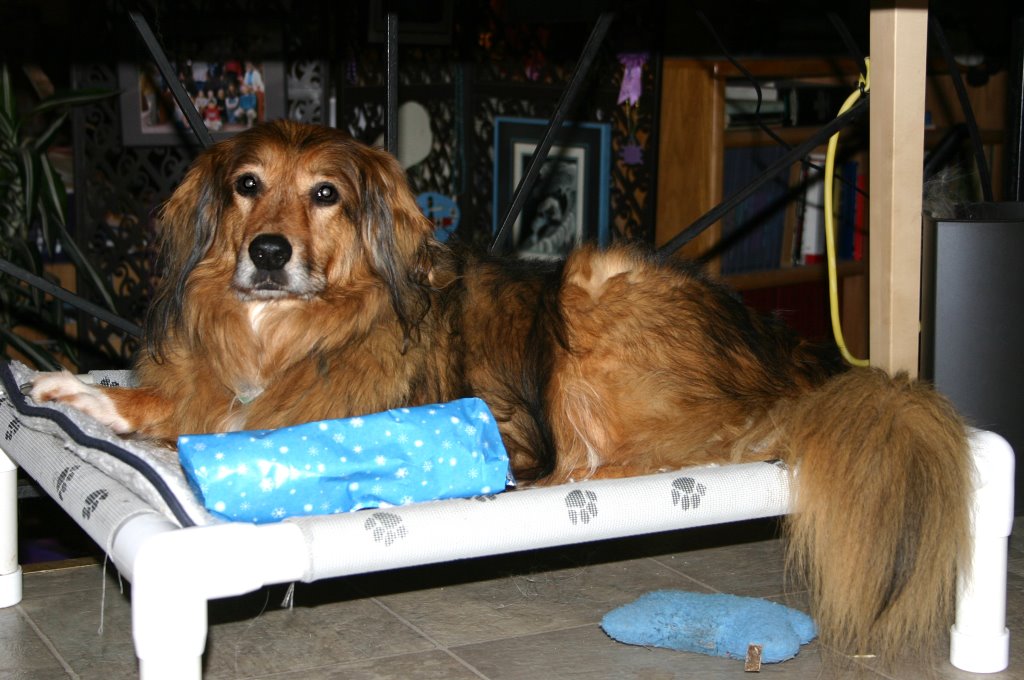
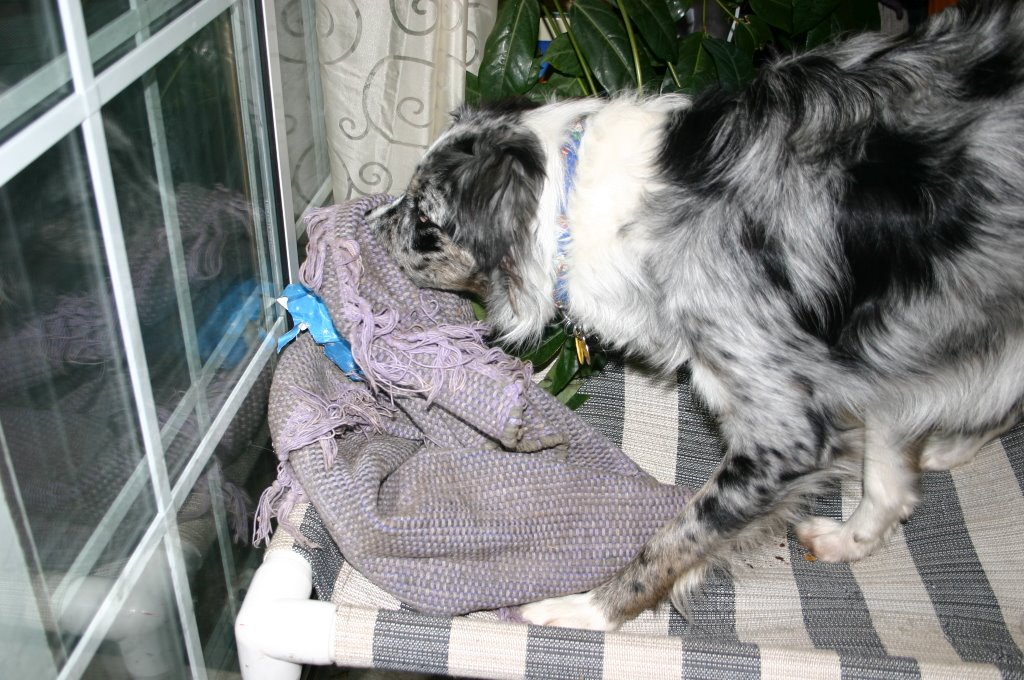
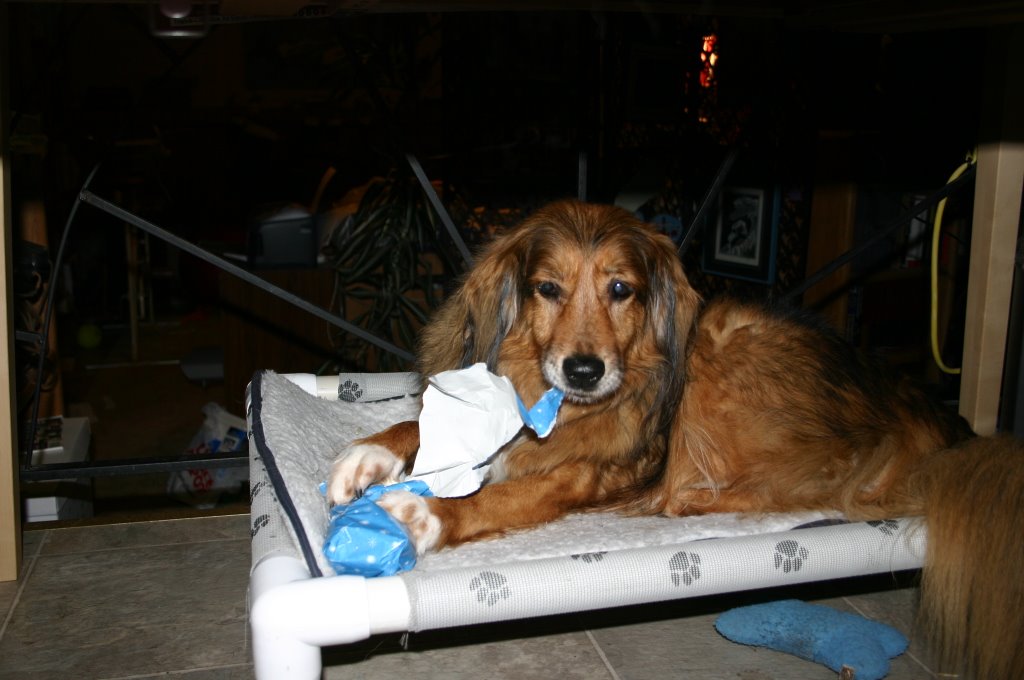
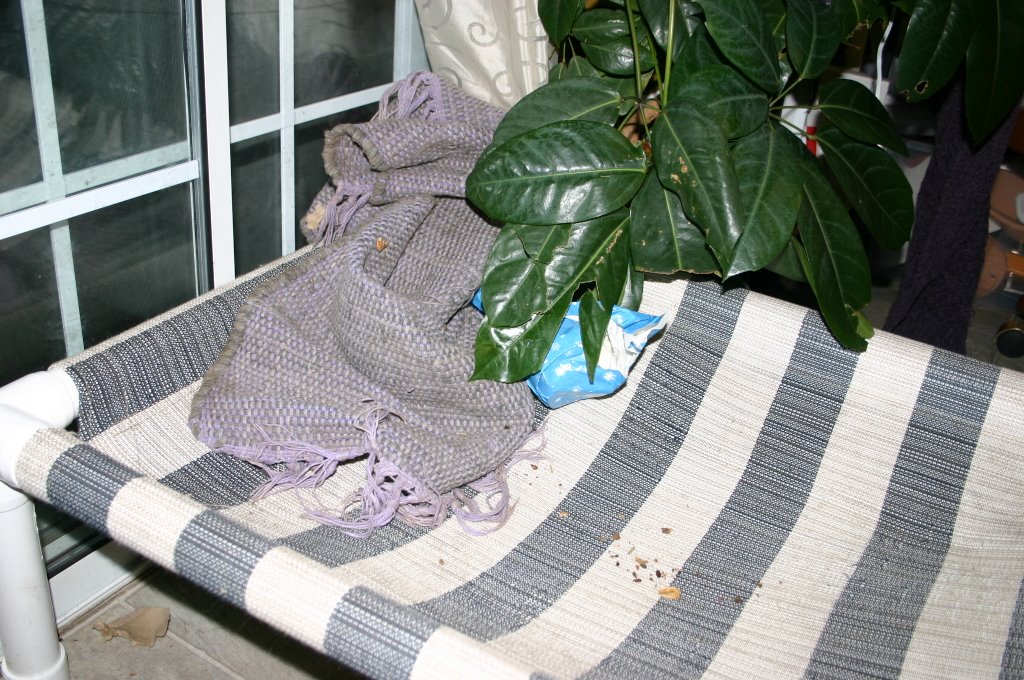
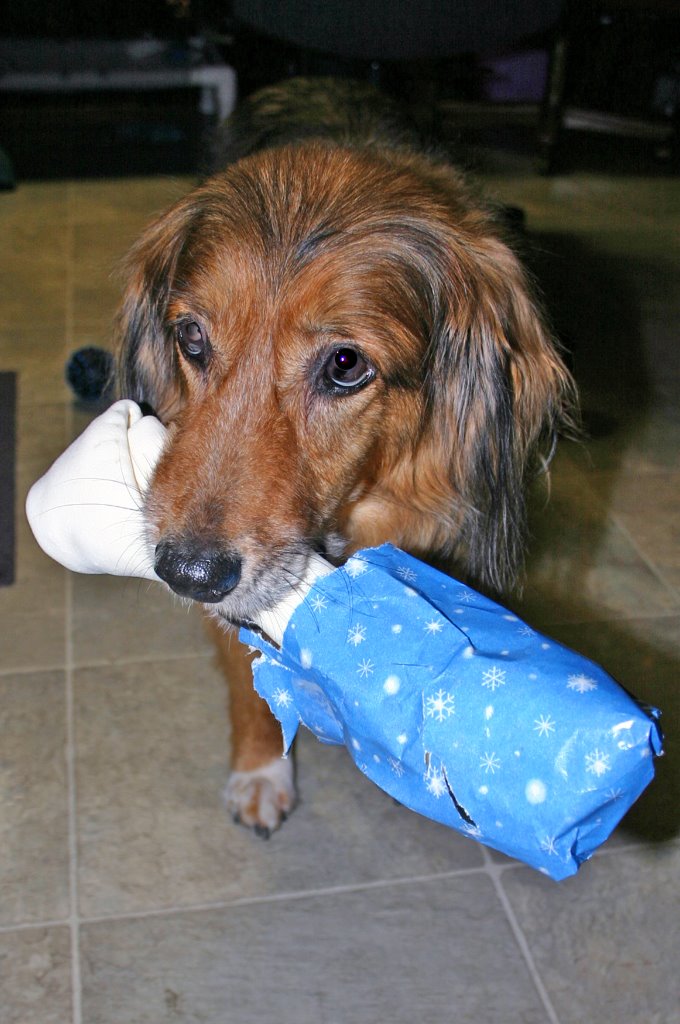
1983 had its highlights as well, although no aliens were involved. The household beasts always received a giant rawhide bone each from Santa. Santa must be a dog person. Or maybe the elves are dog elves and Santa just rolls his eyes and goes along with it. Watching them unwrap their gifts gave warm fuzzies to the humans, too. Although why unwrap the whole thing when all you need to start is one end? In fact, why unwrap yours at all when you are a genius husky and are pretty sure that you can end up with two rawhide bones if you play your cards right. If someone had played their cards right and arranged ahead of time with my department, perhaps we could have resurrected this year from the archives.


I wouldn't mind dusting off 1990, either, when everyone in the family received matching "San Andreas--It's Our Fault" t-shirts, which were enchanted like some of those old fairy tales so that we had to keep dancing and laughing while wearing the shirts until we collapsed in the living room to eat cookies, roast beef, candy cigarettes, and matzoh ball soup. My family had an eclectic idea about Christmas buffets. I'd love to dust those off, too. Do you see what I am getting at here? Asking permission is key.


Also, I seem to recall that 1966 would be perfectly reusable, including all of our annual new Christmas nightclothes and not-annual Tressy dolls ("Her Hair Grows!"). Best thing is that they could fit all of Barbie's clothes. Worst thing was how expensive Barbie's clothes were. That Barbie sure could wow 'em at the Met, though. No, worst thing was that I couldn't fit Barbie's clothes. But I could fit my new Xmas nightgown, although I'm afraid that I outgrew it before the following Dec 24. The same thing I did every year, Pinky. But at least I had bright blue fluffy slippers at the time. Pretty sure Tressy is still around in some quiet repose in the playroom here at Taj MuttHall, so redoing that year would be a piece of cake. Or of cookies.


Even Christmas of 1956 holds promise for a revisit, because I still have Dad's hat. Pretty sure I'd look as charming as I did then. In particular, I notice no wrinkles. In me, I mean. Although, in real life, I grew, and the hat shrank.  


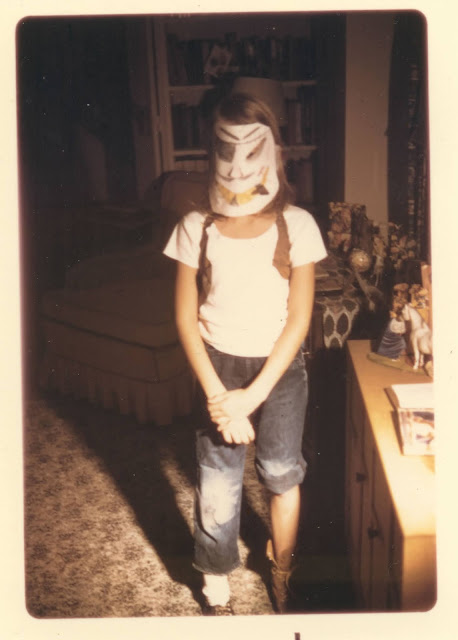
Or maybe I transposed the numbers and I mean 1965 instead of 1956. Why I opted to dress like a pirate at Christmas shall remain a mystery.  But, see, if we were reusing this year, perhaps I could solve the mystery. But nooooooo. Also, it is perhaps because I stereotyped pirates as having bad teeth, being visually impaired, and walking with a peg leg, that eventually what goes around comes around and I ended up with a garland skull and crossbones on my tree two decades later. Let that be a lesson: Don't stereotype pirates. Hear that, Disney? It would never sell.

(You can tell it's Christmas because you can see one of the wise men in mom's childhood creche wearing blue and kneeling just to the left of someone's horse that someone added in front. Not confessing who that might have been. Although it's possible that that horse is still in a toy box around here somewhere. Not that it has anything to do with me. But that family might have needed a better way than the back of a donkey to transport mother and child along with all that gold, frankincense, myrrh; hair combs and watch fobs; hippopotamuses; and silver, gold, and drumming drummer boys. Just saying.)

So, in the future, please ensure that you have properly submitted the requests for a December before I have to deny it because the whole corporation goes on vacation December 1, when it is too late to properly implement a new one or reassemble an old one from storage. Who knows what will happen in an unauthorized December. Just this year, I give you after-the-fact permission and will overlook your mistake this time. But don't let it happen again.

Feeling: Nostalgic. Curious. A little at sea. Transmogrifying. 


See? A perfect recreation is possible.
From a 2011 photo


Tuesday, May 04, 2021

Foxtail Tales

SUMMARY: So small, so dangerous
Started with my response to a Facebook post about dogs wearing anti-foxtail covers over their heads.

They can be beautiful, early in the morning, glistening with dew

I've experienced two unpleasant foxtails encounters, and others not so bad, with my dogs. In the early '90s, one evening while out in our big yard, my husky Sheba started sneezing and couldn't stop, and then started sneezing blood. Ran her to the nearby open-at-night emergency vet , where they sedated her and found and removed a teeny tiny foxtail way up in her sinus. Expensive. And of course the toll on the dog.

And Jake, in the late '90s, we were out of town at an agility competition--we went hiking at a nearby lake one evening and the dogs went swimming [this is where I discovered that Remington loved loved loved swimming; that's a different story]. Foxtails in prime sticking form surrounded the trail to the lake. Back at the car, I must've spent half an hour trying to get them out of Jake's long silky coat and tail.

A trail like this: Narrow; foxtails ripe and abundant.
All it takes is the dog to stick his nose into those for just a moment...


There they are, almost ripe and each
seed ready to torture a dog

The next morning, before the agility competition began, he started scratching at his ear (he had long floppy long-haired ears) and shaking his head. He was prone to ear infections, so I always carried special goop from the vet.  I figured he'd gotten water in his ear while swimming and an infection was starting.  Applied goop per the normal schedule. We went to the vet when we got home--actually the next morning when they opened. Vet said, nope not an infection, but was able to pull a foxtail out of his ear fairly easily without anesthesia--he said that's because the goop had softened it so much that it couldn't stick in anything and he could just grab it with long tweezers(?) and glide it out, no anesthesia. Disaster averted.

So, not too expensive, but of course going to the vet just costs.

Tika had extremely dense fur. Like a husky's. Fun fact: Dogs have, on average, 15,000 hairs per square inch. A husky can have up to 83,000.  (Otters have even more!) Tika had such dense hair, particularly with her winter coat, that I'd have trouble seeing even a speck of her skin.  Her hairs were not particularly long--in memory, I think 1-1.5 inches. But they were perfectly straight and, as it turned out, exactly the length and texture of a foxtail seed. When she managed to dash through a field of foxtails, you couldn't *see* whether she had any in her coat, even though she'd have dozens and dozens.  You'd have to hunt. Wrong kind of treasure hunt, but it was what it was. (Not something I encouraged, I assure you.)

Once, when petting her at home, I found a foxtail halfway embedded into her skin. Fortunately, when I tugged gingerly at it, it pulled out fairly easily with minimal blood. I cleaned the spot and added a little neosporin, and no infection. I tried not to think about what might have happened if I hadn't accidentally found it.

"Bubble head" protectors--friends have posted about their dogs wearing them for several years now. Two people today recommended OutFox brand. Expensive. But compared to some of the horror stories shared in comments to that post...

Note: I have so many photos of foxtails! They are gorgeous, actually. These photos came from different years and locations.

Friday, February 05, 2021

British vs American Bedrooms: A Rebuttal or More Likely Just A Response


Top sheets

Sheba and Amber demonstrating prehistoric
pre-duvet-cover, pro-top-sheet-and-blankets days
Blankets wore out quickly with all the washings.

I've lived in the U.S. my entire multiple decades of life. We were raised putting a top sheet between you and the blanket(s), which made sense because blankets can be a bit scratchy.  Sometimes we might have a comforter instead of a blanket, but we treated those the same way--top sheet first, comforter on top of that, to protect having to wash the comforters too often.  

However, because my dogs also sleep on my bed, my blankets would get dirty from the top side so I always had to wash them anyway. Which was hard on the blankets.


Zorro demonstrating a dog
on a duvet cover
Thirty-five or so years ago, I came upon the concept of a "duvet cover".  When I got myself a lovely down comforter, I didn't want to have to wash it (or dry clean it! Expensive!) frequently due to dog mud and hair. So I was delighted to discover, and start using, duvet covers.  Which are, essentially, two top sheets sewn together.

I realized quickly that a top sheet between me and it made no sense at all and thus stopped using top sheets (except in certain weeks during the summer when it gets very hot and I don't have a/c but still want something over me). 

Therefore, I have a stack of top sheets that are virtually never used because companies too often sell sheets as sets and I can't always get just a bottom sheet of the pattern I want.

Also, this set-up makes it sublime to "make the bed" in the morning. Quick shake: Done.


Found this in a drawer in my
bathroom last month.
Tossed it.
No idea when I last used it.

Hot water bottles

Used them as a kid, for warmth sometimes but usually for aches & pains.  My parents also eventually got a heating pad for aches & pains, but there was something pleasing (and more responsive, more close-fitting) about a towel-wrapped flat rubber bottle filled with steaming water. As long as they didn't start leaking.

Out on my own, of course I had a hot water bottle for many years. Finally splurged (gulp) on a heating pad-- and then I discovered that I could use themit to warm my bed (in small sections) before I got into it. And even keep me warm on particularly cold nights.

 And THEN maybe 25 years ago I discovered heated mattress pads and now I use mine all the time. Haven't had a water bottle in ages. But I still use the heating pad for aches & pains.


Our hot water bottles always looked like the one
on the right. I never saw a heart-shaped one!

Peng, CC BY-SA 3.0 <http://creativecommons.org/licenses/by-sa/3.0/>,
via Wikimedia Commons
https://commons.wikimedia.org/wiki/File:W%C3%A4rmflasche1.jpg


Zorro kindly demonstrating another duvet cover.
He is a skilled demonstrator of such bedding.


And another. I gottamillionof'em.

Thursday, June 27, 2019

Things That Super Frightened My Pups

SUMMARY: Brave dogs, scardey dogs

I'm talking about things that are way outside the norm, things that could flat-out terrify them.

Who What Notes
Amber Nothing that I remember
Sheba Loma Prieta Earthquake and aftershocks She'd lie on my chest for hours (45-lb husky), panting and shaking, eyes looking like she was going into shock. (Amber would just look up and go back to sleep)
Remington Smoke alarm testing He'd go hide in the farthest point of our long half-acre yard and not come out for ages
Jake Nothing that I remember
Tika Vet's office In her last few years, would give her a little sedative ahead of time to take the edge off
Boost Pet stores. Unfamiliar uncarpeted floors. Various other random things
Chip Thunder, fireworks O...M...G
Zorro Nothing that I can think of

Saturday, September 13, 2014

All About my Siberian Husky

SUMMARY: Sheba the Wonder Husky.

(Wow, no posts for an entire month? I have so much to say, too! Maybe later--)

Sheba lived to the wonderful age of 16.  (See a few photos on Sheba's Page.)

Here's her entire history with us in a single wonderful image:


Found in imgur.com: Most accurate description of a Siberian husky I've come across.


Sunday, February 17, 2013

The Photographic Record

SUMMARY: Counting JPEGs, plus dogs on chairs.

I have this many mostly unique JPEGs labeled with the following names of my dogs:
Boost2786
Tika2720
Jake336
Remington37  210
Sheba10
Amber26


The numbers make some sense, because Amber and Sheba were before I became a photography monster and before digital, so I don't have that many to begin with, and I've scanned only a few of those.

Amber was my first dog and my special pal, whereas Sheba, although an important part of the family, always treated us like a nice place to visit between excursions into the wild, so either I didn't take as many of her or I didn't feel inclined to scan in as many as for Amber.

Remington, as my first agility dog and the first one I really thought about documenting in photos--and probably my main Heart Dog so far--has quite a few more than the earlier dogs in my photo albums, but still many fewer than the later dogs. Somewhere around 2003 I started having my film photos scanned to disk at the same time they were processed, so have a few digitized photos of him, but the rest I scanned in one at a time, and that's time consuming, so haven't done many.

(But...huh...there are a bunch more photos on his assorted web pages, and they don't show up in my disk search that found only 37. Hm. Wonder how I labeled them? Early in my digital photo age, I had a tendency to label photos like "Rem" or "dog" or "R". Aha! Yep, that revealed a lot more than 37.)

Anyway, he died in 2003, a few months before I bought my first digital camera in December of 2003, when Tika was almost 3. My dog photo count started going up faster and faster.

Jake was around just long enough (he died in 2007) for me to also get my first digital SLR in 2006 -- and that's when things really started taking off.

How I've managed to have more of Boost than of Tika, not entirely sure--except that by the time I got the digital camera, the fascination with Tika as a "new dog" was long gone, whereas I've been shooting digital like crazy for Boost's whole life.

Makes me want to go lounge in a chair with my dogs. Or a bed. Oooh, that sounds good.


Thursday, May 17, 2012

About Tethering Dogs

SUMMARY: Apparently I'm swimming against the stream here.
The vitriol that people use against other people who tether their dogs in the yard is amazing. More and more places are passing laws where it's illegal to tether your dog in the yard. Period. There is apparently no room for situations where tethering actually makes sense.

Let me give you two examples.

Example one.

When I was a kid, the neighborhood we lived in was a nice, basic, middle-class neighborhood. And none of the yards had fences. You were considered a weird antisocial freak if you put a fence around your yard. Our family dog liked being in the yard and could entertain herself for hours with a toy or a stick or a rock (not that we gave them to her--she'd just find them or dig them up). Normally she was in the house with the family or out in the yard with us kids. But sometimes it was nice to let her be out in the yard on her own for a while. And if the whole family left the house for longer periods, it just made more sense sometimes for her to be outside (potty issues, like that). She always had shade. We never left her outside in bad weather conditions or anything like that. It was a good solution and worked well for all of us. This was not an abused or neglected dog.

Example two.

As an adult, one of my dogs--Sheba--a Siberian Husky--couldn't be confined in the yard. She went over, under, and through fences. We added concrete and electric fence--didn't help. Added Invisible Fence--helped some but she'd still get out sometimes. When we were gone for even a short time, tethering was the only way to keep her safe (at home, out of traffic). She was never near a fence where she could go over and hang herself, always near drinking water, always had shade and shelter. I don't know what we'd have done if tethering were illegal. (And actually just tethering wasn't always a solution--she could slip collars and harnesses, too. The combination of that plus the Invisible Fence was the only thing that worked fairly well.)

I use a doggie door so that my dogs have access to the house as well. If we closed that and confined her to the house while we were gone, she sometimes would break through a window or tear up carpet, doors, or curtains trying to get out. So locking her in the house wasn't always an option.

None of my other dogs have ever been tethered (or needed to be). She had freedom of movement, ability to potty, and interaction with the environment and our other dogs that way, none of which she'd have had if I had to put her in a tiny wire crate whenever we left the house, sometimes for many hours at a time.

And, dunno about you, but I think that's a better solution for the dog than building a permanent concrete and chain-link kennel, in addition to that being an expensive and space-consuming option.

Antitethering laws are general-purpose laws made because some people are idiots and that ignore situations for when tethering makes sense.

Tuesday, February 08, 2011

Invisible Fence Saved Our Siberian Husky

SUMMARY: My experience with the so-called invisible fence.
An "invisible fence" isn't really a fence at all. It's a transmitter attached to a wire that you place around the area in which you want to keep your dog (or to keep your dog out of). The dog wears a collar receiver that's a shock collar; if the dog gets within range of the wire, she gets a shock.

You don't just put the collar on the dog and wait for it to work. You train the dog by first putting up a visible indicator of the wire's range (kite string attached to stakes, for example). You walk with the dog on leash, and when you see the dog react to the shock, you immediately run with the dog into the yard where it's safe, and reward the dog for running back into the yard with you. You do this for a week or two, first with the visible indicator, then without it. It's time-consuming training; you never want the dog out in the yard without you there until they've learned the right reaction.

I refused to put something on my dog that I wouldn't try on myself. So I did: wrapped it around my bare arm and walked within range of the wire. Zap! Very startling, but didn't seem much more painful than when you get a really sharp static discharge on a dry day, walking across the carpet, and touching something metal.

The only reason I went for this option was because we tried for 6 years to keep our Siberian Husky in the yard (I won't bore you with the long list of all the things that we bought, installed, fixed, and/or methods we tried) and we finally put her up for adoption, only to realize on the night before handing her over that we couldn't do it. We needed another option, and I had recently heard about the Invisible Fence.

It succeeded much better than anything else. Her yard escapes reduces from nearly constant to almost never.  (We could also have built a kennel with a concrete pad and solid walls and a roof. I preferred the option of letting her roam the yard and house.)

Our yard was fenced but it was very large (half an acre). We attached the wire to the fence around most of the yard, and cut a groove through the driveway to install it under the pavement where it crossed the driveway.

Its major use is for yards that don't have fences--usually because the yard is huge and the cost of fencing is prohibitive, or the local CC&Rs don't allow fencing (we had a friend who lived in such an area back east).

In 1996, I sent a friend an email about some of the advantages to invisible fencing:
  • It can be used inside a yard as well as around a yard, for example to keep the dogs out of the vegetable garden.
  • It can be used around yards that are, for whatever reason, difficult to fence.
  • It requires much less maintenance and is easier to install than a regular fence.
  • It costs much less than a regular fence.
  • It can be used  around fenced yards for dogs who are escape artists (our situation).
  • Used with a regular fence, if your regular fence is damaged somehow (e.g., wind storm, rotting, whatever), it ensures that the dog won't get out before you notice the damage.
  •  It works almost all the time--compared to all of our other methods and fences, none of which could ever be relied on to work. But we did use it in conjunction with a real fence.

I also noted that, like most solutions to behavioral issues, it is not without its caveats:

  • You must train the dog to recognize that staying in the yard (or running *into* the yard when startled) is the safe and correct way to avoid the fence's correction. This is not a replacement for training, but a [very strong] supplement to it.
  • You must regularly test the collar to be sure that the battery is functioning or simply replace the battery on a strict schedule (the Invisible Fence company has a battery-subscription plan where they simply send you a battery at some fixed interval!).
  • You must monitor whether the wire that provides the "invisible" fence is intact and has power. Ours came with 2 lights that remain lit as long as these 2 things are ok.
  • Densely coated dogs (like a Siberian Husky) have to have a small patch on their necks trimmed or shaved on a regular basis for the collar correction to work.
  • Because she had to have it on 24 hrs a day "just in case", she occasionally developed small sores where the contacts rubbed on her neck and those needed care & prevention.
  • A dog working under a lot of adrenaline can power right thru the fence barrier. In theory, the more they're trained at the beginning, the less they're inclined to try it, although Sheba figured out pretty quickly that, if the gate was left ajar, she could make a break for it and be gone. (And the dog might hesitate to *return* to the yard. If I knew that somehow Sheba had gotten out with the collar on--e.g. during a power failure when I wasn't home--I'd turn off the fence til she came back.)
  • Intelligent dogs who like to escape will test the fence occasionally--we knew when we had neglected to shave the neck, replace the battery on a regular schedule, or check that the line was still working, because Sheba would vanish.
  • It will not keep other things *out* of your yard, such as other dogs, and your dogs are then more or less trapped in your yard.
  • If you forget to take the collar off when you put the dog into the car, and then drive the car over or near the fence, you are torturing your dog. I did this once. Gods, I felt awful!

For more on the down side, here's an interesting post, "The Illusions of Invisible Fencing," from someone who almost lost their dog who powered through an invisible fence (with no supplementary fencing) in front of a car.

The result, however, was that our dog was out roaming only on rare occasions; I spent so many sleepless nights before that, agonizing over whether she'd be hit by a car or we'd never see her again. It was amazing how often she left and yet we got her back again. We were very lucky. Our lives got so much better with her in the years after we installed the fence, and she lived to be 17.

Saturday, October 17, 2009

Earthquake!

SUMMARY: Twenty years ago today.
Twenty years ago this evening, just after 5:00 p.m., the Loma Prieta earthquake hit.

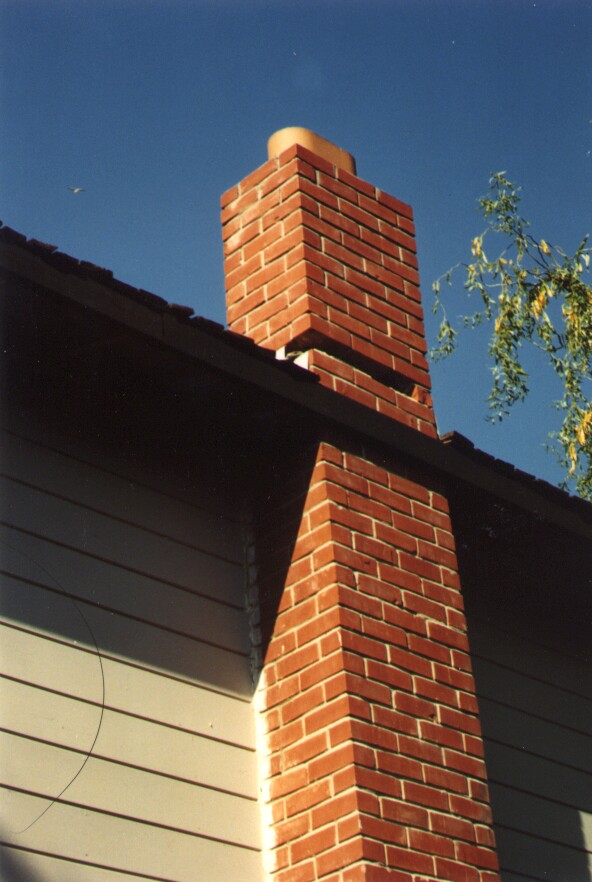
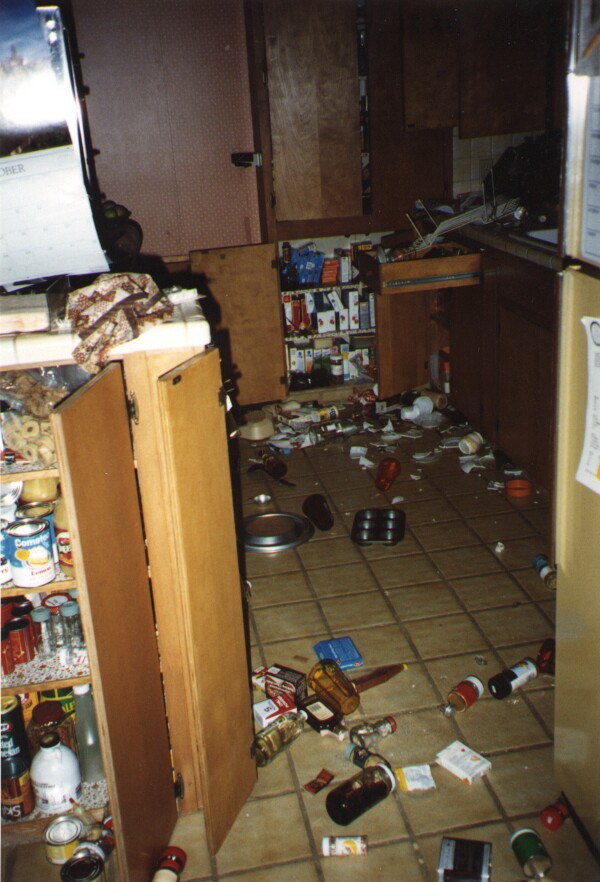
It was NOT the big one; registered a mere 6.9. For most of the millions of residents of the San Francisco Bay area, damage looked no worse than this (one of our chimneys) and mostly much less:

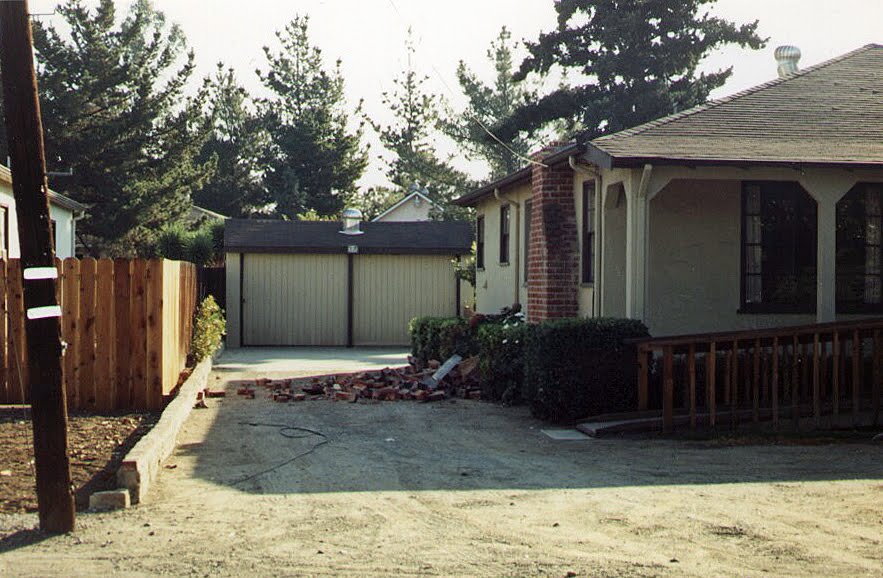
or this (a neighbor's chimney)

I already posted a brief, general account here two years ago.

And I posted some of my photos and other memorabilia on my photo site, with additional commentary about the quake.

I took no photos of the dogs and their behavior (well, I was a little preoccupied). But here's how it went with the dogs.

I was at work when the quake hit, about 15 miles from the epicenter and about 2 miles from home. After the main shaking stopped--and it continued for about 30 seconds, which feels like an eternity when the ground is shaking so hard that you can't really walk--we all evacuated rapidly into the parking lot, where we gathered around our cars listening to the car radios. (Remember--no cell phones, no world wide web. This was "the good old days"!) Aftershock followed by aftershock rolled across the earth, but none so bad as the original quake.

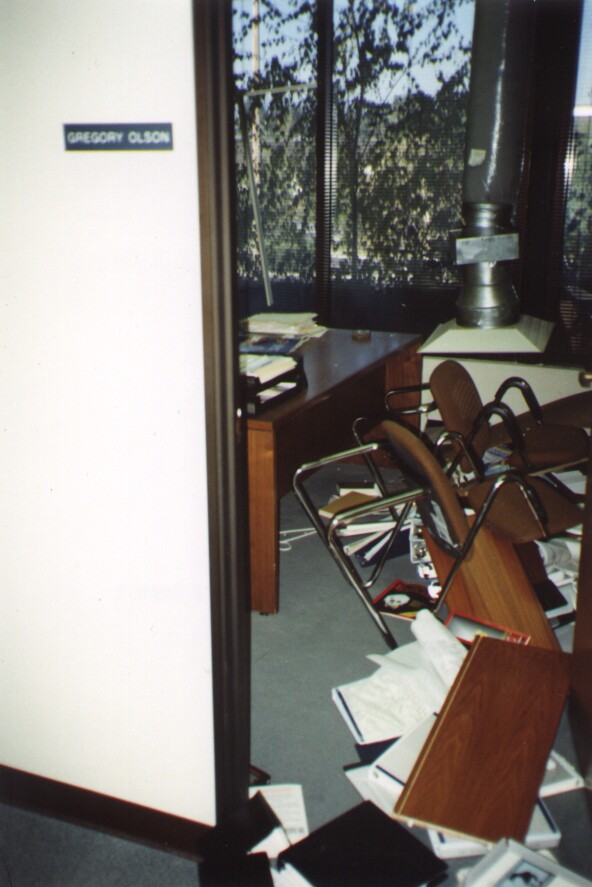
When the aftershocks had died off somewhat, upper management checked out the building quickly: It was a mess (yes, that's the air conditioning ducting hanging out of the ceiling and my co-worker's collapsed bookcase), but didn't look like it was on the verge of collapse. so they escorted us into the building in groups of 3 at a time--to dash in, grab our purses or car keys or wallets, and go back out the the parking lot.

So I couldn't get home for at least half an hour to an hour after the initial shake. I made a quick pass through the house, saw the disaster of broken glass and liquids in the kitchen and assorted disarray, damage, and breakage in other parts of the house, so hustled my dogs out of the house into the driveway. There we sat in the pleasant evening on lawn chairs, listening to the radio (battery-operated--no power!) and hoping that eventually my husband would call and tell us he was OK.

Sheba, our Siberian Husky, was panic-stricken. She was a known escape artist from way back, and the moving earth drove her into a frenzy of trying to get away. We were lucky once because my mother-in-law was staying with us at the time, was in the kitchen looking out at our driveway gate when the quake hit, and could see the gate swing open and Sheba try to make a break for it. We were lucky again as the days and aftershocks wore on that Sheba never did escape; one friend's dog took off and was never seen again, despite all of us plastering the neighborhoods with LOST DOG signs. The humane society reported a vastly increased number of stray dogs in the days after the quake.

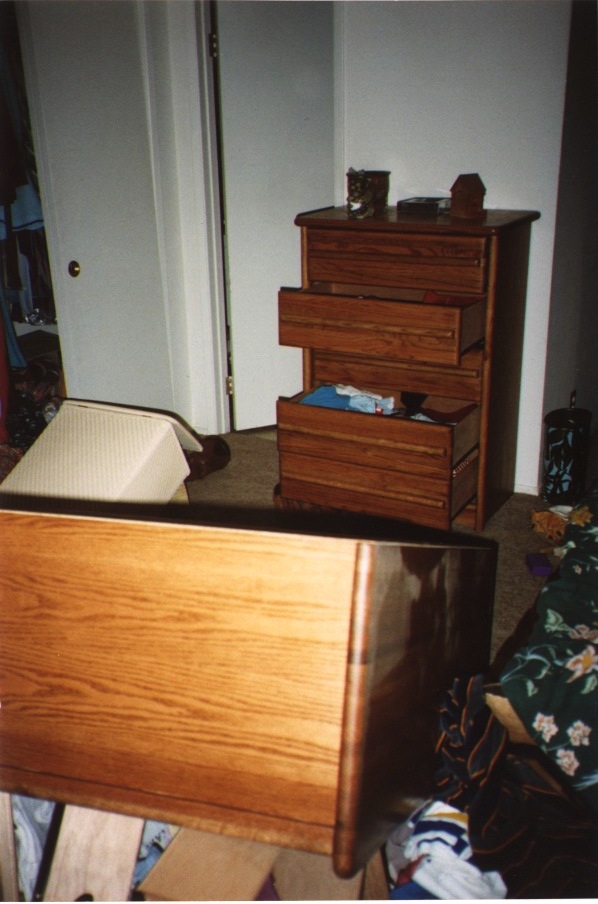
Sheba hated every minute of it. I think that she was in a literal state of shock herself; eyes wide, panting uncontrollably, not interested in eating, shaking and trembling every time an aftershock came, and continuing to do so for a long time after each one. On that first night, I didn't feel comfortable sleeping in our second-floor bedroom (especially with the bureaus and closet doors and such strewn around, and especially not with the aftershocks continuing). So we opened the sofabed in the one-story part of the house and slept there.

Or, should I say, TRIED to sleep. Sheba was not a cuddling dog. But all that first night, she lay on my chest, her haunted eyes staring almost blindly at me, panting and shaking and drooling. She was 9 at the time, and I was afraid that she was on the verge of a heart attack. Took me a very long time trying to get a dial tone on the phone to call the vet. Not because the phone lines were down, oh no! But because everyone's first reaction was to pick up the phone and start calling people! So all the lines were overloaded. The radio kept telling us to STOP CALLING if it's NOT AN EMERGENCY so that people who NEEDED to use the phone for important things (e.g., calling 911) could do so.

Eventually I gave up on contacting the vet that day (and possibly the following day). She didn't relax for several days, and I'm not sure how much sleep she got during the first couple of days.

Amber, our German Shepherd/Golden mix, as a counterpoint to the husky, remained unimpressed by anything having to do with the earthquake. On an aftershock, she'd lift her head wherever she was sleeping at the time, look around in mild annoyance at the disturbance, and go right back to sleep immediately afterwards. Thank goodness, because having TWO dogs shaking and drooling and panting on my chest all night would have been a little too cozy.

And neither of them EVER gave any indication that they had an inkling about an earthquake or aftershock about to occur. None of my dogs ever have. Dang worthless earthquake predictors.

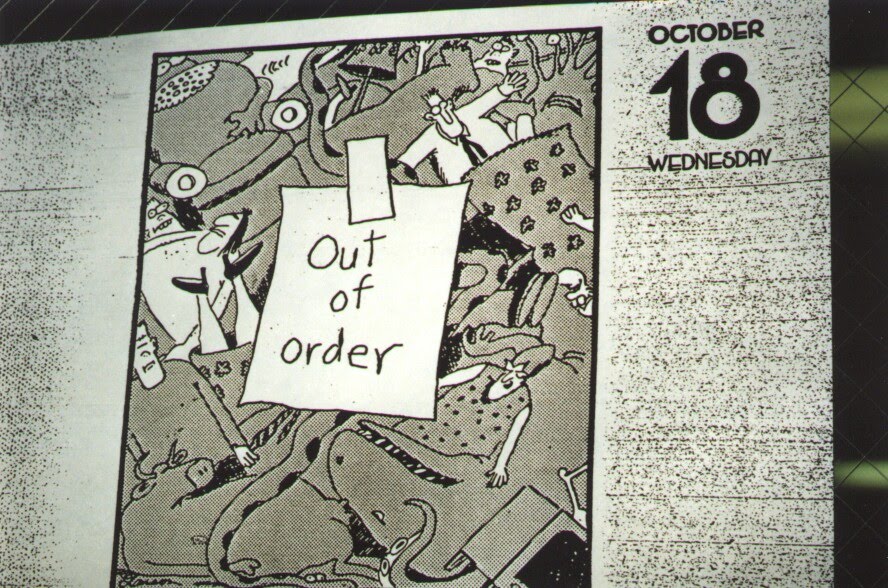
I was amused, however, when my office eventually reopened (after the earthquake safety inspectors had been through) and discovered this on my Far Side calendar for the day after the quake:

Wednesday, October 08, 2008

Escaping Dogs

SUMMARY: Our Siberian Husky had nuthin' on this beagle.


My Siberian Husky, Sheba, who lived to be 17, was one of the canine world's Houdini reincarnations. She went under, through, or over every fence that we concocted. We put her on a tie-out in the yard (a long line on a pulley so she had a lot of room to move), and she'd slip out of her collar no matter how tightly we fastened it, and you should've seen our jaws drop when, after the first time we buckled her firmly into a harness, we arrived home to find an empty, still-buckled harness attached to the line. In the house, she could pop the security bar out of the window, flip the latch, push open the window and the screen, and be gone in under 3 minutes. At about age 12, she learned how to lift the heavy iron L-bar latch on the big wrought-iron gates in our driveway and pull the gate open.

Here's a video of a beagle named Sofia who tops even those stories.

Saturday, April 26, 2008

One Dog, Two Dog, No Dog, Three Dog

SUMMARY: Title chase this weekend, plus: What's the right number of dogs?

If all works well, this post will post itself while I am off having the time of my life making perfect weave entrances at the SMART USDAA trial in Prunedale. And working the score table. And maybe participating in:
  • Boost getting a Jumpers and a Standard leg to finish her MAD.
  • Tika getting a Steeplechase Q to finish her Tournament Master Gold.
  • Boost getting a Steeplechase Q, too, which will put them both halfway to qualifying for Nationals in the Big S.
  • Tika getting a Grand Prix Q, too, which will put her halfway to qualifying for Nationals in the Big GP.
  • Tika getting a Snooker Q to complete her Snooker Silver.

No, I don't really have anything I want to accomplish this weekend; why do you ask?

So, in case none of my dogs achieve anything this weekend and I need to replace them with something more qualifiable, let's talk about What's The Right Number of Dogs?

An agility friend is seriously in the midst of probably most likely adopting a third dog, first time she's done that (two was a leap, I believe), so wanted my opinion, me being an absolute wealth of useless, ambiguous opinions, and I agreeably rambled on about it. Here's my updated response, with photos.

One dog, December 1978 through August 1981

Amber joined me as a puppy. We were happy together. I took her many places with me. It's easy to travel with one dog. It's easy to play with one dog. One dog fits well into small spaces. It's easy to do training with one dog. And when all the Mystic Mints disappear from the box or there is poop on the carpet you know whom to talk to about it. And Amber was generally a Good Dog who generally came when called and stuff like that. Plus she'd hold a biscuit on her nose.

Two dogs, August 1981-July 1992
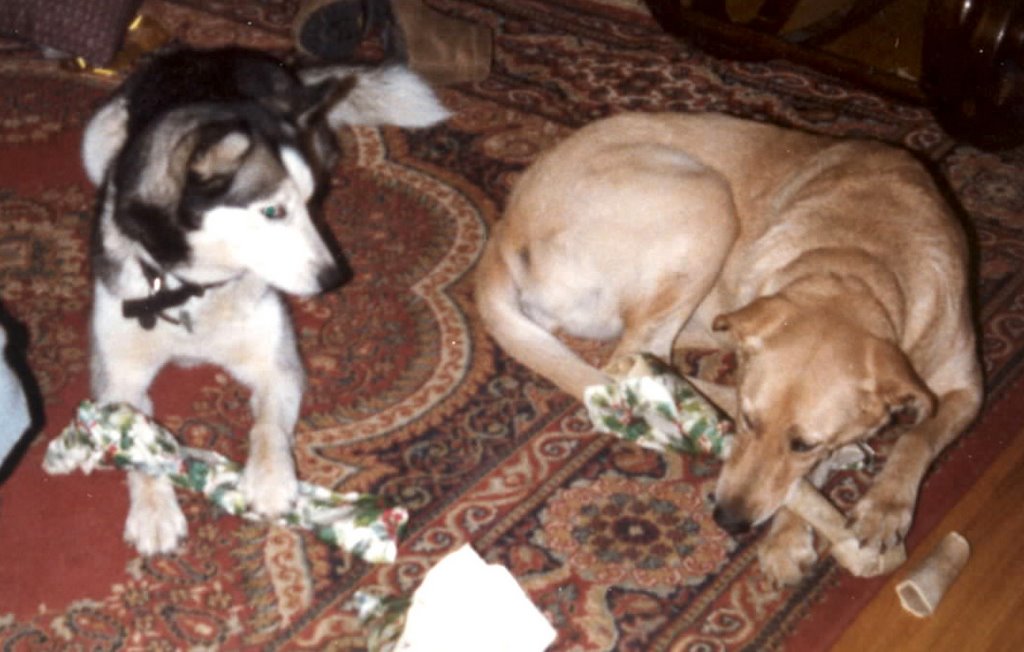

So I got married and figured that two people needed two dogs. Well, the new dog was very sweet but did NOT come when called and did NOT play and did NOT have any interest in doing training and could not hold a biscuit on her nose even if stapled it there (editor's note: Stapling is just a metaphor, no actual staples were used). At least Sheba and Amber got along--once in a while they'd chase each other around the yard, and they'd take turns eating from the same bowl even though we conveniently provided them with two independent bowls with actual food in both.

Sheba was not much fun to travel with and she always had to be on leash, always, or she would end up in Sheboygan. So we didn't go places with the dogs much. But at home one or the other was usually doing something entertaining, or being cute, so when one was slacking off and just hanging out, the other would gamely amuse us somehow. But if the carpet was torn to shreds, we couldn't ever be certain who was responsible, although we had a 99% probability guess on that one, SHEEEba!

One dog July 1992-May 1994

When Amber died, it just about broke my heart. This is one disadvantage of having dogs. They die. They break your heart. If you have one dog, they don't do it as often as if you have two or more dogs. The number of dogs dying seems to be proportional to the number of dogs in the family. I realized now that dogs die and furthermore, Amber died, and I would never be able to have another dog like her again and so why bother. Plus there was always dog hair everywhere and dust and dirt from the dogs everywhere and I was just tired of it, and Sheba was 11 anyway so if we just waited for her to die, which would undoubtedly be soon, then I could have a clean house again and no carpet ripped up and no spots on the lawn all the time and no worrying about dogsitters when we went places without the dogs, which was often.

Two dogs, May 1994-January 2002


When Sheba had rambled on to 13 and showed no signs of slowing down for or even being within a hundred miles of the exit from the highway of life (more metaphors, are you impressed?), it suddenly struck me that my own life would be very, very, very empty indeed if there were no dog in it, plus since Sheba did NOT play and did NOT hold a biscuit on her nose, she often bored me to tears, and wanted a dog who would be more doglike in those particular ways rather than just shedding everywhere and occasionally escaping and trying to thumb a ride to Sheboygan. And within a month, Remington came home.

Sheba was not happy about it. It was no longer easy to snuggle with both dogs, because one would be pissy about it. They did not share food bowls. Remington was generally a Good Dog but if we left him at home and took Sheba for a slow elderly walk, he shrieked, and if we left Sheba at home and took Rem for a brisk youngster walk, she'd be gone when we got back.

But, oddly enough, Sheba took one look at the young whippersnapper doing tricks for treats, and she wanted to, too! So the dog I had failed to teach even to sit when she was 3 learned, at 14, to sit and lie down on command, to shake, and to hold a biscuit on her nose! I loved it! And for the first time I really appreciated how dogs can affect each other in ways that are good for me. So maybe having more than one dog was a Good Thing.

Then I discovered dog agility. Rem went many places with me and learned many things. But Sheba was too old for that sort of stuff and her health was starting to fail. Meanwhile, "All my FRIENDS have two agility dogs, can I please please please, really, I'll take care of them!" The spouse wasn't smitten with the idea of three dogs (two dogs, two people, remember?), but meanwhile Jake became available and I really really wanted him to come home with me.

When Sheba died at 17, Jake was in our yard within a week. And we started doing agility.

So I discovered--duh--it's blatantly twice as expensive to have two dogs when you're competing in agility. It's not just twice the food and twice the basic vet bills and so on--it's twice the weekly lessons (money and time), twice the training in the yard (time), twice the entry fees (money), twice the work at a trial (pottying, warming up, cooling down, planning different handling strategies or courses because they run differently and have different strengths and weaknesses).

On the other hand, if one was injured, the other was still running. If one was having zero-qualifying weekends, the other was doing SOMETHING right so I wouldn't sink into a self-pitying pit of rancid despair (not quite worked into a blatant metaphor but close enough). So there were definitely advantages.

And, for two Basically Good Dogs, walking two dogs wasn't too hard, snuggling two dogs wasn't too hard, training two dogs wasn't too hard because one would wait when told.

But these two dogs despised each other. Fights were too common. It was extremely unpleasant. Plus they were boy dogs, so instead of making dead patches on my lawn, they peed all over the sides of things. And, once one did it, the other had to, too.

Three dogs, January 2002-March 2003

Both dogs were getting older. Jake had arthritis in his back. I figured that neither of them had more than a couple of good agility years left. I wanted to bring a third dog on board so that I wouldn't be left without an agility dog. After a divorce (really only very little to do with the dogs), and the purchase of a new Agility House, Tika came home with me.
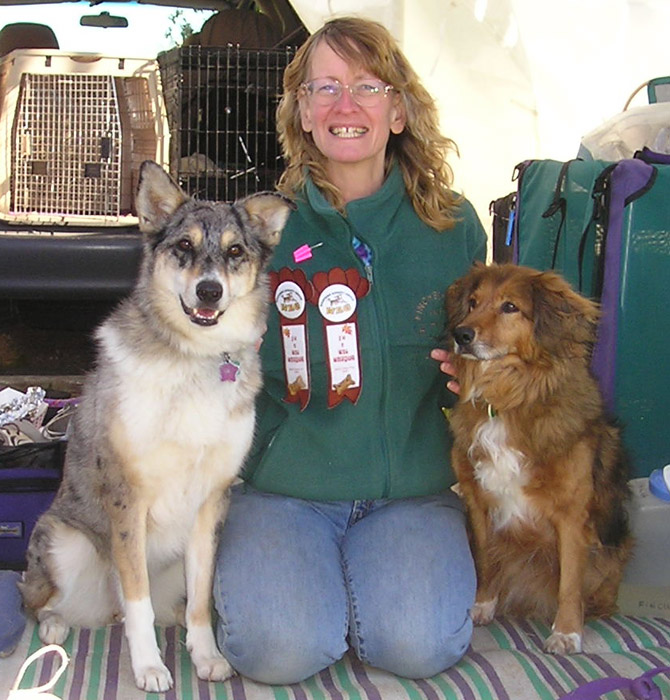
Jake was grumpy about it, but Tika knew how to keep out of his way. It was a lot of fun having a new dog to teach from scratch to avoid making all the training mistakes I had made with the first two. I really enjoyed getting started with her, although, boy, training classes for THREE dogs was quite a wallet-unloader.

I used to go for nice peaceful mile-long walks every day with Jake and Remington, but Tika was a tremendous handful. I did it anyway because the other two dogs were manageable, but it became a bit stressful trying to walk her, too.

Tika entered her first trial with one run the same weekend that Remington first showed obvious-enough signs that something was wrong with him, so I never did have complete entry fees for three full dogs at a single trial, but my two "elderly dogs" up to that point (Rem 9, Jake 11) were still competing just fine so it could have gotten quite pricey--and REALLY busy--at trials.

But now I could take one dog for a walk at a time and not feel guilty because there'd be two dogs at home together. This didn't stop them from complaining about it, but I always felt much better that they were together. This way, I could work on Tika's leash-training by herself, could walk an ill Remington by himself, could walk Good Dog Jake for just a nice relaxing peaceful walk by ourselves. There were advantages to three dogs.

Plus, the things that Jake and Remington both did well at (not running out the front door, for example), Tika seemed to notice and learn from. (She was not so good at it later after Rem died, so actually having TWO other experienced dogs in the house was a very good thing for a rambunctious youngster.)

But three dogs on the bed was a real mess, especially with the two boys being picky about their personal space. I tried to train Tika to sleep in a crate off the bed, but my training failed--on me. So I had to manipulate myself all the time to sleep around 3 dogs on a king sized bed who didn't want to be within 3 feet of each other.

Two dogs, March 2003-2004ish

So, after Remington died, I discovered again how much I liked having two dogs. One on either end of the bed. One on either side of me for snuggling. One per hand when out walking. Two at a competition was plenty.

Three dogs, 2004ish-2005ish

And then I got a renter housemate who had a dog, too.
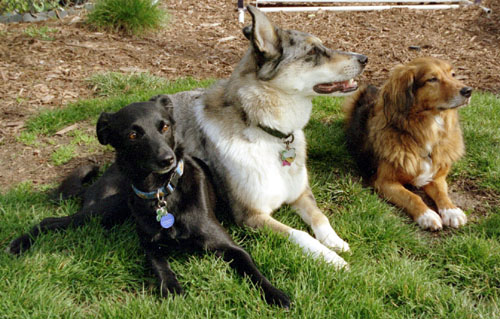
This actually worked out well, because I could play with and even dabble in agility with the third dog, but then turn him over to his mom for vet bills and feeding and walking and grooming and all that stuff.

Jake, whom I thought would have retired from agility years ago, kept going and going, but I knew that at his age (13ish), it couldn't last forever, and then I'd be down to only one agility dog again, and that's a terrible thing (what if one is injured? Then I'd have NO agility dogs!). I had thought that I might make little black Casey my 3rd, but then they moved out.

Two dogs briefly in 2005

When Casey left, Tika was already 4, and I figured it was time to bring in a 3rd dog again. It was a hard choice from a living perspective, though, because I REALLY liked having just 2 dogs everywhere except for competing at agility trials. But, still, Boost joined us shortly thereafter.

Three dogs April 2005-Feb 2007


Once again, I delighted in teaching my young new dog all kinds of wonderful new things. A puppy is a challenge, but also a joy in seeing her catch onto ideas.
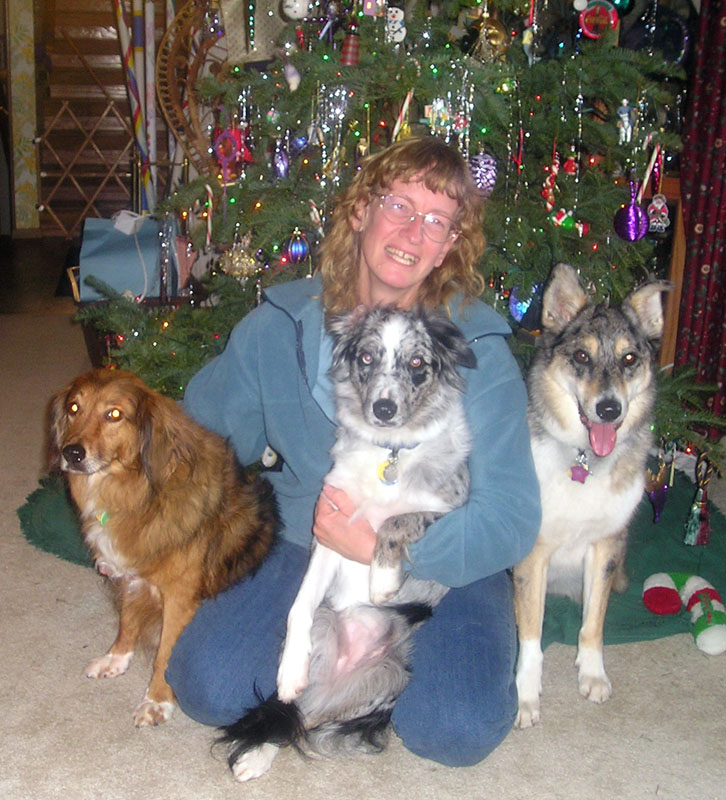
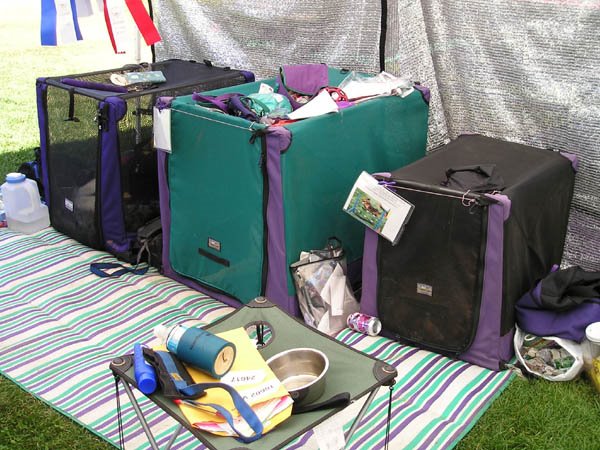
But three dogs are harder. Harder to line up for photos. Harder to snuggle with--you just cannot do 3 simultaneously. More gear to carry and more space taken up at agility trials. One dog you can tuck in almost anywhere. Even with two dogs, you can get by without your own canopy if you're clever. But with three dogs, you gotta have the whole shebang (not to be confused with Sheboygan).
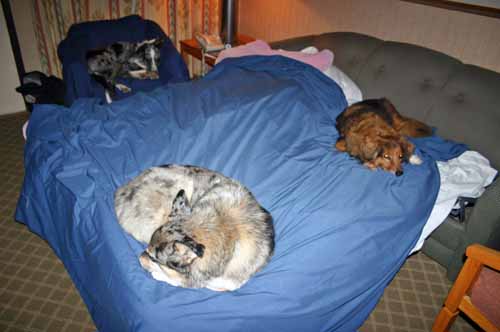
Harder to sleep with and manage in hotel rooms and vehicles. Two crates fit neatly across the back of the minivan, but not 3.

Two dogs Feb 2007-present


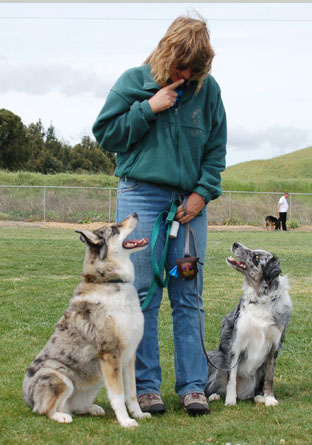
Abruptly, I found myself again with only two dogs. Sure, I missed Jake, but I don't miss having the three dogs. Except when I want to walk one dog at a time, or take one dog somewhere, I don't feel comfortable leaving the other dog home alone, so I am doomed to always have two dogs with me wherever I go. Don't like that part.

General discussion about how many dogs


First, I think that if you have found a dog that seems right to you and you have the time and energy for another dog, you should take him/her home. I've looked at so many dogs and thought "welllll allllmost but not quite," that I value it when I have a take-home response to a dog.

Second, I find two dogs much easier than three. I can walk 2 dogs at a time, pet 2 dogs at a time. Three dogs--depends on the dogs--gets to be a challenge, because now you're using one hand to manage two dogs. Some people just never do that--I've talked to folks who always just walk one dog at a time, whether "out for a walk" or just pottying at a trial. Tika is a tremendous chore to walk with. I managed it with Jake and Remington because they were pretty good on leash, but I find that her bad habits on leash tend to drift over to Boost and the thought of adding a 3rd dog to this mess deters me. So some of that really does depend on the dogs.

However, I also have the question lingering all the time about what happens when my current dogs get older, from an agility perspective. One answer would be to drop out of agility for a while. Sometimes I feel like I'm ready to do that. Sometimes I don't. Assuming that I'm still in an agility frame of mind, in 3 years, Boost will be 6 and Tika will be 10 and I'd want to start thinking about a puppy or young dog that year. I'm guessing that Tika won't be competing when she's 11 or 12. But I've been fooled before (witness Jake at 15). If I *don't* get a 3rd dog, and if these guys live good long healthy lives, let's say Tika dies at 15, boost will be 11 and might not be competing, either. That could be a long dry spell w/out competition.

On the other hand, having only one dog competing would be considerably less expensive. :-)

Somehow I've managed to keep 2 dogs competing most of the time. Tika had just attended her first couple of trials when Remington got sick and died, so I had 3 dogs entered in maybe 2 or 3 trials. Boost had just attended her first couple of trials when Jake suddenly went. At trials where I've had only one dog to run, it has been both relaxing and boring. And one or the other of them usually does *something* well, whereas back when I was one-dog with Remington and he didn't do well (which was often), it really bummed me.

Jake and Remington fought. I hated it. I don't miss that part, but that was the same whether I had just them or added Tika. But I wonder how I'd have felt if, say, I'd already had Rem and Tika and then added Jake. Dunno.

Adding Boost to the Tika/Jake combination was both good and bad. Jake was a grouch but there was something about the way Tika handled his snarfs that made them cautious partners. Tika's the only dog that Jake would play fetch around, and she'd run in and scoop up his toy or ricochet off him half the time and he usually let her get away with it (after a 2 or 3 month adjustment period, at least). And he'd imitate what she did and follow her around, and she'd pay attention to things he did to earn rewards. They were never friends, though. Tika loved Boost. They play with each other regularly. Jake hated Boost and she really felt the brunt of it, being a puppy. I tried to keep them apart but sometimes I just slipped up and he'd be all over her. And I don't know how much of it was because she was a puppy, because she was new, because she didn't know how to deal with him like Tika did, because he was jealous in his own weird way at her taking time from Tika, or because he could.

I am one of those sort of ambiguous dog people. I love having my dogs around. I am so tired of the dirt and the hair and the overhead. I would really miss not having a dog around. I might actually enjoy living without dogs (but it's been so long since I've really done so that I'm not sure about that). The thought of losing them both for some reason sometimes terrifies me. It happens to people, losing two dogs in a short period of time. Three dogs seems less likely that you'd ever suddenly find yourself dogless, sort of an insurance policy of unconditional love or something.

And I don't think that 3 dogs makes it any more complicated in feeding--I just use dry kibble--or keeping the house and yard cleaned. If I'm going to sweep the floor, it doesn't matter how many dogs have shed on it. If I'm wandering around the yard picking up poop twice a day, it doesn't matter how many individual poops there are.

But expenses definitely go up with a 3rd dog. Half again as much food. Half again as many medical bills. If for some reason you need to board them or otherwise cared for (I seldom do, but sometimes), the expenses are per dog. Same if you have them groomed (I seldom do because of the cost, but would if I could afford it). If you have all of them in classes of some kind, it's per dog.

Overall, I prefer being a 2-dog person. And the odds are good that someday I'll find myself with 3 dogs again. But here's the other thing: Several people have told me that 4 dogs are easier than 3, because you can do everything 2 dogs at a time without one dog feeling left out and making a fuss or being resentful. Huh. Dunno. But just in case you find TWO dogs you really like--well--you can give it a try and let me know.
Friday, January 11, 2008

Choosing a Dog

SUMMARY: There are so many ways to go about it, and so few of them have anything to do with anything but what feels right.

One fun thing about participating in the dog-agility blogging community is seeing recurring themes that transcend geographical location, breed of dog, general drift of a specific blog site, and so on.

Such as: Choosing your next dog. Here are some recent discussions on this topic in other dog-agility blogs:


Here's how I've chosen my dogs:
  • Amber: One night, coming home from the swing shift, I caught a prowler looking in my apartment window. It terrified me. The next morning, co-workers announced that their German Shepherd and their Golden Retriever were pregnant and they'd have puppies in a few weeks. Those were 2 of the breeds I thought I might want some day (Collie being the other). (Ah! Research!) I'd never heard of puppy testing. Puppies were just something that you picked one of and took home. So I did. Of the litter, four were black, but two were the same beautiful blonde as my family's mixed-breed dog, and I picked one for my own. I no longer remember how I chose one over the other; I did agonize for a while over whether to take BOTH.
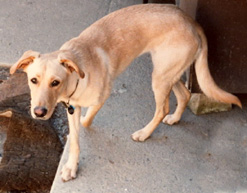
  • Sheba the Wonder-Husky: When I got married, I figured that my spouse needed a dog of his own. He thought Siberian Huskies were beautiful. I read a little about them in my dog books and agreed that they were beautiful. (Ah! Research!) So I haunted the humane society for several weeks, rejecting a variety of Siberians for a variety of reasons (should I have been suspicious that there were so many stray huskies?). Then I found one with a sign on her run saying something like "Lone Star is a sweet, wonderful, delightful dog. We have already held her two weeks past her euthanasia date because she really needs to go home with someone. Please help." (I have no idea where she'd been hiding during my previous trips.) She did indeed seem to be the sweetest, gentlest, calmest, most beautiful dog in the universe. My new spouse agreed, we took her home, and renamed her Sheba.
  • Remington the Squirrelhund: Two years after Amber died, I had decided that I finally was ready for another dog. But now, 15 years after her birth, I knew a lot more about dogs. I did a lot of reading. We went to dog shows and talked to the breeders and owners of several breeds that we were interested in. I narrowed it down to probably Australian Shepherd or Border Collie (mind you, this was before I had ever heard of dog agility). Then, one day, we went to a pet store to buy food on sale, and NARF was having an adoption fair for their rescues, and I found Remington, and he looked just like Amber, and he went home with us right then. (Ah! Research!)
  • Jake the SemiDachshund: He had belonged to a fellow club member who was also my obedience instructor, and Remington and Jake had been on a team together at a USDAA trial. For some reason I really liked him. (Ah! Research!) When he became available for adoption (this story is quite shortened for this post), our husky was barely on her dying legs and my spouse didn't want three dogs and felt it wasn't fair to an old, ailing dog to have a new dog in the house. I kept stalling Jake's current foster home and, finally, the inevitable happened and our 17-year-old husky died. Jake came home with me the following week.
  • Tika: Remington was getting old. Jake was getting older. It was time to start looking for another dog to start training as my next agility dog. Rem was never big on tug of war or fetch, and I knew that I wanted a dog who liked those things. I wanted one with drive and intelligence for agility. I wanted one who would snuggle. I had recently divorced and was living in a rental. An agility acquaintance was fostering a beautiful Kelpie mix that I would have taken home with me, but the landlord was an idiot and I didn't want to risk anything by bringing in a third dog. But, with this discussion, the acquaintance became a friend and she kept me in mind as she got other foster dogs. She showed me two or three other dogs over the next few months, which I rejected. Shortly after I moved into my own home, she introduced me to Tika, who loved to tug, would stop immediately to snuggle, was a gorgeous blue merle (which I've wanted since I was a kid), an Australian Shepherd-type dog (see research before Remington came home), and yet different enough from standard Aussies to appeal to me (I liked the shorter-haired, longer-legged ones). I think it was the blue merle as much as anything that kept drawing me to her, because she barked barked barked barked BARKED, at anything and everything. Well--the friend made progress on that, and a couple of months after I first saw her, I finally decided to bring her home on a trial basis. She never left.
  • Boost: OK, REALLY long story. Read it here.

Thursday, December 27, 2007

Retrospective Photos

SUMMARY: From my collection, one of each dog.

For the Power Paws new years party, Instructor N is gathering photos and video clips from students for a show. These agility photos aren't necessarily the best ones of my dogs, but they are distinctive in one way or another. For this blog, for completeness, I added photos of my first two (preagility) dogs. I have very few photos of them, turns out, and most of them are lying down. Wish I had tons more, but nooo--these are the best photos of the whole dogs.
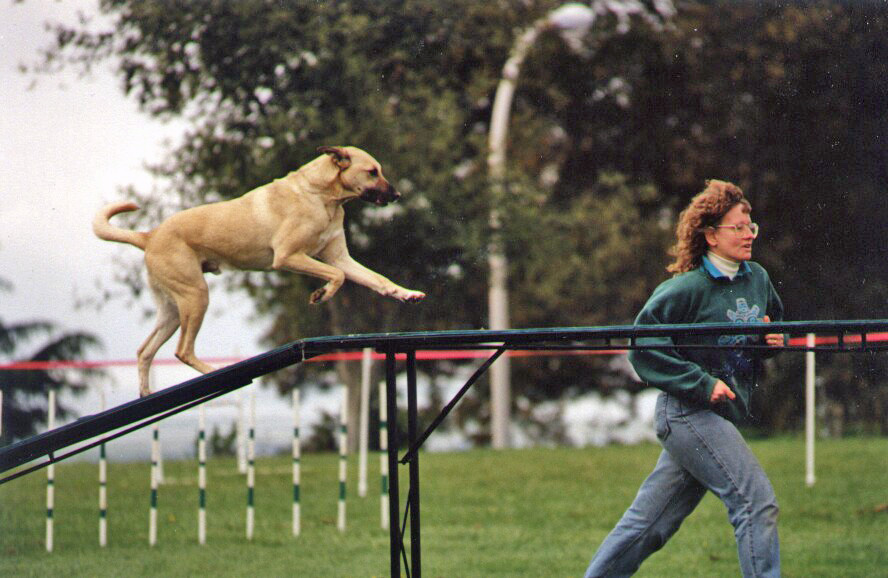
Amber, my first dog, German Shepherd/Golden Retriever. Here she's about a year old. Got her at 6 weeks; she lived to 13.
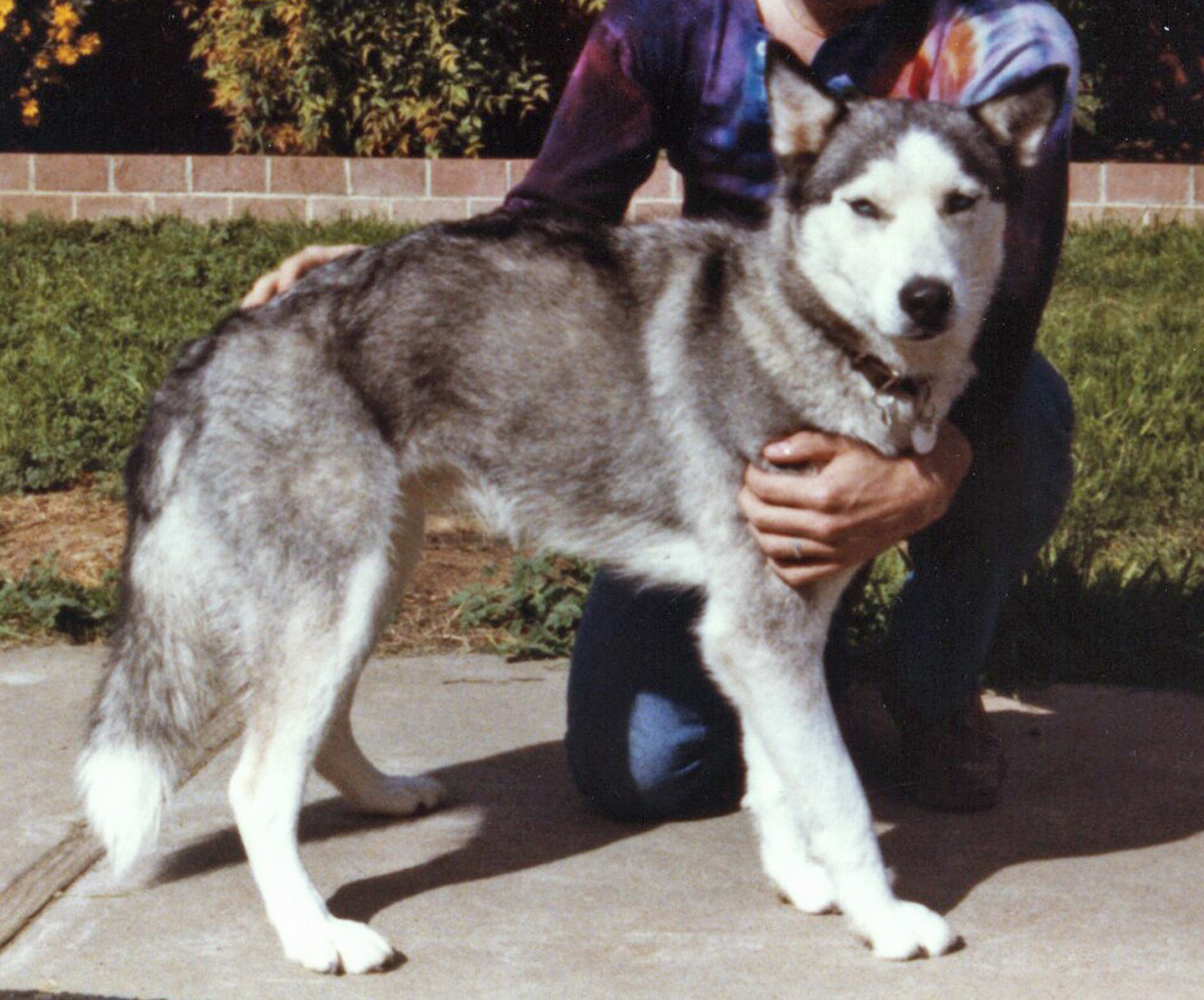
Sheba, our Siberian Husky. Came to us at about 6-12 months just after we got married and barely predeceased our marriage (her: 17 years; us: 19).
Remington. He was about 10 months when we adopted him, and 3 when he started agility. I chose this one for the presentation because it shows the whole dog and has me in it, and I realize that it's been almost 5 years since I lost him, so there may be many people who know me but don't remember him. Almost inconceivable that it's been that long--he was just lying on that bed in the corner only yesterday, wasn't it?
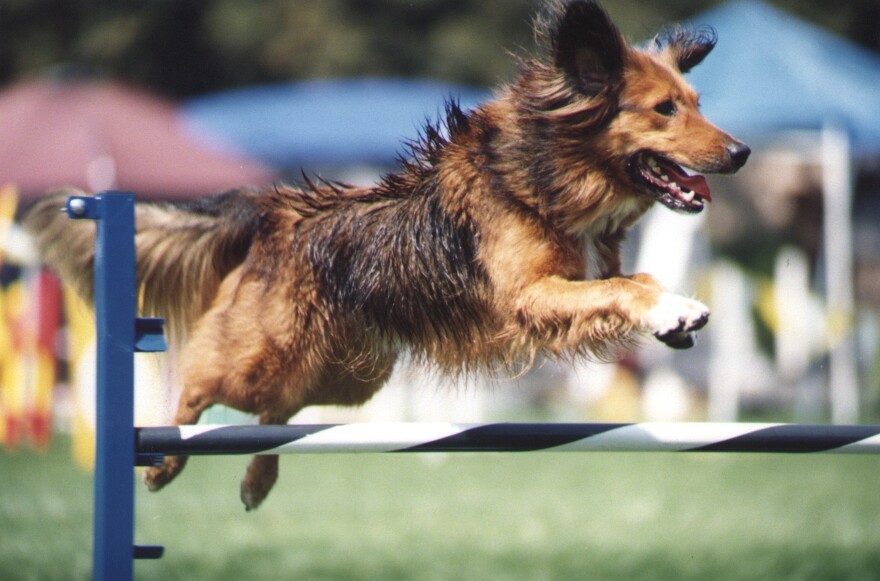
This remains one of my favorite photos of Jake, who joined us when he was 6.
Tika, adopted at about a year old. Picked this photo for the presentation because it's the funniest weave photo I've ever seen.
Boost is only the second dog I've had as a real puppy--about 3 months when she came home. I don't have a lot of photos of her doing agility yet, but this surely shows off her teeter speed--although lately she's often been sliding into a slam-down, which is a joy to behold.


(Oh, by the way, here's a photo of Boost's mom, Tala. Nah, there's no family resemblance--)

Thursday, November 29, 2007

What to Feed a Performance Dog?

SUMMARY: I know next to nothing about nutrition, but it's always a hot topic when it comes up.

Backfill: Added one more section of links, Nov 30 noonish

I feed my dogs Nutro Natural Choice Chicken and Rice. I got here down a long path.

Grocery-store kibble

My first two dogs thrived on whatever name-brand kibble we could buy on sale at the grocery store. Amber, a Shepherd/Golden mix, lived to 13 1/2 with very few health problems, mostly apalling flea-related skin problems (this was before Advantage and that ilk). Sheba, a siberian husky, lived to 17 and I don't think had a sick day in her life, even when blood tests in her dotage said that she should've been at death's door.

Move to Science Diet for digestive reasons

Remington, my third dog, threw up or had diarrhea constantly. It wasn't just the kibble-- Pigs ears made him sick, where my first two dogs had ingested them with no problems. So did rawhide, sometimes. A very occasional can of dogfood gave him diarrhea. And so on. My vet suggested two or three varieties of kibble, and we tried them all, and then settled happily on Science Diet when it seemed to cure his intestinal ailments.

Move to Nutro for weight and performance reasons

When we added Jake to the family, we discovered that his love of fruit combined with our highly productive fig, plum, and apple trees meant that he was battling weight gain constantly. Not good for an agility dog, and I didn't want to cut out his kibble entirely--an all-fruit diet, I suspected, wasn't the healthiest nutrionally for any dog, let alone an active agility beastie. My agility instructor suggested Nutro Max as being a high-performance food that also helped keep the weight off. We switched both dogs, and Remington tolerated that as well, and it seemed to help. Eventually I switched to Natural Choice when weight-maintenance became less of an issue.

More high-powered kibble

These days, the same instructors have been feeding their dogs a couple of different products. One, Caribou Creek, is developed and used by sled-dog racers--they refer to it fondly as "rocket fuel." It's expensive and they buy it by the pallet-load for discounts and allow students to also buy it at cost. Lately, they say, "We are feeding Solid Gold's "Barking At The Moon" kibble. It is a high protein/fat, low carb food with salmon as the main ingredient. The dogs love it."

The Raw (BARF) diet

Meanwhile, it appears that large portions of the agility community have gone to the BARF diet (stands for various things), basically raw food, that is, largely uncooked meat and bones. I have several problems with this:
  • Time. I'm stressed in my life without taking the time to shop for, preserve, and prepare this food. It's so much easier to buy a bag on my way past the neighborhood pet store, and to scoop a bowl of kibble.
  • Expense: Nutro isn't cheap, but for a limited budget, it's much less expensive than a BARF diet.
  • Quality. I don't trust the safety of raw meats in my grocery stores for *me*; why would I feed it to my dogs? Other people do. That's fine for them. Otherwise, you buy it from people who prepare the food for you from trusted sources. That's THEIR trusted sources.
  • Storage: I have one large bin for 50 lbs of kibble. That lasts me a month. I don't know that I could fit even a week's worth of raw diet into my fridge or freezer--they're already full.
  • Safety: Bones. I've had it drilled into me for so long that splintery and raw bones are dangerous for dogs that I can't buy into it. I think that most of the prepared foods are ground up, but I dunno. An agility acquaintance's dog died last year from a perforated something caused by eating a raw bone. OK, sure, sometimes dogs choke to death on kibble, too. Somehow that seems like less of a risk to me.
  • Nutrition: Huh, OK, this is where my lack of expertise and knowledge comes in. I just don't know and have no good way of finding out. Read this excellent post by a veterinarian on the lack of data about this. I believe that, based on my dogs' general health, that any name brand dog food is probably nutritionally complete.
  • Taste: I don't think my dogs care. You should see Tika leap into the air and salivate just before she gets her kibble. Not willing to put time, money, storage, etc. etc. into something that doesn't matter to them.


Links to more info


  • Rawfed.com, pro-raw, has a "Myths" page and other info.
  • BARFworld.com, a seller of packaged raw food, has a lot of info on their site promoting the raw diet and theirs in particular, just for comparison.
  • Dogaware.com has tons of info related to dog food, recalls, nutrition, and so on. The site owner is a proponent of raw diet but it looks to me as if she has taken care to be sure that most of the info provided is generally useful and unbiased.
  • Second Chance Ranch is anti-raw-food and has a second page with links to tons of vets and others who are also anti.
  • Azmira.com, a holistic animal care site, also anti-raw.
(Thanks to Elayne for the anti- links for balance here, although she's pro-raw.)

Friday, December 29, 2006

Christmas Rawhides

SUMMARY: Different dogs, different rawhide personalities. (This was one of several scenarios that I had envisioned as part of my Christmas letter. But I pared a lot out of it, so you-all get it on my blog, instead.)


Sheba and Amber: Christmas 1983, just a couple of normal dog pet pals enjoying a treat. Maybe Sheba wants to enjoy two treats.
Jake Step 1: Carry his gift around looking concerned and mildly reproving.
Tika Step 1: Tear off enough paper to get to work. No nonsense here.
Jake Step 2: Carry his gift around looking concerned and mildly reproving.
Boost Step 1: Carry it to bed and check it out cautiously.
Jake step 3: Carry it to bed and monitor for intruders.
Boost step 2: Bury the rawhide in a secret place.
Jake step 4: Carefully remove just enough paper to tempt the other dogs to just dare to try to come take it.
Boost's cleverly buried rawhide bone. No one will find it now.
Jake step 5: Carry his gift around looking concerned and mildly reproving.


In the Olden Days, when we had Sheba and Amber (who were just normal sort of pet dogs, although special in their own ways), we gave them giant rawhides for Christmas every year. They'd pull the wrapping paper off and lie there chewing on them for a while and eventually get tired of them and then chew on them off and on for maybe weeks.

Remington was completely spooked by giant rawhide. (He was a sensitive soul.) He just wouldn't go within a foot or two of one, although he'd chew small rawhides with pleasure. After two or three attempts in different years, we just gave up.

It occurred to me that I hadn't tried giant rawhide bones with any of my current dogs for Christmas, I don't think. So I bought three large rawhides, wrapped them loosely with just one piece of tape holding the paper, and handed them out.

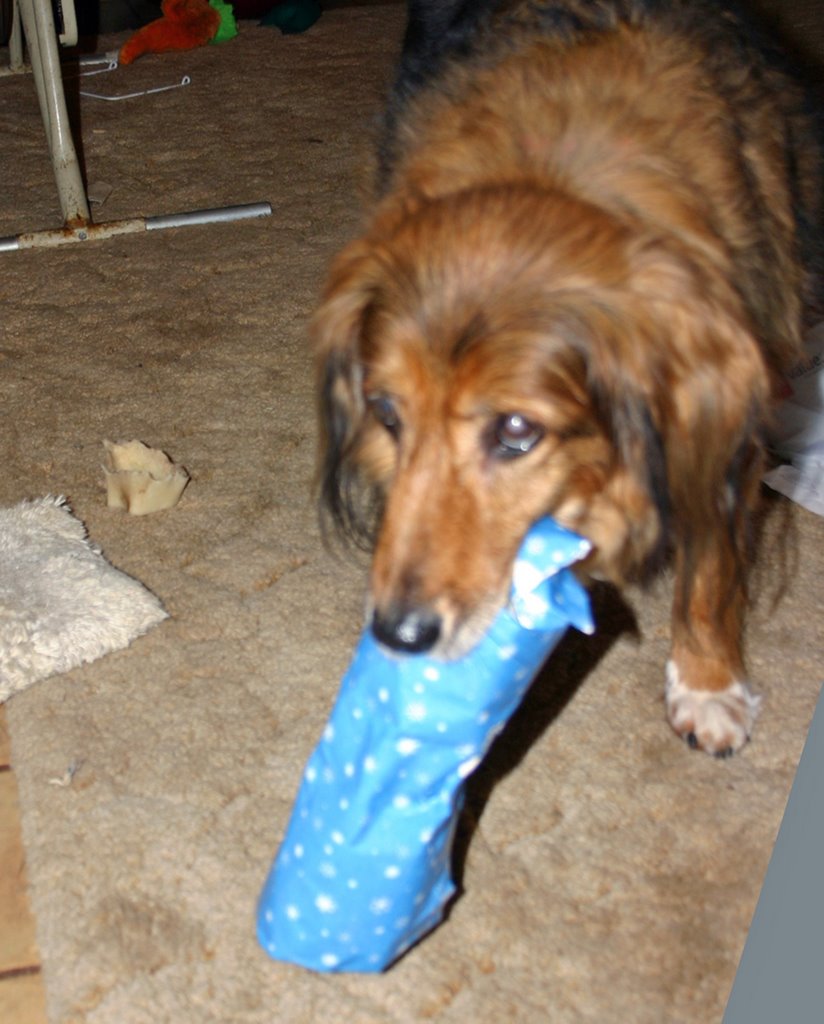
Tika immediately trotted to the den, gently tore off enough paper, one small bit at a time, to get at one of the big knobby ends, and proceeded to gnaw. Normal. Except for the wrapping paper remaining on half the bone, for hours.
Jake, typically, carried his slowly around or just stood in one place, looking concerned and occasionally shooting me admonitory glances for saddling him with such a huge responsibility. Eventually he retired to his bed and let it rest beside him for a while, while he monitored the environment for encroaching canids. When none approached him, he appeared disappointed at not having a chance to warn them off, so after a while he tore the wrapping off half the bone and went back to carrying it around past the other dogs, looking concerned.

Boost took it gingerly, watched the other dogs for a couple of minutes, then took it to her bed, where she examined it closely for a while. Then she determined that the best course of action was to bury it where no one else could find it while she decided the ideal plan of attack. A couple of hours later, Jake found the cleverly hidden package and walked around with THAT one for a while, looking concerned. Eventually, it disappeared again, and I assumed that Boost had buried it again. Apparently she had, but in some odd corner of the living room, because the next day Jake found it again (still wrapped) and carried it around for a while before Boost finally took over once more and removed the wrapping paper to give it some chewing.