a Taj MuttHall Dog Diary: walking courses
Showing posts with label walking courses. Show all posts

Thursday, February 03, 2011

Walking a Dog Agility Course the Taj MuttHall Way

SUMMARY: You've heard this all before, I'm sure.
Yesterday I talked about how often I walk a course and how I know when I'm done. Today: What I do while I'm walking.

What do I do during walkthroughs?

After all these years of walking courses, reading about walking courses, listening about how to walk courses, and taking workshops on how to walk a course, I've concluded that there is not just one right way, and any given method isn't necessarily appropriate for every course.

For example, it's common to be told to walk the course the first time without thinking about your handling, just to get the idea of the flow, the gotchas, what the dog is seeing on the course, and where you might have to make decisions. (Some folks walk as close to the dog's line as possible--walking between the jump uprights and so on.)

Great advice. (Really.) I do that maybe once out of every, oh, um, well, pretty much never. Two reasons:
  • I see all that stuff right away (whether from years of experience or being good at spacial relationships in general). I don't much think about it. I may make handling mistakes, but I almost never come off a course saying, "huh, it never occurred to me that xxx would be a problem."
  • I find that, no matter how I first walk through the course, that tends to be the way I'll want to run it. So, on my first walk-through, I try to pick how I'm going to handle it and just walk it that way. (That doesn't mean that I know for sure--if I see handling options that I might like, I'll try them each *during the first walk-through* so that I can pick a good working theory and continue walking the course with that in mind.)

What I'm scanning for as I walk:
  • What are the laws of physics going to make my dog do as she's running? In other words, is it really a straight line from A to B to C, or will she have to change direction, no matter how subtly?  (More on that later.)
  • Is there any obstacle within a 180-degree range of the direction she's going that she could possibly confuse with what I really want? (Probably up to 30 feet.)
  • What are known challenges for my dog? Tika and Boost don't always have the same issues. (And what are known challenges for ME--like, I'm not always super-fast or nimble and my timing's not always great.)
  • Are there multiple ways that I could handle each obstacle or each section of the course, and which of those choices works best for me and my dog(s)?
  • What are other handlers doing on that section of the course? (Amazing how many good ideas one can pick up from watching what others are doing. But you have to watch the right people. If you have a large, fast dog, watching what the people with slower, smaller dogs are doing won't do you much good.)
  • What markers can I use to ensure that I'm where I need to be at any given time? (E.g., when doing this front cross, I need to be beyond the wing of the red jump before my dog exits the tunnel--or--I need to run all the way to that bare piece of ground before starting my rear cross motion--)

Yes, I do all that on the first walkthrough. It's quick for me. On subsequent walk-throughs, I'll revisit and concentrate on the last three, because I've picked up on the first three the first time around.

For those additional walk-throughs, I'll add things like:
  • Can I actually get there? I don't usually run a full course full speed during walk-throughs--only those occasional parts that I need to test or get a better feel for.
  • Are there weird things that I need to be aware of or that I can fix? (Deep hole hidden in the grass right where my path takes me. Unused obstacles lined up right outside the ring ropes so they might look like course obstacles to the dog--those are not challenges built into the course by the judge and I just fix them if I can, or ask someone to help.)
  • On a really difficult bit that I can't puzzle out, I might just ask another handler what they're doing and why (or why they're doing what they seem to be doing). Sometimes the explanation helps me to decide something completely different.
  • Walk challenging or nonobvious sequences several times to embed them better.

So--are all my runs perfect, then?

I'm far from perfect. I make mistakes. I forget where I'm supposed to go. I miss my cross. I don't get to where I want to be. I expose my dogs' training deficiencies. But when all's said and done, when I mess up, it's virtually never because I haven't walked the course enough.

Laws of physics and straight lines

It intrigues me how often people mistake the angle of an obstacle for the angle of the dog's approach. Or can't determine where the dog's straight line really is. Here are a couple of examples:
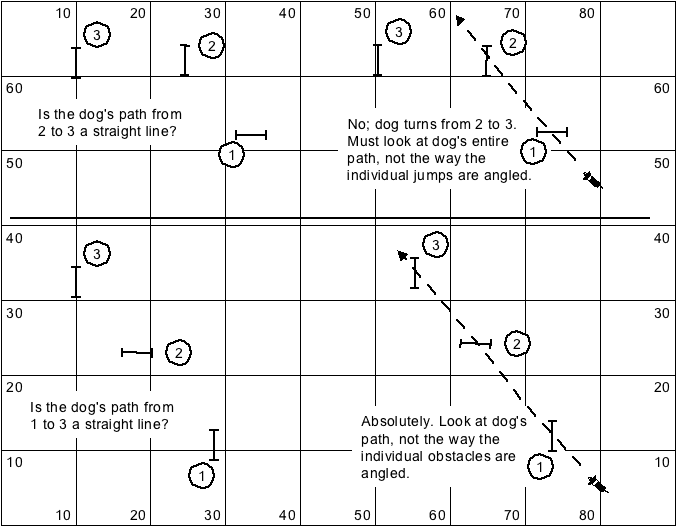
I also know, in the first example, that any obstacles along that straight line from #2 to oblivion are possible off-courses because they'll be easier for my dog to take than doing the #3. I think some people miss those because they're thinking that the dog is going straight from 2 to 3.

Wednesday, February 02, 2011

Walking Dog Agility Courses Obsessively

SUMMARY: How often do I walk a course?
A couple of months back, someone commented online about making sure that you really take your time walking a course and making sure that you know exactly what you're going to do so that you don't have to actually think when you get out there with your dog.

How many walk-throughs?

So: How many walk-throughs does that take?

The answer: As many as it takes you.

Is that a cop-out? Not at all.

I might see a top handler walk a course six or seven times--or 10 or 12--or more. (By "top handler," I'm talking about those who so predictably end up at the top of their class in competitions.) And another top handler might cruise briskly through a couple of times and be done with it. It doesn't seem to make a lot of difference--they both remain top handlers.

I've encountered some Masters courses where I barely needed two quick walk-throughs--one to get the pattern, and another skimpy one to make sure I didn't miss anything. Others I've walked parts of repeatedly and still not felt completely comfortable about.

Everyone jokes about "obsessing" about courses. You *know* that, if the course is left open for half an hour for walk-throughs, there will be people out there walking it over and over and over. And even so, during the actual run, some people's brains (ahem. Well. Yes.) will still go south or timing will be complete crap at some critical juncture.

And you know that, if the walk-through is limited to 8 minutes, the top handlers will still be the top handlers.

When am I done?

Here's when I decide I've walked enough--choose any one of the following:
  • It's easy.
  • It's memorized.
  • It's frying my brain.
  • I'm the last one out there.

It's easy

Even at the masters level, some courses are straight-forward enough that I'm not likely to get lost and there are no unusual challenges *for me*, so I can handle it on semi-autopilot. I mean, do I really need to walk through a big loop around the outside of the field, with no traps as off-course potential, more than once?

Obviously that's an oversimplification, even for Novice courses these days, but I know you've seen 'em where the flow is so smooth that you'd have to work extra hard to go off-course. (And, thank you, I'd rather not start thinking about that possibility because, sure as shootin', I'll end up trying to run it that way.)

Plus--if I think it's easy but see that other people are walking and walking and walking, I might start fretting about it--"what have I missed?" (see "It's frying my brain). Often, that just means that it's an easy course *for me and my dogs* but it might not be that easy or obvious for someone else and their dog.

It's memorized

This is when I can close my eyes and run the course in my head. Welllll--I do move my feet and arms, but usually taking only a few square feet of space. Do I know where exactly I want to make my turns and crosses? Can I picture clearly the body language I'm using all the way through and what voice commands I'm using when? Do I know the rough spots where I have to more carefully watch my dog's reaction and have my Plan B clear in my mind?

And, BTW, I don't usually bother with this if I already stopped at "It's easy."

It's frying my brain

There comes a point at which I am beginning to stress about whether I can do a good job on the course. I can--and do--completely hose a course because I'm overly stressed about whether I can do it. Much better for me to walk away and go browse the vendors for a while.

Maybe it's a handling situation that I know will challenge me and my dog, and I've walked it 10 times already and now I'm just fretting about it.

Maybe it's a handling option where I like (or don't like) two different choices and can't make up my mind. Walking it repeatedly both ways will not help me to decide and it would just make me lose my concentration on the rest of the course. Because I've walked the options multiple times, I'm more comfortable taking my decision to the sidelines and applying the "let's see how those choices work for other people" filter.

Besides--I have two dogs to run, typically 5 or 6 runs a day per dog, typically two days in the weekend; that's 20-24 runs. I don't need to wear myself down physically and/or mentally just on this one course.

When I'm running and forget what obstacle is next, I can guarantee that that's not because I didn't walk it enough. It's because--doh--sometimes I have brain freeze. That's it. And I'm more likely to have brain freeze if I've evaluated multiple options in multiple locations and spent time on all of them. One can really overanalyze.

But that's something that I know about myself. For example--when I really really really want a Super-Q, I can't walk it a lot or analyze it a lot or figure out what everyone else is doing and try to figure out a better way. I have to pick something and walk away until it's my turn to run, or it goes all to pot.

I'm the last one out there

Unless there's some really good reason why I'm the only obsessing one left (e.g., I started much later than everyone else), it's just time to stop. If everyone else is done and I'm still wandering, then, really, what could I possible glean from continuing to walk that everyone else hasn't already gleaned? Maybe a new handler on a novice course... but at the Masters level, really!

And in conclusion

But that's how *I* decide and that's what *I* do. Tomorrow I'll talk about how I walk a course. Which is also how *I* do it and not necessarily how anyone else does it.