a Taj MuttHall Dog Diary: seminars
Showing posts with label seminars. Show all posts

Sunday, August 10, 2014

Chip the Almost Trick Dog

SUMMARY: Seminar.

Before my back went south, I signed up for a tricks-for-agility seminar with Chip. I've been considering my pain levels ever since, trying to decide whether to cancel and try to find a replacement for my spot.

But I've had several goodish days lately, so we went. A friend drove and picked up me and Chip after noon and helped carry stuff. That was lovely, about the only way that we'd have made it.

Chip lasted about 2 hours into the 4-hour session before he more or less shut down.That's actually good for him--when I first got him, learning new stuff was very stressful for him and he might last 2 or 3 minutes before stress signs started appearing and he'd quickly shut down.

Today that became obvious when he stopped accepting treats for anything except a couple of very familiar behaviors (nose touch to my hand, "shake" which is almost ready for primetime finally).  Also didn't want to try anything or do anything.

And my back had had enough at about the same time despite me trying to manage everything to avoid aggravating the nerves.  I spent several sessions, while others were practicing, lying on the lawn with Chip and stroking or massaging him. Lots of people thought it was cute and took photos (hope I get some). They didn't necessarily all know that we were both pretty much done for the day!  

Still, a couple of behaviors that were not too different from his normal life he was eventually willing to try, and he had some fun playing with very simple behaviors with a friend who kept providing different kinds of treats after my kinds fell from favor. So he did end up relaxing and enjoying himself again.

But the seminar was fun and I got a few new tips and it was excellent experience for him.  Maybe tomorrow I'll list the things that we worked on.

Tonight--pretty sore among my various aggravated nerves, and very tired.  Off to bed with me.

Sunday, December 02, 2012

Nosework

SUMMARY: Report from last weekend.
Saturday and Sunday after Thanksgiving, the Merle Girls and I attended our first-ever nosework training. I'd spent some time reading about it, so I had a vague idea of what's going on. Quite a few people I know are starting to compete in it or even teach it. Sounded like a fun thing to do.

The basic idea is that someone hides a specific scent somewhere in the search area and the dog finds it.

Rather than using scents like drugs or explosives (as a police or army dog would be trained for), the nosework competitions use specific scents that are not too likely to be encountered randomly. Dogs start with birch.

Our instructor was Andrew Ramsey. I had met him once before at another dog shindig and a friend waxed raphsodic about his skills at training dogs. He's a nice guy with a very good idea about what he's doing and how we can do it, too. Main thing to know is that he came by dog training primarily through his work with military dogs. As a civilian, he pursued jobs at the military's huge training facility and over the years trained thousands of puppies, dogs, and people in protection and detection work--the detection work being the key thing here. You can read a bit more on his web site.

Andrew gives us background info. We were a deliberately small group so that all 10 dogs could get enough working time.


He happened upon "pet" nosework by chance and fell in love with the idea.

OK, next thing you need to know is that there is, so far, only one official nosework organization, the National Association of Canine Scent Work, and they've trademarked the phrase "K9 Nose Work". It's sort of like the early days of dog agility when there was only the USDAA in the U.S. and they service marked "agility dog".

The NACSW defines the rules under which nosework competitions take place, same way that USDAA, CPE, NADAC, AKC, etc. define their own rules under which agility competition takes place. They also certify nosework trainers, and they seem to be pressing hard to have students sign up only with their certified trainers. This makes sense for them because they charge quite a bit for the certification program.

I don't think there was ever anything like *that* in agility-- "certified agility trainer". (Sometimes I think it might have been a good idea, but at other times I think that not having rigid controls on what and how to teach has enabled the sport to advance more quickly and creatively.)

OK, NEXT thing to know is that Andrew is not certified by them. He said that he considered it until he thought about the fact that he'd be trained by people who had only an iota of the experience that he already had in detection work, and decided to pass.

Meanwhile, the UKC wanted to start its own nosework program and they contacted Andrew--so they're developing their own set of competition rules. And the AKC contacted him as well, although I think that they then went off on their own to come up with their own rules since he had already worked with UKC. So--he's held in pretty high esteem by Those Who Know.

LAST thing to know is that his dogs run into the search area, lope around the perimeter, quickly identify the vicinity of the scent, zero in on it in amazingly short time, and freeze with their nose on the location of the scent (e.g., the lip of a drawer in which it's hidden). This is what we'd like our dogs to do.

Soooo (this was supposed to be a short post), now on to the training.

His method emphasized the dog having a methodical approach to searching for the scent, for example, working clockwise around a room.This is why he starts with a set of drawers as shown in the photo above.

[Disclaimer: I am simplifying all of this quite a bit and leaving out detailed descriptions of exactly how the various steps are done, so I doubt that these notes will give anyone really enough info to do it themselves.] 

The result that you want is demonstrated (by the end of day 2) by classmate Kathleen and Tika's compatriot veteran dog Annie (they're very close in age, started competing about the same time, as Kathleen's previous dog and my Jake were finishing up their careers in Performance):

The dog freezes, nose pressed against the scent location, handler using the leash (during training) to exert just enough pressure to get the dog to stop pushing forward when it's clear that the dog has found it, and after a fraction of a second, the dog's favorite toy is thrown right where their nose is, so the dog associates being in that position at the scent with getting their favorite reward (rather than looking to you for their reward).


Obviously, we have to build up to that. The ideal way is to have two very close to identical toys that the dog loves, if the dog is toy-driven. And, yes indeed, Boost is extremely toy driven. I handed over Boost's two purple riot tugs (you can see one in Andrew's pocket) and Boost was quite happy to play a rousing game of tug with Andrew.


Because Boost is so toy driven and usually food plays second fiddle to toys, that's how I wanted to start her.

OK, for the very first step, andrew gets the dog excited about the toy, handler holds the dog back, andrew drops the toy into the first drawer, and you release the dog, who races forward, plunges her head into the drawer, and pulls out the toy, then you play tug and repeat the whole thing a couple of times.

Then Andrew hides the 2nd toy in the second drawer (bottom drawers are all open at this point), pretends to drop the 1st toy into the first drawer, and when the dog races forward, they're so certain that the toy is there that they keep looking and inevitably get around to noticing it in the second drawer.


Well.

Andrew got Boost all excited about the toy, I held her back, he dropped the toy into the first drawer--and she stood there looking at the drawer and then at him. I finally urged her verbally to get it, and she went forward cautiously, reached in gently and lifted the toy out.

We wasted our whole first session trying to get her to understand about getting the toy, but apparently it was the wrong kind of toy (for her) for this--maybe because the riot tugs are usually interactive toys for us, not thrown toys? dunno-- Anyhoo, for her second session, we switched to food and she figured it out VERY quickly and within probably 5 minutes was methodically checking all the bottom drawers left to right to find the hidden item.

Here, Boost is working with food--she has just found it in the third drawer and I'm holding the leash taut for a moment to get her to freeze there, while Andrew prepares food for her next find.

(Photos from this one on down are by Tonya Jensen--I was so busy listening and watching that I forgot to take any more photos!)

After doing the 2nd drawer, then you hide it in the first drawer again, then again pretend to hide it there but put it in the 2nd drawer again, then in the 3rd drawer, then the dog very quickly figures out to keep going forward sniffing for it, and most dogs progressed pretty quickly to moving on around the corner.


The next step is to close the drawers and again hide the toy (or food) but now alongside a little jar with the birch scent in it (a tiny drop of essential oil on a q-tip). So they do 6 or 10 finds like that, which basically gets them associating the birch scent with the thing that they want. Then you repeat with just the scent. This is why having a toy to throw is the best option; if you're working from food, you don't really want to throw the food and contaminate the ground.  A tug-n-treat might work. I forgot to take one the 2nd day. Something to work on.


PRESS that nose against that find!

With Tika, there was never ANY doubt in anyone's mind that she is a food-driven dog.


She figured out very quickly that she needed to keep looking to find her food, but she was too smart-alecky for her own good--realized that the food was appearing farther around hte circle, so started skipping the earlier drawers and had to go back through. That was easily fixed by mixing it up more, sometimes in an earlier drawer, sometimes in a later one, sometimes in the same one twice in a row, etc.


She was harder for me to catch with the tension to freeze her--she wanted to get her paw in there. Here I'm applying the tension, not realizing that she already has a paw on the drawer and I've frozen her like that. Finally got that message and pulled her back away so that she could approach it again and I could stop her in the correct position, with just the nose, not the paw.


Within our group, some dogs were toy-driven enough for the toy to work well, some were food-driven enough for the food to work well, and for one--well, we all encountered our first-ever pine-cone-driven dog.


By the end of the two days, virtually all of the dogs were searching by scent alone, some even onto the 2nd tier of drawers and one dog with even more challenges beyond the drawers. (The drawers are just a good way to get them started because the drawers retain more of the scent, but you want to get away from using them exclusively pretty quickly.) Each dog had 5 sessions of maybe 10-15 minutes each, which was a pretty aggressive schedule, but we all wanted to get as much done as possible in our two full days.

And all of the dogs' successes were achieved with no instruction, assistance, or prompting from any humans except telling them to start looking, putting the tension on the leash after the dog had already found the scent, and then rewarding the dog. It was amazing to watch! 

I think I'd like to do more of this, but I'm sold on Andrew's method of training, and he's out in Sacramento, so not sure how/when I'm going to get more practice.

Meanwhile, I've revised the find-it game that I've played with the dogs for years at home (hide food in another room and then release the dog to go find it). I restarted along the lines of the seminar training, first showing where the food was at the far left side of the room, then gradually moving it further along and then also back again, etc., trying to reinforce the idea of methodically searching starting from one side of the room and going clockwise.

They have always liked this game and still do. [grin]

Friday, November 02, 2012

A Good Night At Class

SUMMARY: Boost and Human Mom do well; Tika--well--

It's been two weeks since our last class; the Power Paws instructors were all off at Power Paws camp last week. We didn't do camp this year, so we were on our own for practicing.

We haven't done much in the last couple of weeks. I did set up a straight tunnel in the middle of the yard (usually they're in U shapes around the sides of the yard to give the dogs somewhere to run and keep running back into the yard). This is because, at our last trial, Boost (a) didn't seem to understand about sending to the far end of a tunnel where the opening wasn't facing her, and (b) tends to come out of tunnels and chutes and then turn back to me instead of taking the following jump.

So I set up jumps past either end of the tunnel and practiced a little bit of both of those scenarios.

Did just some random jumps and things with Tika to try to be sure that she stays in shape.

Practiced a few dogwalks and teeters. A few table downs.

Wednesday night and yesterday morning it rained a bit around here. Not a huge amount, but enough to get the ground and the grass wet, and enough so that, when class time rolled around in the evening, when the temperature hit the dew point, everything turned wet wet wet--jump bars, grass, dogs, everything.

Typically in class I alternate runs between Tika and Boost, so they're both getting half a class worth of runs. Two weeks ago, Tika ran well in her first two chances, and then on the third one, she seemed slow and uninterested, so I put her away and ran Boost instead for the rest of the evening.

Last night, Tika ran beautifully in her first run, although it seemed to me that her rear end slewed out from beneath her on many turns. Still, she was bright-eyed, happy, and eager. A break for her while I ran Boost once, then the next time I got Tika out, all she wanted to do was sniff the ground around the start line. I tried to jolly her into paying attention and running, tried restarting her, clapping hands, offering treats. Sniff sniff sniff.

Well, sniffing can be a huge displacement behavior--"I'm stressed and don't want to do this." With Tika, it's sometimes hard to know, as she is SUCH a food hound, and a damp ground probably has even more interesting smells. But when I finally grabbed her collar and almost pushed her over the first jump, she ran with me, but not particularly fast or drivingly. Not droopy or sore looking, just--not all there. So she was done for the night.

She certainly had no issues like that at our last trial. Maybe class isn't exciting enough for her, or the runs are too close together, or,  I think, maybe all that slewing around in the first run made her uncomfortable or nervous, or I dunno--just another sign that she's not going to be doing agility forever.

Boost, meanwhile, ran great! She had two bars down for the evening, and for once I was alert enough to catch her each time before she got to the next obstacle to give her a time out. Everything else was wonderful. Even better, *I* felt great last night--knee didn't bother me at all, I felt like I was hauling butt around the field, getting in what felt like aggressive crosses and such. This doesn't always happen, so it felt good all around. A couple of classmates even commented on it.

If only that all holds up for another week--our last USDAA, and last trial period, for the year next weekend.

THIS weekend, I'm off to a two-day seminar featuring THE Bob Bailey and Dr. Sophia Yin, who is another expert on dog behavior. A sampling of topics:
  • "Dog training: Craft or Technology--is there a diffence?"
  • "The difference measurement makes: Lessons from the treat and train project"
  •  "Your mind's saying one thing, but your body's saying another: The subtle differences in technique that make one handler exceptional and another so-so"
Looking forward to it, even if it is two days of lecture!

Friday, August 27, 2010

Blasts from the Past

SUMMARY: My faithful Dog Training Notebook, with fun recollections and tips from the experts.

At last Tuesday's session, I pulled out my old Dog Training Notebook that I always carry in my Dog Extras bag in my car--it's ALWAYS there. You can see how the top third is faded from where it sticks out of the bag's pocket.


Sometimes I forget that I even have it!  So, through the years, I've managed to take notes on many other media,  not always here. But there's a lot of good stuff inside anyway. Here's what's in it:

Notes from my January 22, 1996 second-ever private competitive obedience class with Remington. Back when I was still trying to fulfill my childhood dream of having an obedience champion dog. The following weekend, we did our first agility trial, the NADAC mudfest in San Martin. Heh.

Notes on the Jan 27-28, 1996 NADAC trial! I'd forgotten I had this!  Notes on my FIRST RUN EVER in competition, with Remington:
Novice A Gamblers - he was all over the place but paid just enough attention to qualify: 21 points (min 20) and 20-point gamble [which was a jump to a tunnel to a table]. He was wired, shaking, uncontrolled on leash until after run.

Then on to run #2:
Novice A Titling. Almost perfect 'til ran PAST final jump, therefore past finish line, for our only (and nonqualifying) fault. [Is it because I] relaxed and took it for granted? Not sure.
And so on, details about all my runs! How cool is that? Plus at the end--I should've kept this up every trial--
LESSONS LEARNED
  • He was exhausted after 1st day--slept in car on way home, went straight to bed at home. 2nd day more normal.
  • After ugly #3 run 2nd day, before #4 I did some tricks with goodies and without (had been NO goodies most of weekend); practiced some close/attention obedience things; practiced some plain walking on leash to be sure he was paying attention. Maybe that helped.
  • Have to think more about handling turns.
  • Need to work on his attention; despite yelling COME on #2 two or three times, he still went ahead. Plus the 2 out of control runs.
  • Maybe need "NO" in my vocabulary--might have stopped him from going on wrong obstacles?
  • Remember to be upbeat  and give goodies at end of runs.
  • Use stopwatch to time/plan gambles.
My notes on my January 29th obedience session say, "Skipped 3 days [of practice] because of NADAC." Heh heh.

Continuing notes on obedience through July.

Notes on Aug 31-Sept 2 '96  "USDAA DAM and Standard event" (back in the days when there was only one DAM, one Grand Prix, and one Steeplechase a year in the whole area). Includes the comment:
"[Jumping 30", we're ] competing against the likes of Nancy Gyes with Scud and Winston, Jim Basic and Mick, Stuart Mah and Recce, Bill Newcomb and Flash, other experienced handlers like Ralph Frazier, Sharon Freilich, Rob Michalski, Candy Gaiser..."
Huh! How little things have changed in 15 years--

And for that DAM, Remington and I teamed with Karey and Inyo, and Pam and her cute little semidachshund Jake! (Yep, the same Jake who eventually came to live with me.)

A couple more notes in the fall  of 1996 on obedience lessons.

That January, I broke my foot and was in and out of agility for a year, and never went back to obedience.   Next entry:

Notes from Feb 28-Mar 2 1998 Stuart Mah seminar. (In capital letters: "STAND UP STRAIGHT! STOP SAYING GOOD DOG!")

Then a couple of pages of notes from agility classes, followed by:

Details on  April 1999, Gambler's Clinic, Jim Basic. ( "Key to success: PRACTICE!")

Details on November 5-6 1998 Stacy Peardot Seminar. Includes:
"At the top level [of competition], focus changes from dog/equipment to getting around the course efficiently. Historically, for a quite a while the Nationals winners were slow and steady because they could do the obstacles. Then it was the fast dogs [who won]. Now it's the HANDLER who wins." 
[Wow, lots of great notes and observations in this book. Maybe I'll post all these seminar notes. Someday. Later. Yeah, right.]


Then Greg Derrett ["Darret"] Seminar, July 2002:
"Do all these exercises over and over until you're pissed off at them, and then do them some more, because you don't want you or your dog to be *thinking* about these on course." He trains only 10 minutes a day per dog, every day.
 Next up, Clicker Training with Mo Strenfel, November 2002.

Suddenly I'm back in regular classes, with Rachel Sanders,  August-November 2003.

And another Jim Basic Gambler's Seminar, November 2, 2003.

Next: Puppy-stuff trip with Rachel Sanders, June 3, 2005 (boost and 4 other puppies drove to her new place near San Luis Obsipo)

And finally: August 18, 2010: Nany Gyes on Boost jumps, refusals, and tables. 

And that's it for the little book for now!  Only 12 blank pages left. What will those pages hold in the future? Who knew it would last me 14 years!?

Tuesday, January 12, 2010

Tricks for Balance and Body Awareness--Part 1

SUMMARY: Limp and handstand.
Boost is SO CLOSE to doing a handstand! She's lifting her back feet in the air to place them on something above & behind her but hasn't yet made the transition to just keeping them in the air without looking for the support. Around Christmas I vowed 2 weeks, but then I haven't practiced every day like I planned--more like once a week.

Tika is SO CLOSE to limping while holding up her back foot. She lifts it pretty high if there's something near her back foot but loses it as soon as there's nothing nearby. She doesn't even have to put her foot on it any more, but there's something about that prop behind her.

I taught Remington to limp with his front paw up--that was pretty easy, actually, once I thought about it, because he could already "shake" while standing up. But back foot up? Triiiiikeeeee!

Both of these ideas came out of the Silvia Trkman seminar of tricks for building strength, balance, and body awareness for agility. If I remember to work on them every day for 5 minutes, we could be there very soon. Maybe I'll post videos if I'm not too lazy to get it out, set it up, take the vid, connect it to the computer, remember how to use the software, upload the vid, edit it to what I want, save it, remember how to include it in my blog...

You can see why I don't do videos very often.

What tricks are YOU working on?

Wednesday, December 09, 2009

Silvia Trkman Tricks Seminar

SUMMARY: We'll have fun fun fun till our human puts the goodies away.

Last week, Tuesday and Thursday evenings, I had the opportunity to do something that I almost never do any more: Sit in over an hour's worth of ugly traffic to make a 35-mile drive.

Ha! But that's not the only thing. I used to teach Remington tons and tons of tricks. I loved it. Loved adding to his ever-growing list of things he could do. The usual stuff: Hold a biscuit on his nose and walk, sit up, wave, limp, jump onto anything I pointed to, say his prayers, be embarrassed, count, do figure 8s around my legs, play the tuba... you know. Except for playing the tuba, not really. But agility gradually took over my brain. Now when I want to fine-tune something, it's usually weave entries or contact speed or rear crosses or playing the saxophone.

Ha! Kidding about the saxophone, too, none of my dogs play instruments. But now that you mention it, that would be a good trick to work on.

Anyway, I audited two nights of Silvia Trkman's tricks seminar. Tricks were geared towards stretching, balance, targeting, and other nifty things that are extremely useful to agility dogs (but are fun for ANY dog). A Bay Team member has a lovely indoor facility (Javadog Training Center), which is extremely rare here in sunny California, and so we could work on a cold, dark winter's evening in a beautiful indoor setting.


She gave brief descriptions of each trick, explained a little about how to shape the trick, then let all the participants work on the trick for about 15 minutes. She said that an "operant" dog (that's actually Susan Garrett's term, not one Silvia used) should be able to learn any one of her tricks in about that amount of time. Several dogs did pretty good; several others really had little or no experience shaping and few or no tricks.

At least my dogs are fairly operant because I dink around with shaping them to do stuff from time to time.

Because I had just picked up Tika from the vet the first night, she and Boost were there with me, hidden in the back of the room where we wouldn't get in the way of the paid participants. So I took the opportunity to work on my own dogs with some of the tricks without assistance from the instructor.

I think I'm pretty good at shaping. Not an expert, but I can coax some things pretty quickly out of my dogs. Sometimes I get stuck--more in a moment--and half of being able to shape well is to figure out how to get around your dog's mental blocks.

One trick was to have the dog grab a pole with her front leg and hold it (picture them sitting up and doing this with a teddy bear. Very cute). In one session, I made great progress with both Tika and Boost in the time others were working with just their one dog. They weren't quite holding it yet, but I was out of time.

Another one I worked on a little was having Tika do a figure 8 BACKWARDS around my legs. I picked her for this one because she already does backwards on command (I use "beep beep beep" like for a truck backing up) and she already does figure 8s around my legs. This was tough to get started. Silvia had suggested standing against a wall or corner so that, when the dog backs up, the only place she can go is through your strategically placed legs. Well, Tika backed up against the wall and stayed there. Took me a while to figure out what angle of approach worked and what stance of my own helped. I got her to do one backup through my legs two or three times, and I was sweating at the end of it.

Another I worked on was having Boost ricochet off my torso. Silva started by having people teach the dog to jump onto your lap and then into your arms while you're standing. The trick for that, she said, was to get the dog to be turning his head as he arrived at you, because it's much easier to catch a dog who's sideways to you than coming straight on. Lucky me, when I taught Boost to jump into my arms, she figured out that turning bit on her own. So I just needed to expand on that.

I started by placing myself at an angle on a chair (no actual lap) and encouraging her to jump up, then throwing a toy and telling her to get it as she turned. Gradually I stood up more and more, continuing to throw the toy but still with a slight bend in my legs so she had somewhere to land and still catching her slightly, but not impeding her in immediately going for the toy. We made good progress, I think, but I worked up a sweat on that one, too.

The most popular tricks that she had people start on--and that I think we're going to see a lot more of in our area--were the dog standing on 2 legs. Sure, on their hind legs, that's pretty easy to shape. But how about doing a handstand? As it turns out, shaping that's not too bad, either. But how  about standing on the legs on one side of the body? Or kittycorner legs? She demonstrated with her own Pyrenean Shepherd, La. So wonderful to watch! And now I have ideas on how to shape it. (E.g., for kittycorner, you teach one rear leg up and then while they're doing that, you ask for a shake on the opposite front leg, assuming they already know that, too.)

Silvia didn't go into this sort of detail, but did mention in conjunction with other things some of the key pieces in shaping (for anyone who hasn't taken a seminar in shaping or read a good book on it) include:
* Breaking things down into really really tiny pieces, as small as needed to make progress.
* Being able to reward the dog regularly, every few seconds, or the dog can become frustrated or bored and progress halts.
* Timing. You have to click (or say "yes!") at the instant that the behavior you want occurs, not a moment before or after.
* Patience to start with, for the dog to do *anything* *anywhere near* what you want.
* Click for behavior, reward for position.

For example, another one I worked on with Boost was walking backwards. To shape this behavior, I started with the dog standing up facing me (I was sitting for better view of her feet) and waited for the tiniest movement backwards. People often want too much. I start with half a fraction of an inch backwards with even one foot, which dogs usually do fairly quickly as they're looking at you and figuring out what you want. So I'm watching her feet, not any other part of her body, so I can click at the instant that any foot moves backwards a millimeter.

Immediately after the click, I reward for position: I don't want her to come towards me, as that defeats the lesson of going backwards away from me. So I toss a treat between her front legs, so that to get it, she has to take another step backwards. When she does that (even if she doesn't have the first treat yet), I click again and toss another treat between her front legs. If the dog cooperates, you can be clicking/treating constantly for EVERY step backwards until she gets too far away to throw the treats accurately.

I had Boost backing up there in the back of the classroom within just a few minutes.

You can also teach a dog by leading or luring , for example by luring them forward with a piece of food. I taught Remington to back up wayyyy back when by walking towards him so that he had to back up. I think that makes the dog pay more attention to what I'm doing and wait for information from me, when what I want in a tricks dog (AND in an agility dog) is one who thinks about his body and his movements and figures things out for himself so I don't have to micromanage him every step of the way. I started working with clicking and shaping when Remington was several years old, and he loved it, too.


About dogs' mental blocks:

Tika confounded me with backing up (when I taught her probably 5 or 6 years ago) because every time I tossed a treat between her front legs, she stepped forward into a turn to go back and get it, so I couldn't get the constant click-click. I had to find creative ways to keep her from doing that. Like put her next to a wall on the side that she preferred to turn. I think I even set up a couple of chairs at one point on either side of her. I had to use the right kind of treat and practice so that it landed JUST between or barely behind her front legs so that it was easier for her to get it just standing there or moving one foot backwards. It was a challenge, where Boost was a breeze.

Yesterday I was working on teaching both girls to nest one food bowl inside another. (This is a Silvia trick from one of her videos; Boost's breeder Tammy was there and her dogs were doing it, so I came home with that idea.) Both dogs already pick up their food bowls and drop them near me, so I figured this would be a cakewalk. Tika picked it up pretty quickly--it is so amazing to see the dog figuring out the space that she needs to maneuver through to make it happen.
Boost, however, has made a concerted effort to drop the bowl anywhere the other bowl was NOT. It has been challenging, and I will continue to work to find clever ways to get her to drop the bowl under her own power nearer and nearer to the other bowl. I haven't figured it out yet, and neither has she. It's always something. It's a good mental workout for both of us.

And you never know which dog will get stuck with what--Boost, after all, was the dog who learned how to get into a box a couple of years back (this was also one of Silvia's tricks at the seminar) by watching me shape Tika into doing it! That dropped my jaw in amazement--after 5 minutes with Tika, when I called Boost over, she immediately jumped into the box.

Anyway--if you want ideas on tricks and to see many of the tricks she introduced at her seminar and a squillion others, visit Silvia's video page. I love watching her videos. She obviously loves her dogs and her dogs love doing the fun tricks with her.

Updated an hour later: I took my camera with me both nights but took only the one photo. Fellow Bay Teamer Team Whisner took photos, however; see her blog post.

Wednesday, December 02, 2009

Trkman Masters Handling Seminar

SUMMARY: Good personalized help and some nice pointers.

Boost and I participated in Silvia Trkman's Master Handling Seminar on Monday. Goal is to identify and execute the tightest lines through a course.


Silvia is so good at watching your run and remembering everything about it, then giving you intelligent suggestions in a manner as if she's talking to a peer (not to an idiot or a beginning or a pathetic handler who'll never be as awesome as she is). I loved it.

(If you're not familiar with Silvia's name, she's a multiple-time world champion and one of the most interesting dog-trick trainers around: Go to Youtube and search for "silvia trkman tricks" and see some of what she does.)

She didn't have a detailed bulleted-point agenda or system. She said that every dog and handler has to choose the handling system that's best for them. For example, she disliked blind crosses "for 15 years" until she recently got a Border Collie who is too soft for both front and rear crosses, and blind crosses work great.

She looks SO young. I poked around a bit: She *is* young. Best as I can find so far, she's either 27 or 29. Just barely more than half my age, and she has been a top European competitor since the late 1980s. Think about it!


Her primary suggestions weren't any that I hadn't heard before in one form or another, but she was able to help each of us use and prove the strategies on 5 different courses:

Dog must know where she's going, not just the next obstacle but the one after that, so cue cue cue with body language and voice.

You HAVE to be there. Hustle. Be clear in what you want the dog to do (e.g., don't gesture at a tunnel that the dog has to take at a weird angle while you're running; you have to be right there and take a litttle step/push to get the dog in. Hard to explain without a drawing, sorry. Just--hustle!)

Use voice cues particularly for turns. Have to cue before the turn, not over the bar or after the dog has landed. She has different verbal cues for turn left, turn right, wrap tightly left, and wrap tightly right. (How to teach those was Tuesday's seminar, which we didn't attend.)

Dogs must must must have independent weave entries & completions and dogwalk & Aframe contacts if you want to play with the big dogs (so to speak), and often just to be able to get around a course successfully. And that's from any oddball angle. Not so much the teeter, because you've usually got plenty of time to run with the dog and still get to where you need to be.

Don't stop moving! If you hustle to get there and then are standing there waiting, that's TOO much hustle and it'll slow the dog down. Move fast and the dog will, too.

Sometimes you just have to trust your dog. (She managed to set up at least one scenario where all of us checked back on our dogs and they all then either hesitated or took the wrong obstacle, where if we ran looking straight ahead, the dogs ran, too.


At the end of the day, she said that she was impressed with how well we all did and how fast and accurate our contacts were. We said "flatterer" or to that effect, and she looked taken aback and said, no, really, I mean it. And it's likely true: Among other excellent participants were Rob and Wings (winner of this year's Steeplechase championship and often a finalist) and Rachel Sanders (winner of various prior national championships & often a finalist), and those are the people we're competing against every day, so we know where we need to be.

(Thanks to Laura Hartwick for first 2 photos and thanks--I think--to Vici Whisner for 3rd.)

Saturday, November 28, 2009

Seminars N Stuff

SUMMARY: Sylvia Trkman this week, and just tired.

How did I get so tired after one mere day of agility? Slept fairly well last night but still needed a 2-hour nap this afternoon. And plenty ready for bed now,and I hardly did anything all day.

Monday, Boost and I are in a Sylvia Trkman Masters Handling seminar for a day, then I'm auditing her tricks class two evenings during the week. I think I know how to teach my dogs all kinds of things already, but I love her creativity in coming up with new tricks for her dogs. So I'm interested in what she has to say.


Guess I'm not going hiking tomorrow with Tika's sore foot. This pretty much sucks. Does this mean no USDAA agility in 2 weeks for Tika? Last chance to redeem our Top Ten positions for the year? (Not that I think that one Q will make any difference, really.)

One day of agility was NOT enough to tire out even Boost. Gah. Little maniacs today. Good thing they're cute and make me laugh.
Wednesday, October 07, 2009

Thank Goodness For--

SUMMARY: --many diverse things--


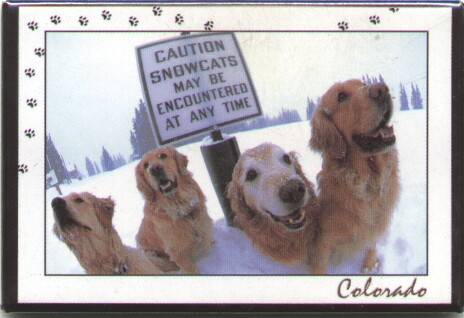
  • Nieces who go to Colorado and bring me back entertaining magnets like this one!  (Thanks, Elizabeth and Katie.)
  • Agility friends who are stealth blog readers who have bought a new camera so we have arranged for me to get her barely used Canon 40D! Tomorrow! Yay! (Thanks, Cheryl.)
  • Pet Club store near me, which doesn't take credit cards, but when I am horrified that they charge $33 a bag for my dogfood, I just have to walk into PetSmart and see the same bag for $54 to be grateful for the discount.
  • Fanatical agility friends who have brought Sylvia Trkman to Silicon Valley in December so we can do her seminars! (Thanks, Ashley.)
  • Disneyland-o-phile sisters who arrange trips to Disneyland so I can just go along for the ride! Yay! Just a month away! (Hence the push now to get the camera--) (Thanks, Linda.)
  • Dogs who let me sleep in in the morning! Even to 9:00! What good girls! (Thanks, Tika and Boost.)
  • Mild California autumn days,  not too hot, not too cold, everything still in bloom, grass growing-- (Thanks --uh-- whoever's responsible.)
  • Expert Apple friends who not only arrange for me to borrow a cable that Apple didn't think to send with their new equipment, but also drive out of their way to deliver it! (Thanks, Steph.)

Friday, June 12, 2009

All the News That's Fit To Blog--Plus Clothing

SUMMARY: Boost jumps and dogwalk and weaves, Tika jumps, flying your dogs, Disneyland, Sylvia Trkman, facebook, insurance--whew! Anything else? Oh, yeah, it's all about the clothing!

  • In class last night, Boost hit bars like a new 21-year-old on amphetamines. Argh. I was jumping her at 24", not the 22" that we usually do in class (although often use 24 or 26 at home). Will be doing a private with our instructor this weekend to work on bars.
  • Also: Contacts! Last week in class Boost left her dogwalk contact early once and I punished her severely ("Oh! My! What happened!" (lean over and grab her as if to pick her up, and in a low voice:) "You have to stick those contacts! Don't be leaving early!") and all of a sudden she wouldn't blast to the end into 2on/2off but instead stopped halfway into the yellow. I immediately put her back on 2 or 3 times until she got the 2o/2o and rewarded lavishly. This week, first dogwalk, stopped halfway into the yellow. OMG have I broken her perfect dogwalk at age 4 and a half?! Dang sensitive dogs! We repeated the down-ramp part 2 or 3 times until she got it, then rewarded lavishly.
  • On the other hand, Boost's weaves were perfect all evening! Even the hard ones!
  • Jumped Tika at 24". Have been jumping her at 22" lately, too. She knocked several bars. I have to remember before a USDAA trial where she'll be jumping 26" in a couple of runs to get her back up to 26" probably at least a couple of weeks before the trial with plenty of bar-knocking drills at that height. It's always something!
  • Southwest airlines is now accepting small pets in the cabin on a trial basis.
  • I'm going to Disneyland! Nov 7-8. Staying with my sister & husby at their favorite place, the Candy Cane Inn, which has a convenient shuttle that I almost never use. Which means I won't be doing my club's (Bay Team's) November CPE. Instead I'll do either the Turlock USDAA right before it or the Turlock CPE a couple of weeks later. Nice to have choices! Disneyland, yayyyyy!
  • Sylvia Trkman is coming to the Bay Area to do 4 days of seminars! I can't afford all of them, but signed up for a one-day Masters Handling with Boost and two evenings of tricks as an auditor.
  • I'm going to try to get onto the FaceBook brand-new choose-your-username-URL land grab at 9:01 this evening to get my choice! I think I'll go for Ellen.Finch if I can get it; if not, maybe TajMuttHall. What do you think? (You have until 8:30 PDT today to tell me what you think. ;-)) The thing is, I'm mostly taking as friends only people that I really already know in one way or another--e.g., local agility folks, relatives, people I've communicated with in blogland--not the world at large. So my own name might be more appropriate. We'll see...
  • Still waiting for the final insurance paperwork to arrive for me to sign and send back to finish the settlement on my auto break-in. They said it went into the mail "late last week or early this week." I haven't gotten it yet. Hm. Starting to look into what camera & lens I can really afford on that settlement. And haven't even started looking for a replacement for my Perfect-For-Everything Coat.

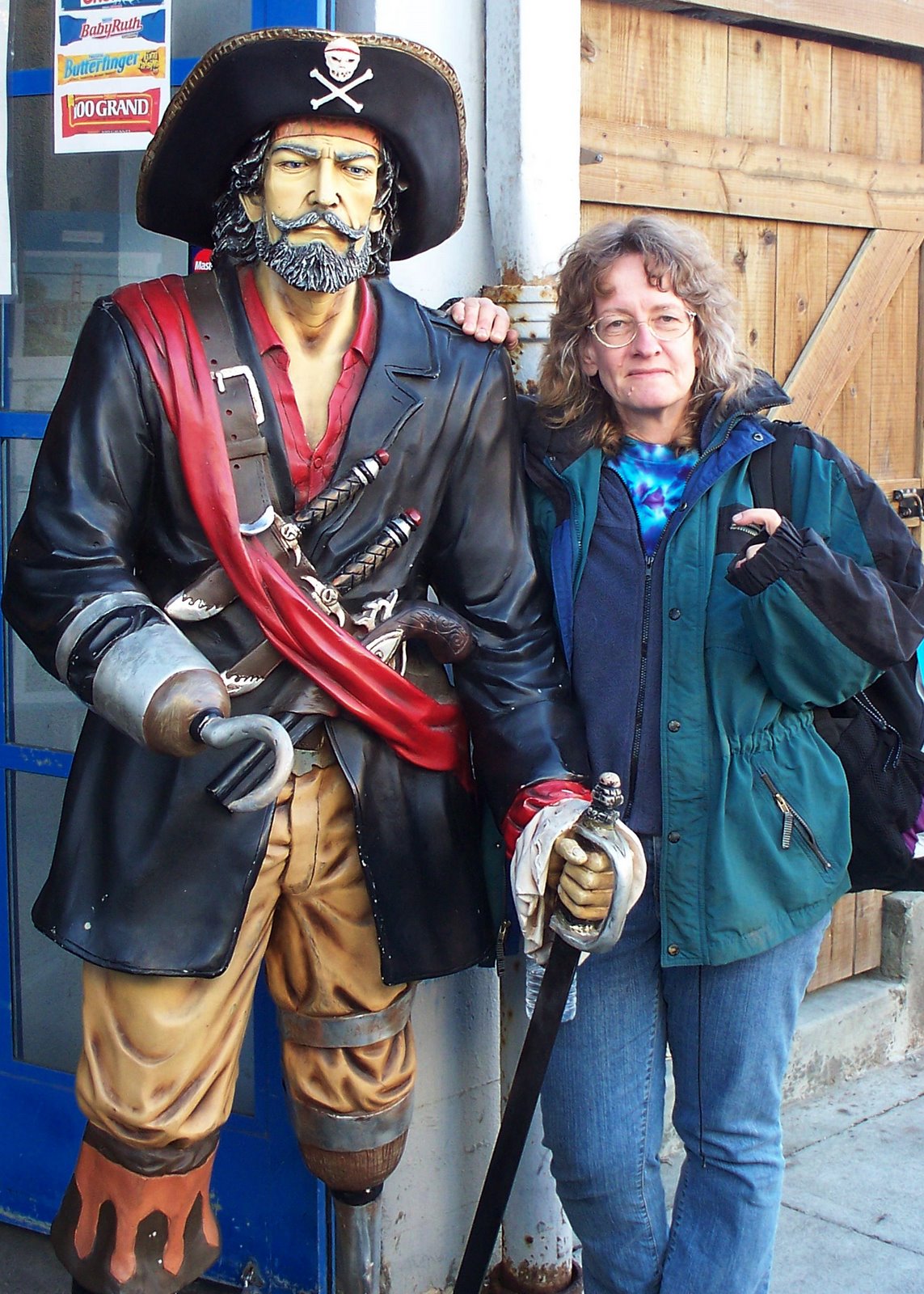
A Few Adventures of The Perfect-For-Everything-Coat


Finding the right replacement coat is crucial because--after all--agility [and everything else] is all about the clothing!

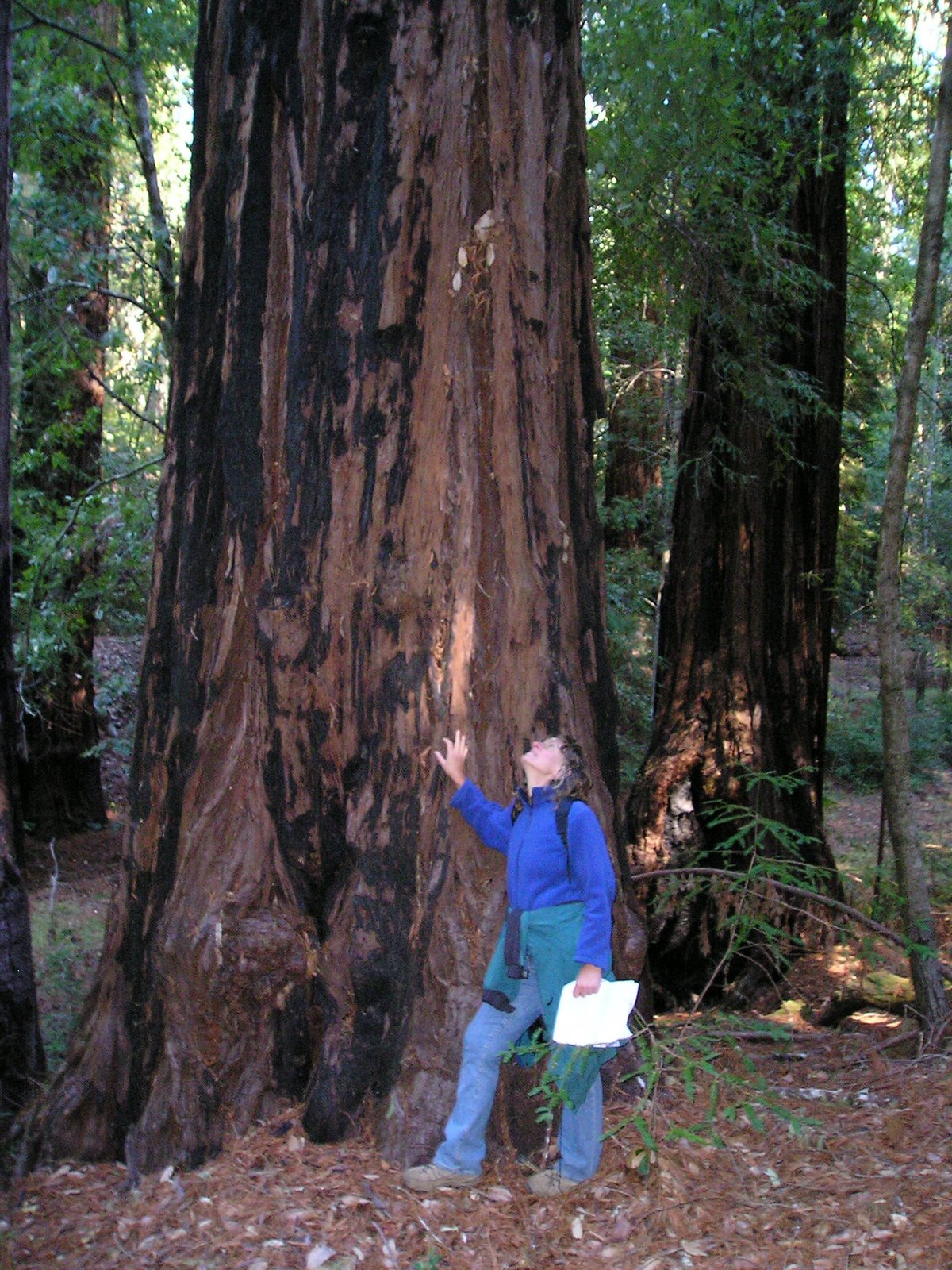
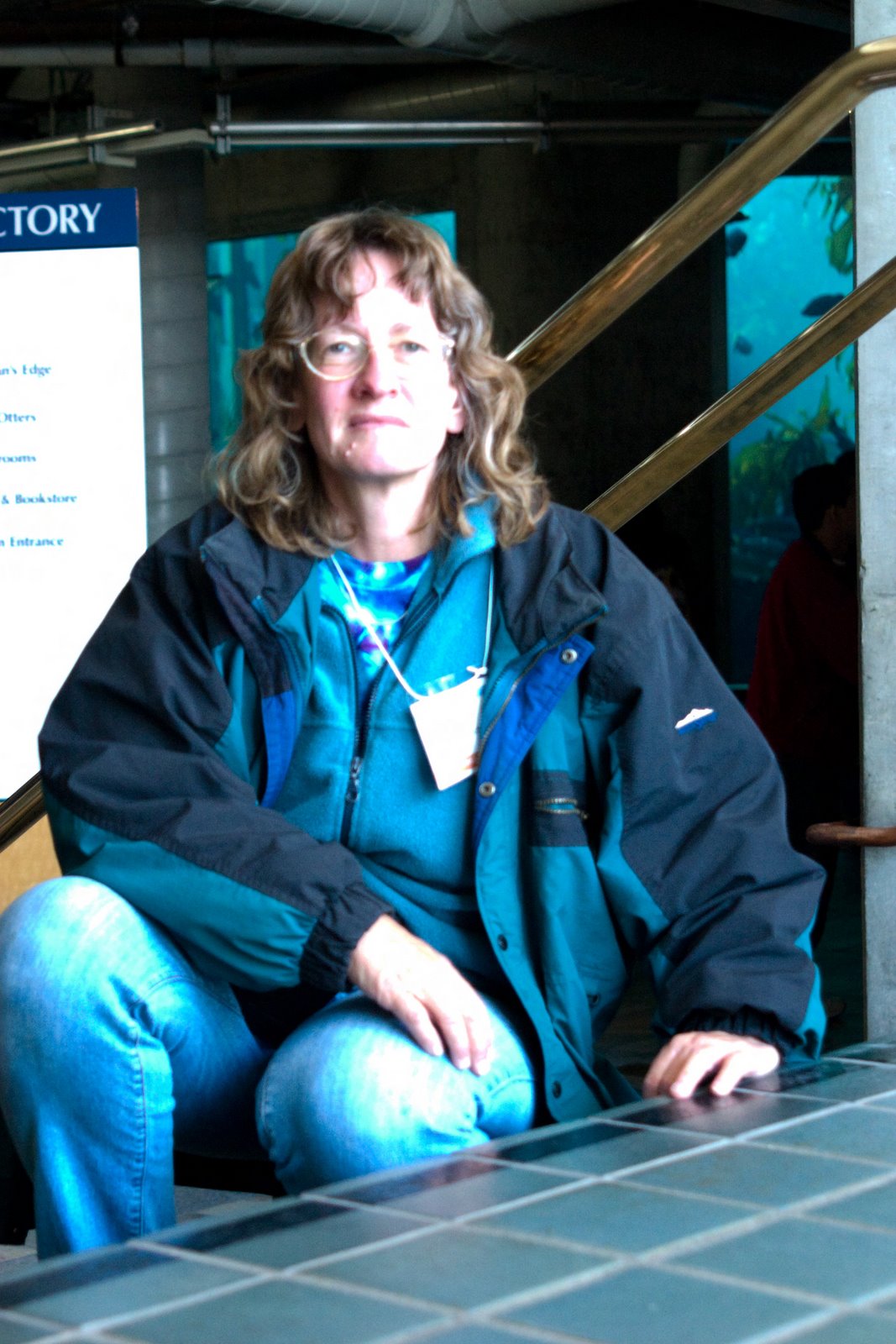
Photo junket at Almaden Quicksilver Park Winter 2009Touristing at Cannery Row Dec 2008Hiking at Big Basin Redwoods Park summer 2008Beterphoto.com seminar at Monterey Bay Aquarium Oct 2008
Flying home from Montreal Sept 2008 (reflected in seat-back TV)

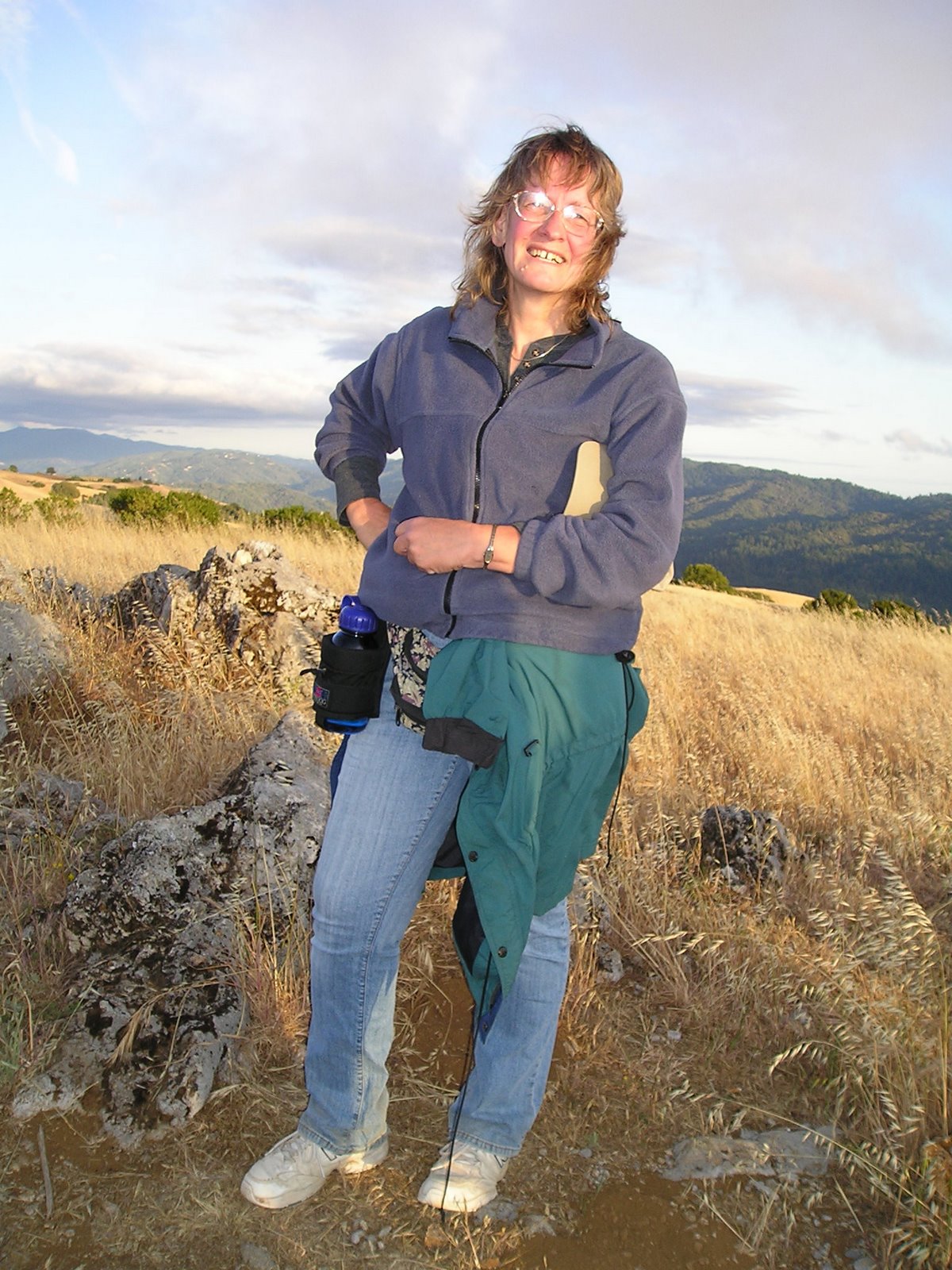
Hiked up Black Mountain Spring 2008
Hunkering down at Grand Canyon May 2008

With Tika, hiking at Truckee March 2008
With Boost at Power Paws Camp 2007 (on back of chair)
With Jake and Top Turkey Team, Nov 2005
Tika's C-ATCH Nov 2005

Wednesday, February 27, 2008

Rachel's Running A-Frame Part 2

SUMMARY: Sorry it took so long--a little busy.
Part 1
Brief note on up contacts

Advance note: This was supposed to be the same seminar delivered once in the morning for 3 hours and once in the afternoon for 3 hours. However, by the time I had to leave, about 4 hours into the day, it looked like it was going to be a sort of 7-hour seminar with some repeat of what was covered earlier. In other words, I didn't really see the dénouement, which would be how to fade the PVC frame (except for removing the little feet from the bottom as a first step).

Adding the A-frame


OK, you've worked the simulated A-frame on the ground and the dog can do it reliably (all 4 feet in the box every time, with you ahead, behind, left, right, moving, standing). And you've videotaped consistently enough to know that she really is getting all 4 feet in every time.

Now you can move to the Aframe. Notes:
  • Start at 4'6".
  • Only 2-3 times a week, half a dozen at a time. Don't want to fatigue the dog.
  • Don't add other obstacles in sequence after A-frame until they're pretty solid.
  • She won't work dog on running Aframe until over a year old because of muscle & power development.


Step 1 positioning
 
Step 3 positioning
 
Breaking 2on/2off part 1
 

Breaking 2on/2off optional part 3
 
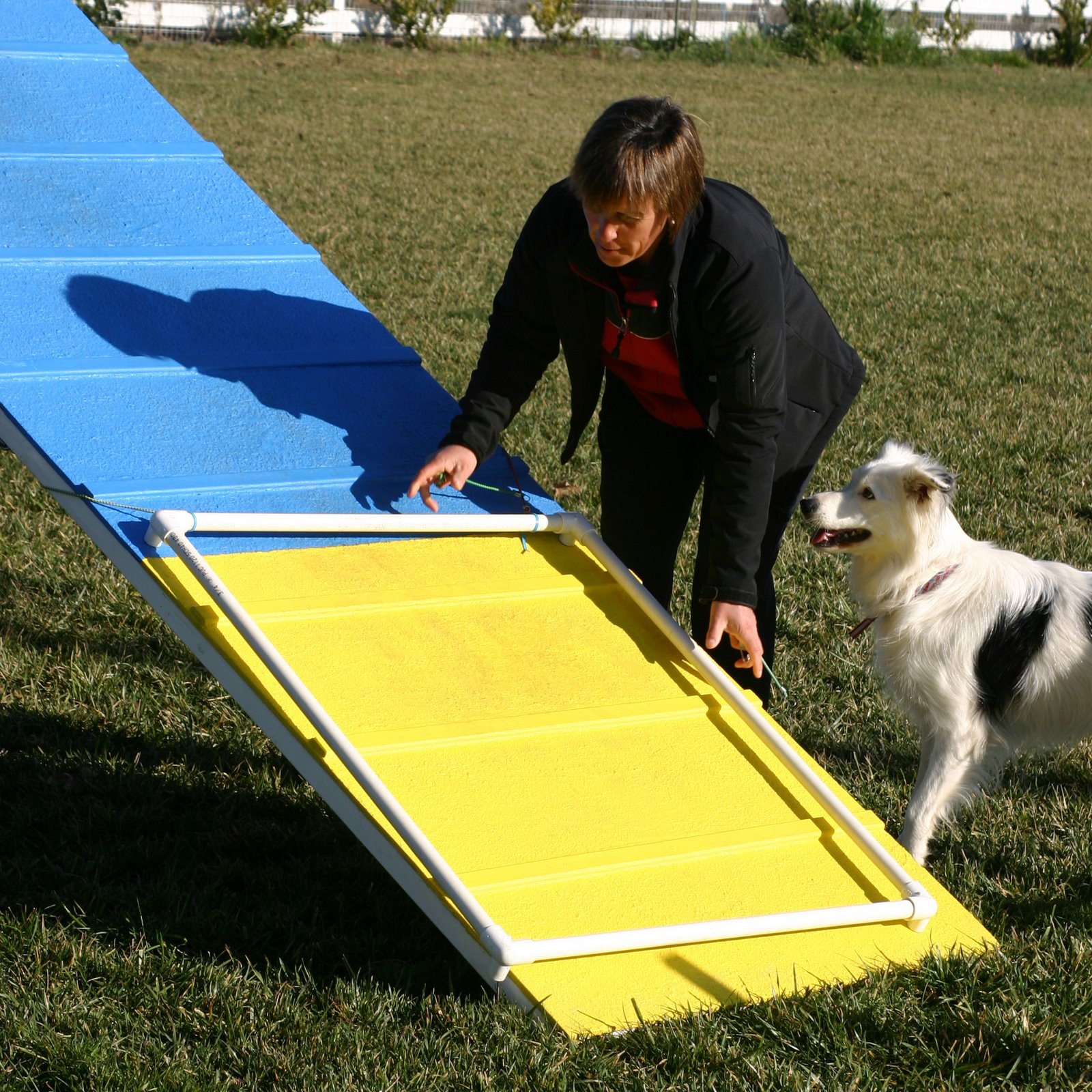
Set up the box on the A-frame (see Part 1). Back chain the dog by placing the dog on the A-frame above the 2nd slat above the contact zone. Then you get into whatever position you're going to start from (remember to vary) and give the command (oh, yeah, did I mention adding a command way back when they've learned how to run into and out of the box?).

Second step is with the dog starting just beyond the apex (on the down side).

Third step is to get the dog to run the whole thing with a good running start.

Breaking the 2-On/2-Off

For dogs who've already been trained to the 2-on/2-off method of stopping at the bottom, you need to break that behavior. They might just avoid it naturally when you set them up as discussed above, but if they don't, you need 2 or 3 extra steps.

Important: DO NOT EVER give the 2o/2o command on the Aframe again. (If you keep the 2o/2o dogwalk, you'll want to intermingle some DWs and AFs to be sure dog understands the difference.)

First, put the box on the ground slightly in front of the Aframe and set the dog up in the 2o/2o position; you'll have to do this manually somehow because you DO NOT EVER give the 2o/2o command again. Move to your position, then give the "hit it" command. Dog should do it just like he's been doing it on the ground all along.

Second, set the dog on the Aframe in the contact zone so all 4 feet are there (since that's where he's going to be hitting, in theory). Move to your position and give the "hit it" command.

You shouldn't have to do these steps more than once or twice, I think she said. If the dog still wants to stop when you go back to the Aframe steps 1/2/3, you can just make it harder for the dog to stop by angling the box so it's partway off the Aframe a couple of times.

That's it! Now you have running A-frames!

Monday, January 21, 2008

Rachel's Up Contacts

SUMMARY: summarytext

I asked Rachel about using this method for up contacts, because I know that she's done it and because that's (currently) my main interest with Tika. This seminar didn't cover it, but Rachel said that the criteria and the training are different--for example, the criteria is one foot in--and she has worked with multiple dogs on this, too.

I'm convinced enough that she's come far enough with this that I'm going to schedule a time to go down to Atascadero some day soon (I hope) to work with her.

She did say, though, that she's not sure that one could use this method to teach BOTH a solid up contact AND a running down contact, because the criteria are different for a similar set-up. I said I'd be interested in doing that, though. She wasn't encouraging.

For Tika, if that's the case, I'll have to decide whether the missed Qs from the up contact are more relevant than the missed Qs from time--but here I'm talking about Steeplechases and Grand Prixs. Sure, we've missed some Standard Qs from up contacts, but in fact she has more Standard Qs (16) than any regular class except Snooker (22), so that's not a major concern at the moment. BUT the number of times that we've missed a Steeplechase Q by less than a second or two when we've dropped a bar, or the number of times we've missed getting into Round 2 of the Grand Prix by a second or two when we've had some fault, says that if I increased the reliable speed of her Aframe, maybe I'd get more Qs in St and more 2nd rounds in GP even WITH the fault.

On the other hand, it's also true that, when I really push her, she pops off the Aframe anyway so isn't wasting a lot of time there--although it might still waste a little time because I'm taken by surprise and because she knows she's likely to get called on it so might hesitate.

So, anyway, I have to decide, but I think a couple of hours with Rachel will help me with that.

Sunday, January 20, 2008

Rachel's Running A-Frame

SUMMARY: Attended a half-day seminar with Rachel Sanders on running A-frames.

Disclaimer: This is a summary of what I heard. It is also my interpretation of what I thought was meant. Any errors are mine, not Rachel's. This is my first real exposure to this method. (Figured I had to say this before people start pointing out my mistakes!)
Jan 23: I've cut out a bunch from my original post, as it was too detailed to be fair to Rachel.

Goals

To get the dog to do the down ramp in two strides, hitting all four feet in the contact zone, and leave the A-frame without stopping. For dogs of any breed, any size.

Why? Rachel isn't doing this primarily for speed on the course; she's doing it because she believes that running contacts are much easier on the dogs physically than 2 on/2 off ("2o2o"). And she believes that this method will prove to be more reliable than several other methods of teaching running contacts, which she discussed. (She also discussed several of what she calls myths about running contacts, like dogs of only certain builds can do it, or dogs can learn to do it on only one height of A-frame, etc.)

She has now worked with more than 60 dogs with this method, quite a few of whom are competing. She's still refining it as she encounters more dogs with different responses to the method--which is, of course, completely typical for working out a new method.

After a 3-hour seminar, jam-packed with info, I am jazzed about the possibilities and realized very quickly that even the 3 hours could provide enough to get me started but not necessarily all trouble-shooting issues and a detailed training plan. I'm hoping to get some more work with Rachel in March.

Equipment


The box will be centered over the contact zone.
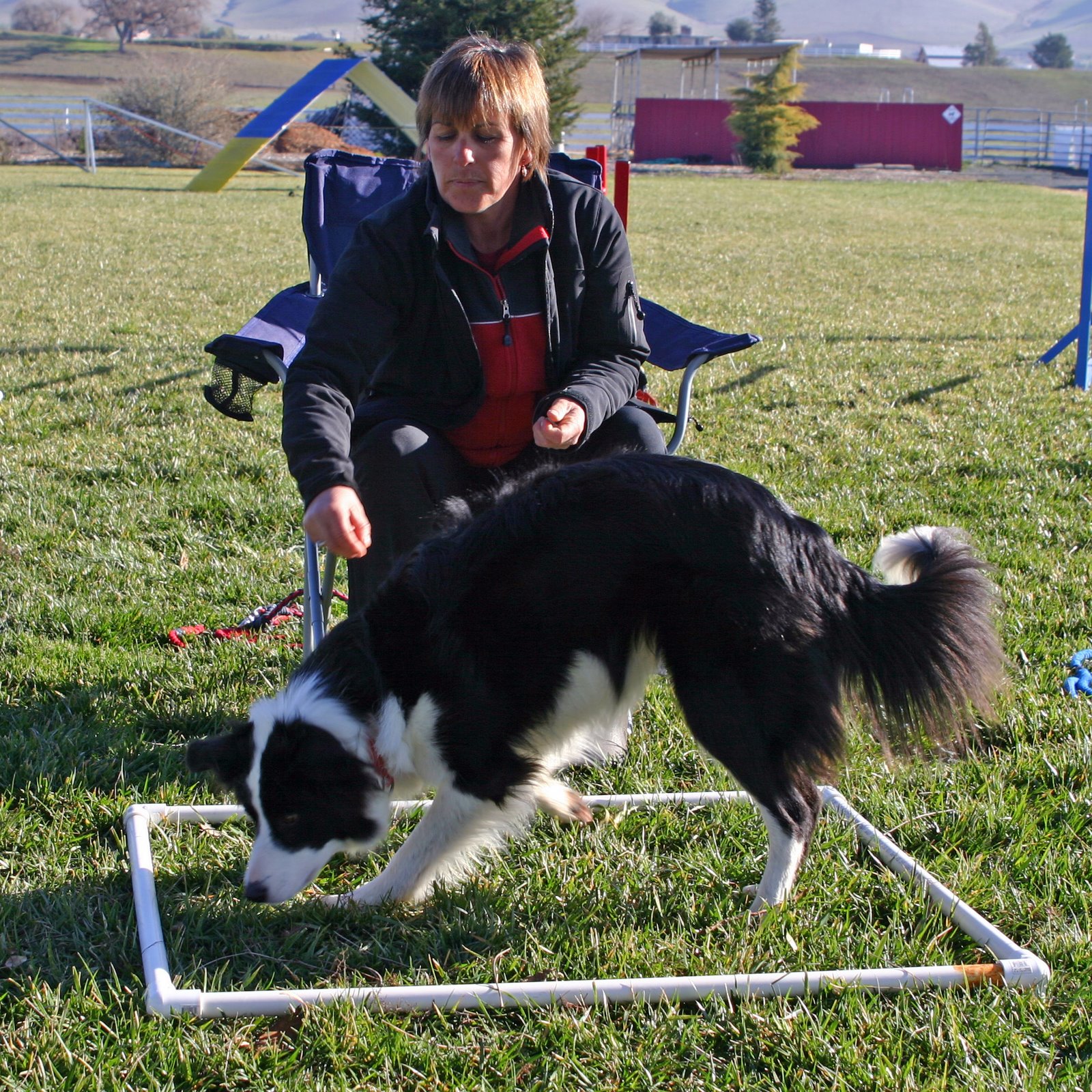
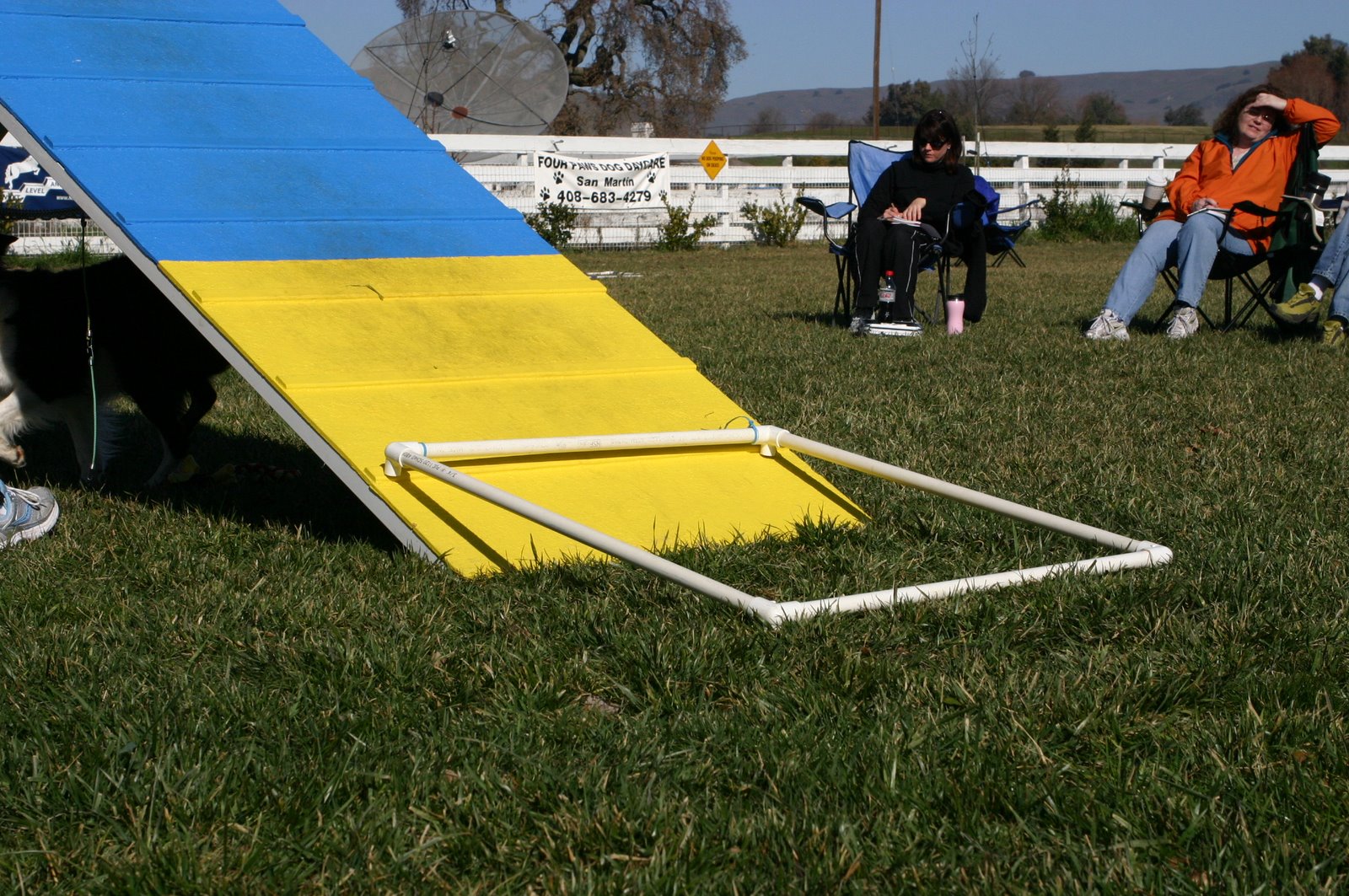
A "box" made out of PVC.

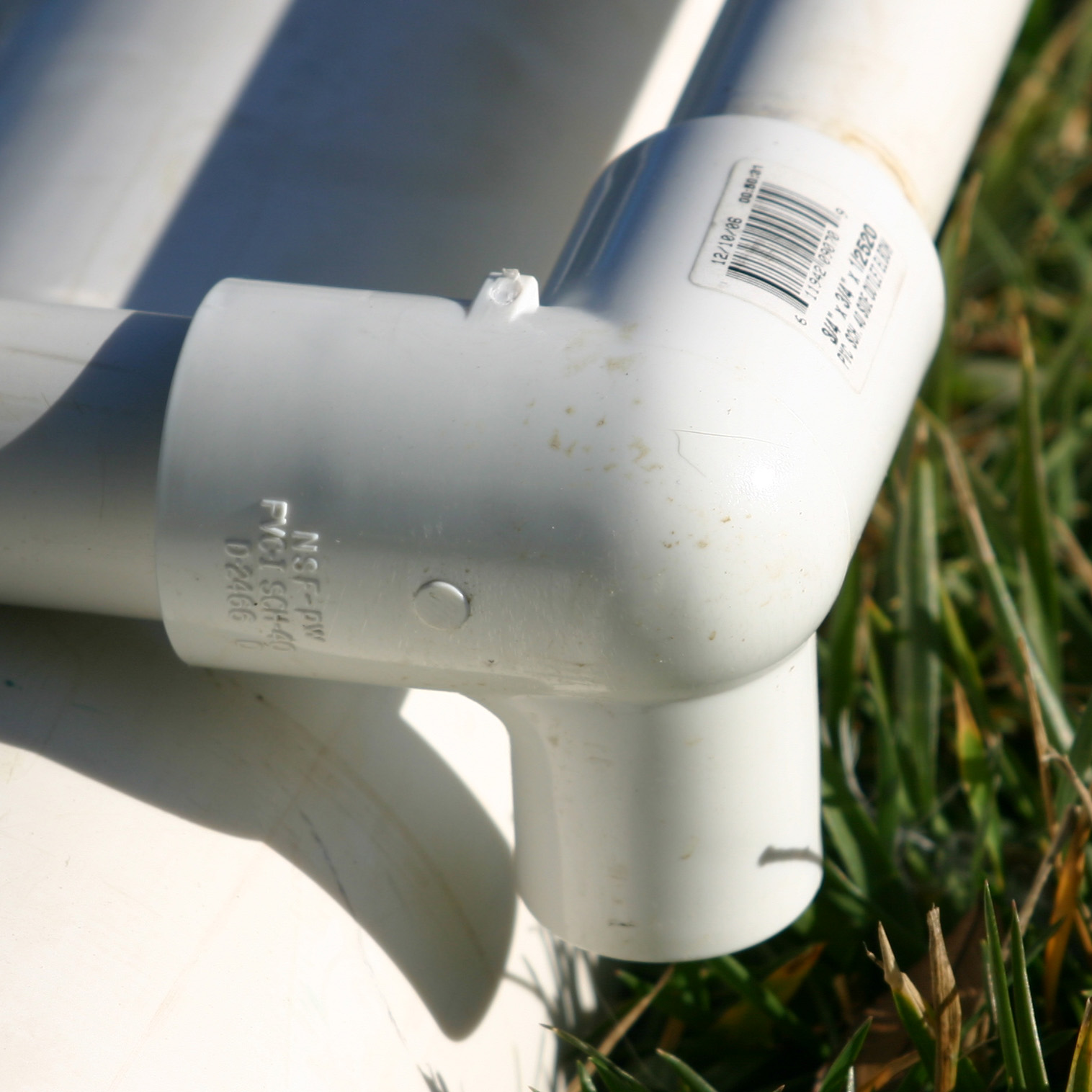
The corners are just standard PVC ells with a third "leg" where a riser would screw in.

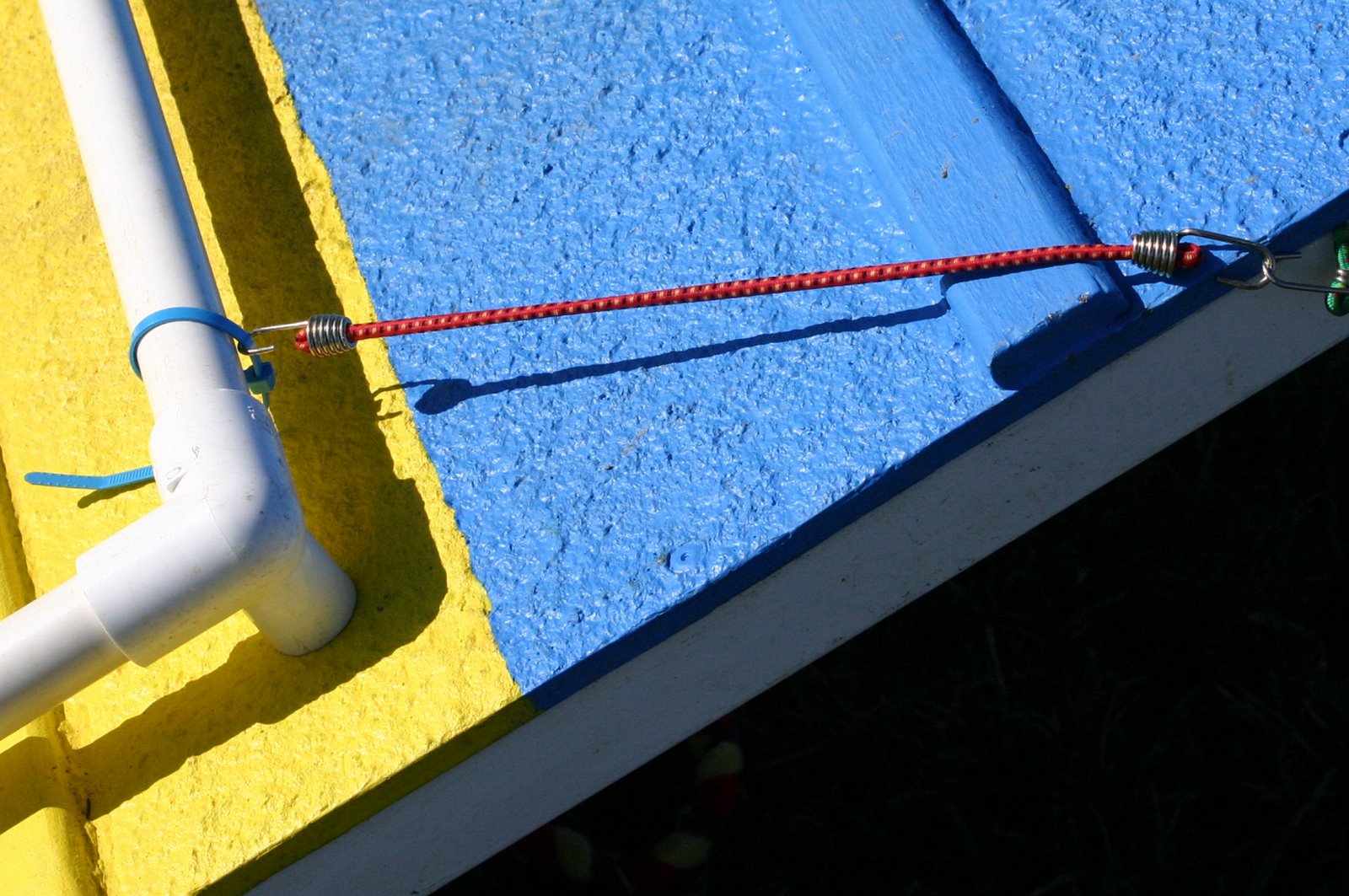
Corner detailHold in place with plastic tie and bungie to chain underneath Aframe.


Training the box

Click to mark all four feet in the box by tossing the reward away from you.


Before you get to the A-frame, you work with the box on the ground, first teaching the dog to go into it with all four feet. First, when the dog shows any interest in the box, click and reward inside the box, away from you. Then reward for all four feet in the box.

Continuing box training


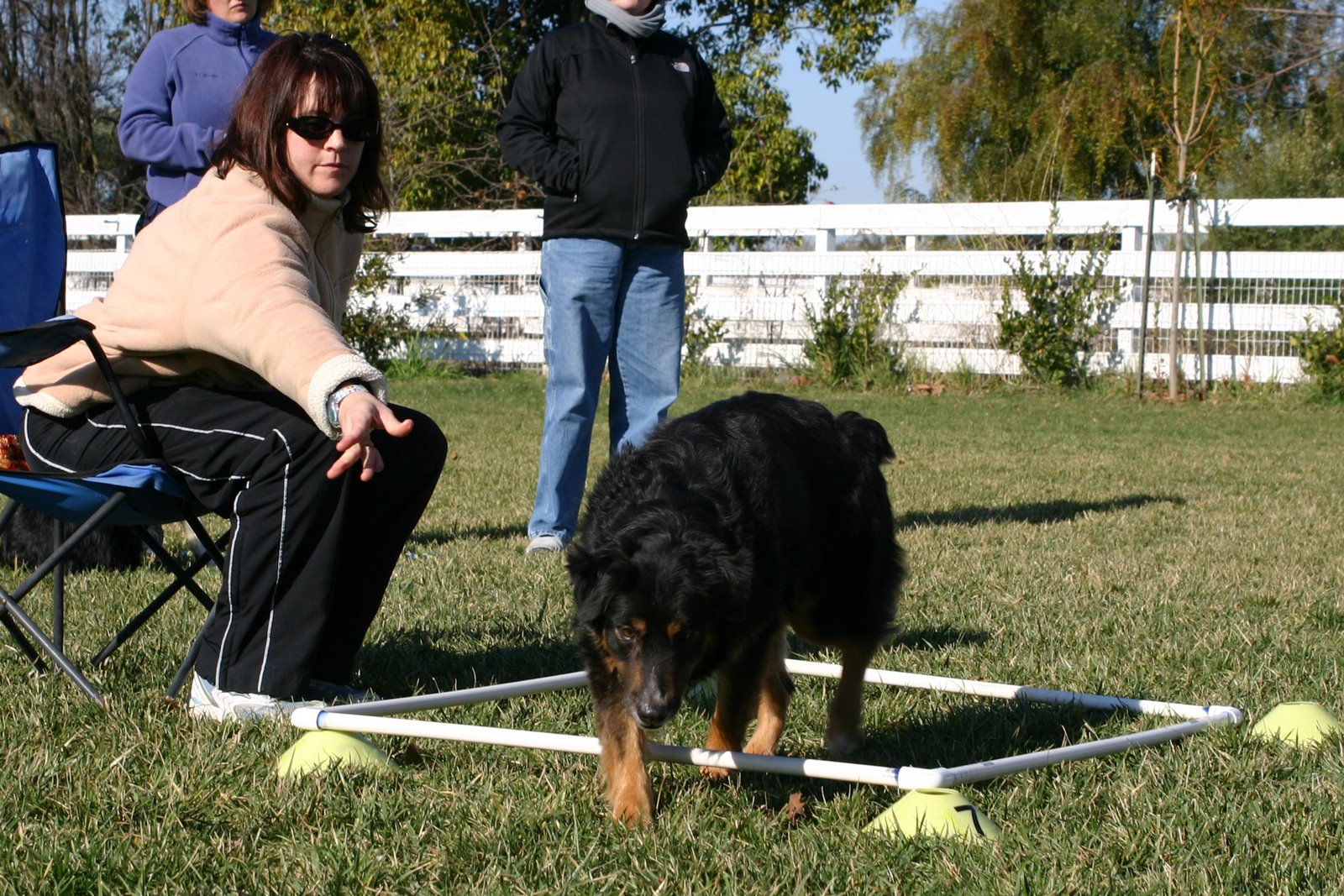
To get the dog moving out of the box, reward by tossing treat outside the box. (This box is slightly raised to make it easier for this dog.)

Eventually, reward motion that carries the dog out of the box opposite the side on which he entered. Toss the treat away from you across the dog's path so the dog doesn't look at you for the reward. Replace the treat with a toy as soon as possible.
By now you should lose the chair, but try to find a way to stand where you're not tempted to move, lean, etc.

Gradually you work further away from the box, always rewarding only if all four feet land inside the box. (Rachel emphasizes that the only way that you can train your eye to recognize it is by videotaping and watching your actions.) Then you'd gradually add motion. Same sort of thing as teaching any other obstacle.

Flat A-frame


Flat representation of an A-frame.

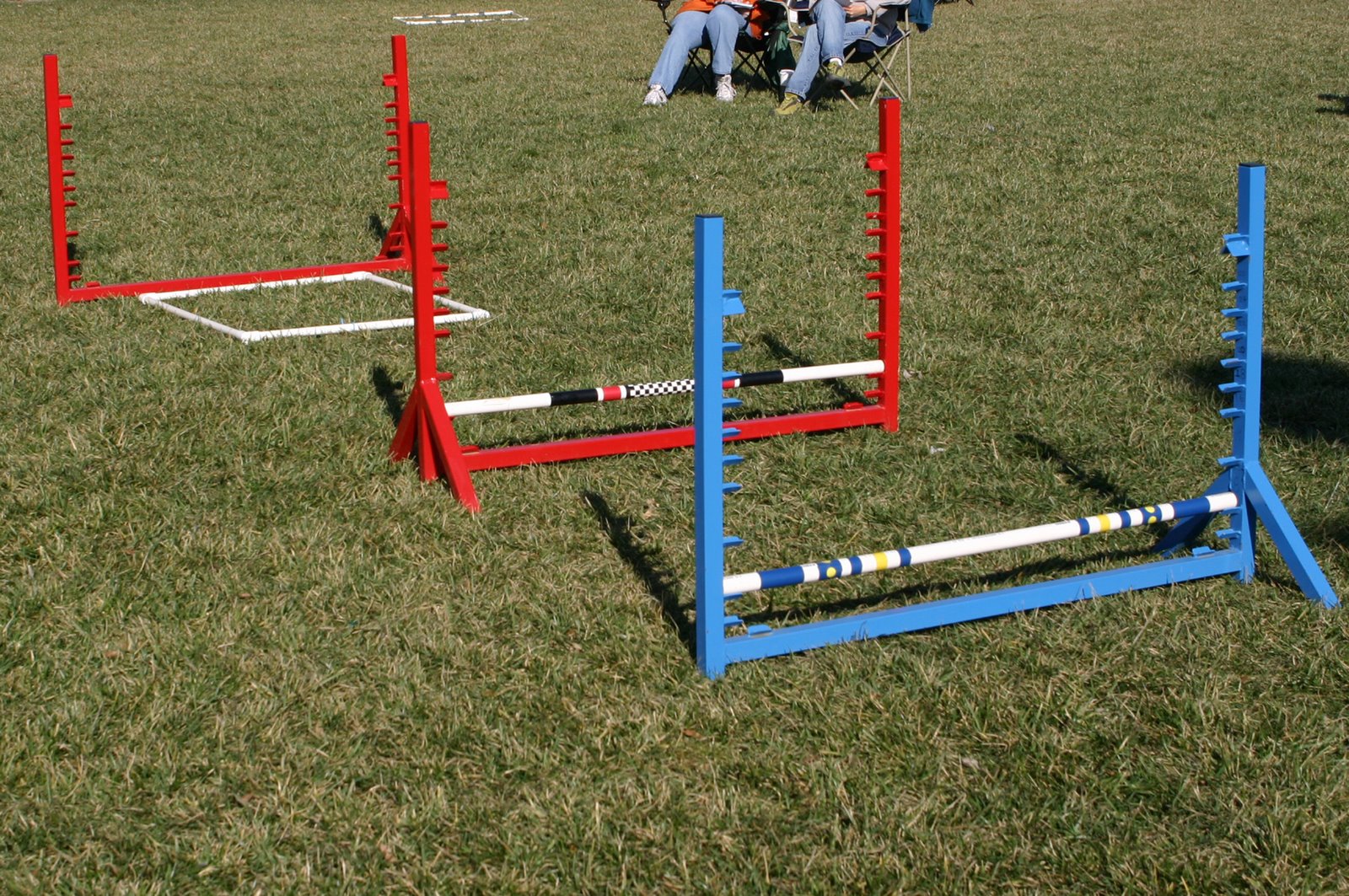
Rachel also discusses how to practice doing the A-frame without actually having one, using jumps to emulate the layout of an A-frame as shown in the photo. The middle jump represents the apex of the A-frame. The PVC box goes right where it would go on the Aframe.

Then work with the dog in the same way you did with just the box--first standing still at different positions, then adding motion from different positions. Goal is always all four feet in the box.

(I'll have to post more tomorrow--on working the A-frame itself and on breaking a 2o2o contact to move to a running contact.)

Update: Feb 27 2008
"Tomorrow" eventually came: Part 2

Friday, June 15, 2007

Manchester-Derrett Seminar

SUMMARY: Boost and Ellen learn some things in the oppressive heat.

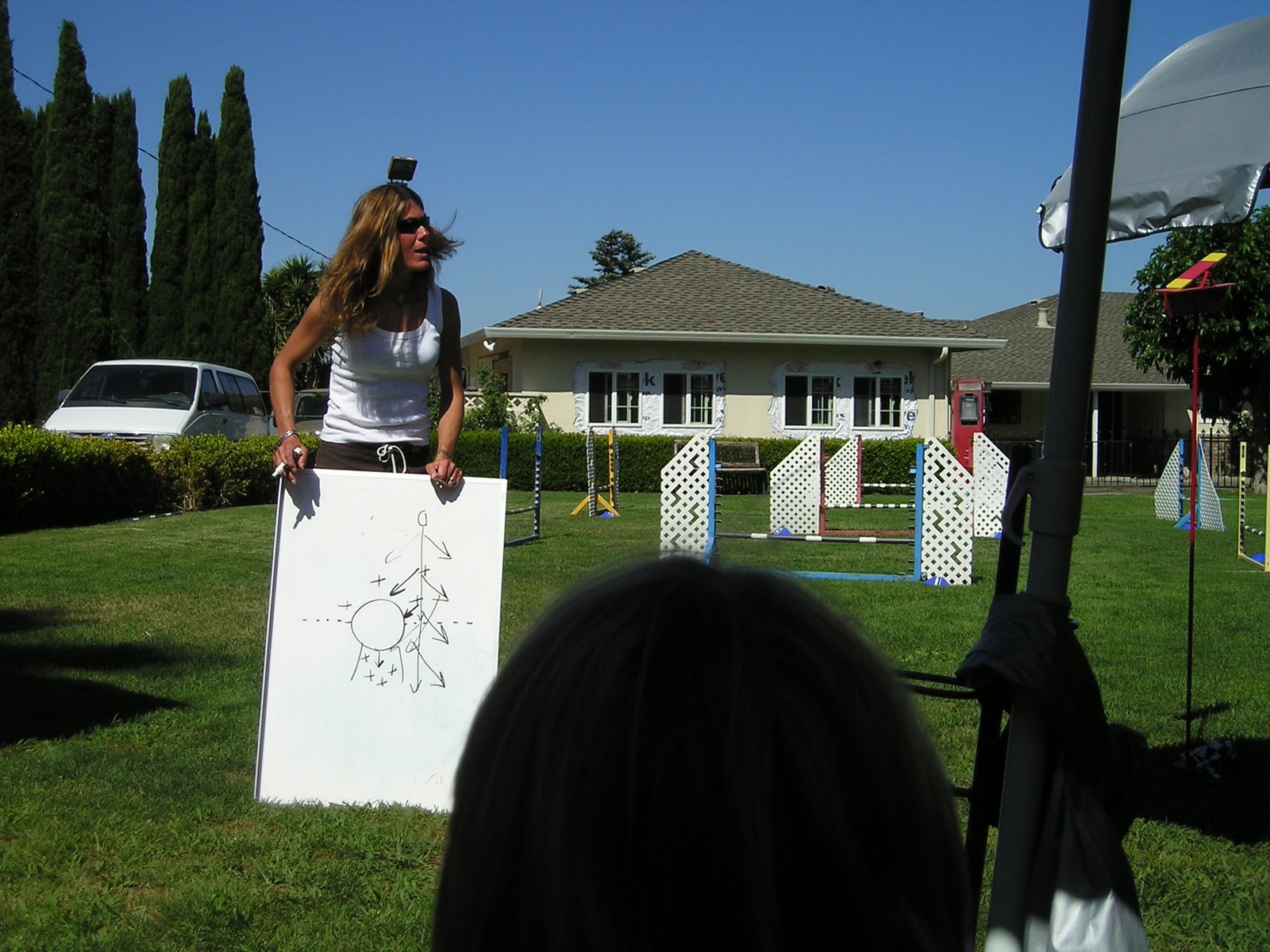
Laura Manchester-Derrett discussing the no-go zone.

Greg Derrett has been coming out from England to teach seminars at Power Paws Agility for several years. I've taken his seminar(s) with a couple of my dogs, plus I've been in his sessions at Power Paws Camp in years past, PLUS Power Paws incorporates his ideas into their training. Not to mention that a lot of what they teach is also taught by others to whom I'm been exposed, and I'm not even sure where all of the ideas come from originally. So I'm reasonably familiar with their material.

basic no-go zoneI basically understand the "no-go-zone" or the "blind cross zone" or various other names for it--essentially, if you draw a line extending out through your shoulders to either side of you, the dog should never go into the zone behind that; they should be driving at all times to get into the zone directly in front of you, loosely defined by the same line but more specifically directly in front of you in the direction you're going.

This is illustrated with a simple situation: Set the dog in front of three jumps in a row. Walk out and stand just beyond jump 2 but about 10 feet to the right, facing he same direction the dog is facing. Release the dog but don't otherwise move. (That's a lateral leadout.) The dog should drive forward over the two jumps and then curve in and stop in front of you.

basic front crossIn theory, this is why front crosses work--you direct your body forward until the dog is committed to the obstacle ("committed" meaning there is nothing you can do to pull them off that obstacle), then turn your body, so dog wants to drive out of no-go zone and drive to get in front of you again.

teaching dog to drive into no-go zone
That also shows what happens when you turn too early--before the dog is committed: The dog ceases her forward motion and strives to get out of the no-go zone and back in front of you. I had been basically aware of this concept relating to why Boost has so many refusals on course. (Keep in mind that you don't really teach the dog not to go into the no-go zone--you reward them for driving in to your side and for driving in front of you; the lines and the zones just make it easier to understand why some things are happening.)


However, I hadn't managed to make the connection, until Laura pointed it out in yesterday's seminar, why Boost has started making the occasional blind cross--which I've *never* taught and done everything to avoid--at the same time that she's getting fewer refusals. Which is that, in my rush to not be too late on my turns, which is a perennial problem for me with both dogs, and to "turn and get the heck out of there," which is also a perennial problem for me to do, I have started turning TOO EARLY (before the dog is committed to the jump, and yet still trying to insist that she still go over the jump (because I said "hup!") rather than responding to my body position. teaching your dog a blind cross

So, basically, if you HAVE to make a mistake, it's better to cross late (which could give a wide turn or, ok, possibly an off-course if you can't correct for it) than to cross early (which teaches a handling pattern that can affect you for a long time to come).

There was, of course, a lot more in this seminar, but for me, this was the most revealing insight.
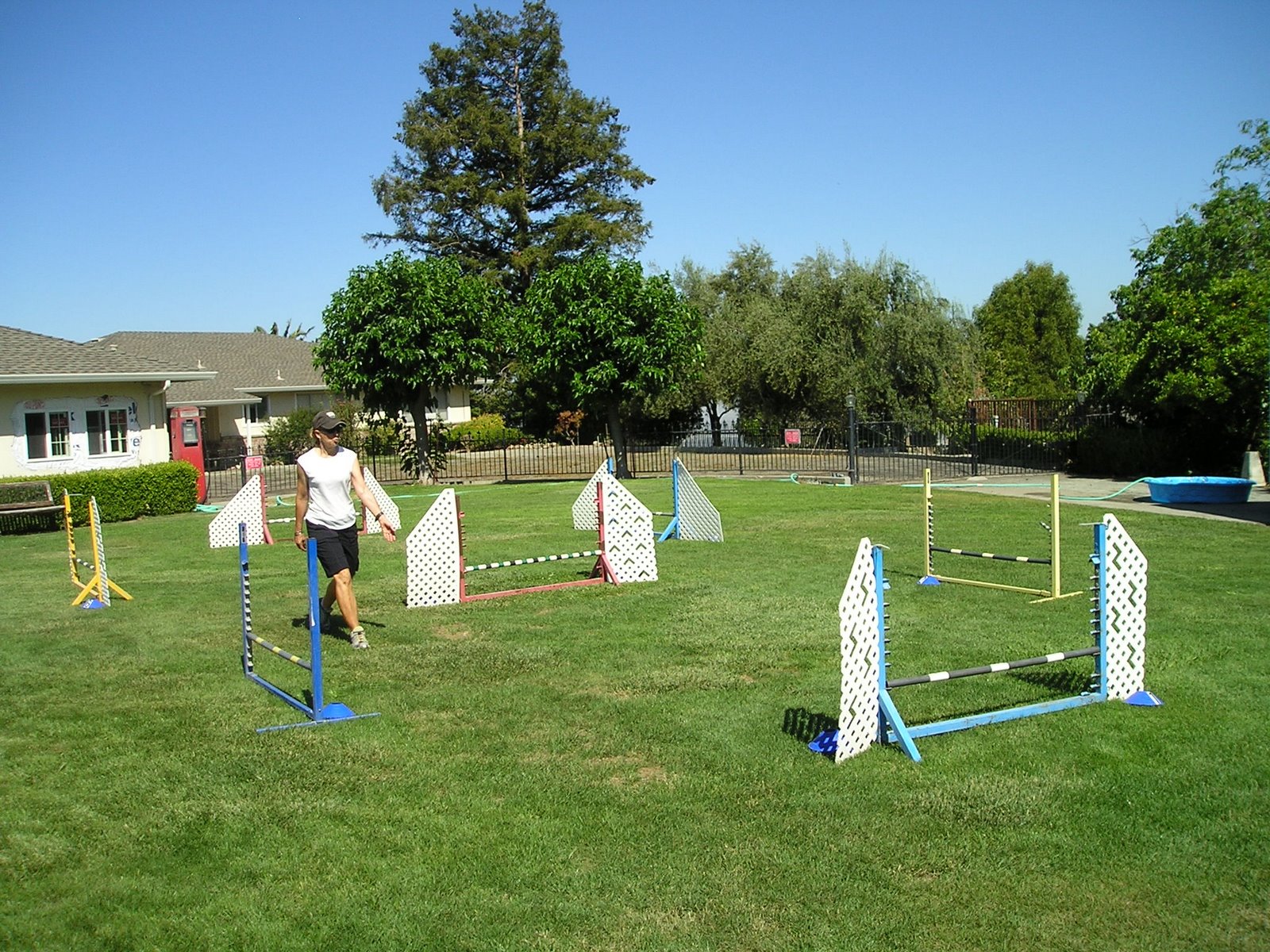
Walking a double-box course on Power Paws' small lawn.